




Volvo Thinks the Fuel of the Future is DME – and It’s Almost Here
Think “alternative fuel” and what comes to mind – natural gas, or maybe propane? Volvo Trucks North America believes it has one better: dimethyl ether, or DME, which it thinks is the real fuel of the future. Volvo, with the help of a small chemical company, financial investors and officials in the state of California, intends to get it to market as a motor fuel by 2015.

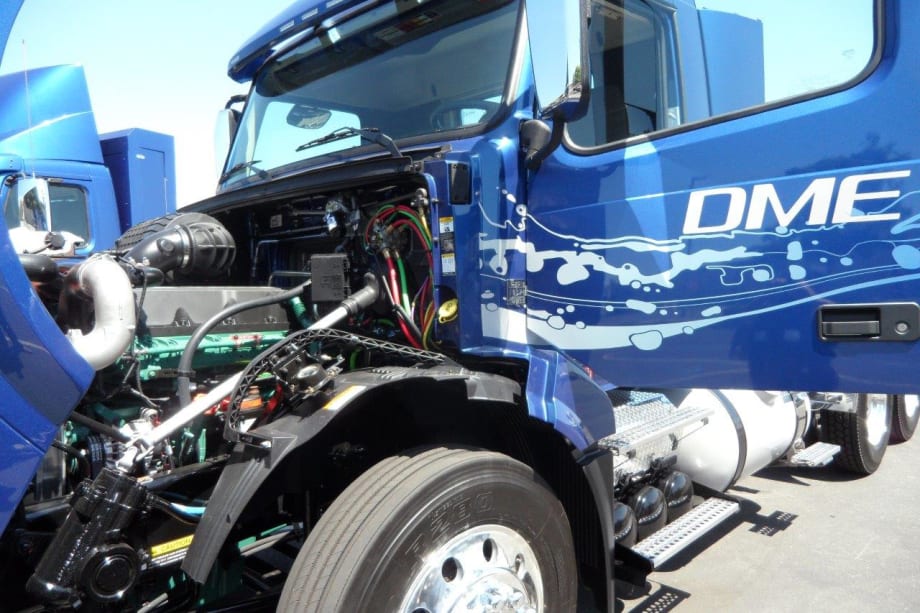
DME engine is based on Volvo D13 diesel. This prototype has common-rail fuel injection, which production engine might or might not use. In the background you can see the back of a cab set up for CNG, with the cabinet behind the cab housing four high-pressure tanks. Volvo remains committed to natural gas for customers who want to use it. (Photos by Tom Berg)
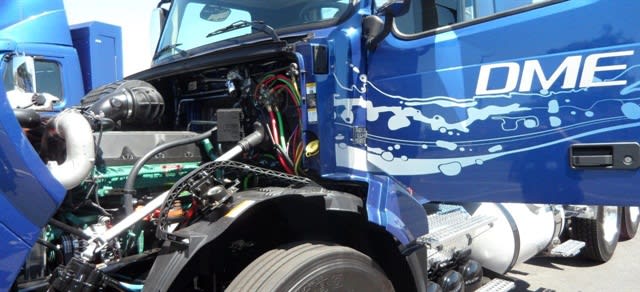
DME engine is based on Volvo D13 diesel. This prototype has common-rail fuel injection, which production engine might or might not use. In the background you can see the back of a cab set up for CNG, with the cabinet behind the cab housing four high-pressure tanks. Volvo remains committed to natural gas for customers who want to use it. (Photos by Tom Berg)
Think “alternative fuel” and what comes to mind – natural gas, or maybe propane? Volvo Trucks North America believes it has one better: dimethyl ether, or DME, which it thinks is the real fuel of the future. Volvo, with the help of a small chemical company, financial investors and officials in the state of California, intends to get it to market as a motor fuel by 2015.
The arguments for DME are numerous, said executives of the truck builder and the company that has devised a way to efficiently produce it in small quantities. That way markets can be developed locally and regionally, thus sidestepping the country-wide infrastructure question.
The execs unveiled their plans Thursday at an event in Sacramento, the capital of California, a state whose officials have long been dedicated to cleaning up fouled air and enamored with the idea of renewable energy. State grants and tax waivers for now are allowing the plan to be financially feasible.
But Rebecca Boudreaux, president of Oberon Fuels, said she and her colleagues have established a good business case for DME without government incentives. Oberon will begin producing DME late this month at a new plant at Brawley, in California’s Imperial County near Mexico.
What is DME?
DME is used overseas as a cooking fuel and other things, but not motor fuels, she said. One exception, noted Volvo people, are 10 trucks in Sweden that are running on it. Most Americans have never heard of it, even if they use it every day. DME is a common propellant in aerosol sprays that dispense many consumer products, such as hair spray, deodorant and lube oil. It is non-toxic, so there is no threat to people or the environment.
DME burns so cleanly that it leaves no soot and emits just a fraction of other pollutants, Boudreaux said. For example, carbon dioxide emissions are 95% less than with diesel. DME can be made from methane that occurs in many forms, from decomposing cow and chicken manure to rotting grass clippings and landfill gas, and natural gas now being produced in great quantities here in the U.S.
Diesel engines take well to DME, and need only a special injection system and different cylinder heads to handle high fuel flow, and simple steel fuel tanks to store it aboard a truck, said Ed Saxman, Volvo’s marketing product manager for alternative fuels. Those tanks are the same as used for propane, so are far cheaper than the vessels required for compressed and liquefied natural gas now appearing on commercial trucks. DME stores at about 75 pounds per square inch and at ambient temperature, versus 3,600 psi for CNG and minus 260 degrees for LNG.
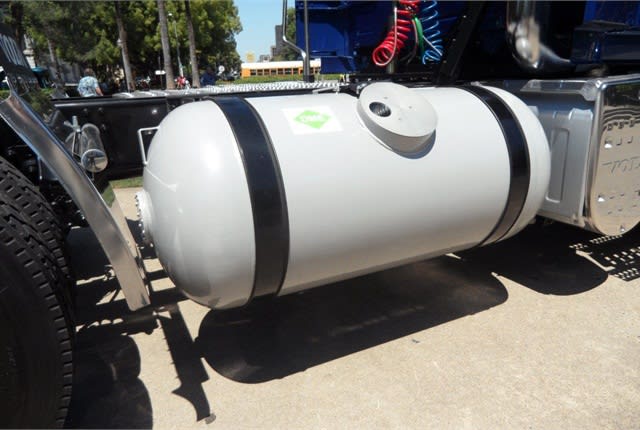
Steel DME fuel tank is the same as for propane. Modest storage pressure of 75 psi makes the tank, built for propane’s 125 psi, overbuilt.
DME storage is simple and relatively inexpensive, with a fueling station costing in “the tens of thousands of dollars instead of in the hundreds of thousands, as with natural gas,” said Boudreaux. Fueling will be consistent, with no short fills caused by low pressure in a storage tank, as sometimes happens with CNG, Saxman said. And DME can be stored in the hot sun, like propane, with no boiling off and venting as can occur with LNG.
DME burns so cleanly that the engine needs no exhaust-gas recirculation, a diesel particulate filter or variable geometry turbocharger – all sources of reliability problems and maintenance expense for owners of modern truck diesels, Saxman said. It’s injected at relatively low pressures, so the fuel system needn’t be so stout. With no DPF there are no regenerations to burn out ash, and with compression ignition the operating temperatures are lower than with spark ignition required for CNG and propane. Engine control software is the same as for a diesel.
DME still requires a catalytic converter and might need selective catalytic reduction – something that will be known for sure in a couple of years, when Volvo will begin selling trucks with DME engines. One thing already known is that DME lacks lubricity. Eitehr the fuel will have to be treated with an additive to protect exhaust valves, or the valves could be hardened as in gasoline engines destined to burn propane or natural gas.
More importantly, DME has about half the energy content of diesel fuel, so a truck will have to carry about twice the amount of DME for a given range – a penalty that’s worse with CNG and LNG. Two gallons of DME weigh 11 pounds compared to diesel’s 7.5 pounds, so a DME-fueled truck or tractor might be heavier than one with a straight diesel. That’s unless the truck’s owner can reduce that range (most vehicles today carry too much fuel anyway, Saxman believes). The typical DME-powered truck will be a daycab with a 600-mile range.
Fleet Tests Starting in U.S.
Like any alternative fuel, DME will initially be better suited to local and regional trucking than long-haul, said Boudreaux. With an output of 4,500 gallons per day, Oberon’s small-scale production plant in Brawley is meant to support hub-and-spoke operations where trucks return often to refuel. Nearby customers could be signed up prior to the erection of such a plant, which in this case cost about $8 million.
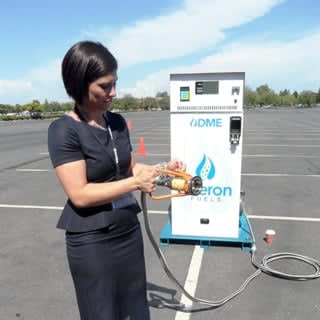
Rebecca Boudreaux, president of Oberon Fuels, shows a 21-gallon-per-minute dispenser that priced at $21,000. Nozzle twists onto a vehicle’s filler neck. Propane-type storage tank costs $1 to $3 per gallon.
Starting next year, Safeway, the grocery giant based in northern California, will use some of that fuel in a few test tractors. Meanwhile, most will go to Texas for use by Martin Transportation, a hauler of bulk commodities and construction materials that’s now testing DME-burning Volvo tractors. And some will be bought by California agencies that are backing the project.
The Brawley plant will convert natural gas from a pipeline to dimethyl ether, and next year it will be equipped to use biomass gas, such as from plant materials and meat and fat scraps from restaurants, Boudreaux said. At that point it could make as much as 10,000 gallons of DME per day.
DME’s cost per diesel-equivalent gallon will be about the same as diesel’s, she said. Its advantages are its cleanliness for low emissions; safety, so a leak will be a non-event, unlike the mess and official concern for a diesel spill; and the use of plentiful domestic natural gas or renewal biomass feedstocks. Of course, it’ll be a fuel that’s made in the USA, so the issue of imported oil will be avoided.
What will a truck or tractor with a DME engine cost? It will be “competitive with diesel,” is all Saxman or Volvo’s sales and marketing president, Goran Nyberg, would say. But without the EGR, DPF and VG turbo, it might be less than a diesel. And with common propane-type steel tanks, it should be far less than a natural gas vehicle.
That Volvo Trucks is involved in DME development should be no surprise. The Sweden-based company declared its concern for the natural environment as far back as 1972 and formally made a commitment in 1985, Nyberg noted. In 2008 it displayed heavy-duty trucks with engines equipped to burn eight different alternative fuels. Careful evaluations since then showed that DME scored the highest.
Whether it scores as high in North America is something to be determined.
More Fuel Smarts

How Volvo Updated Its D13 for EPA 2027 [Watch]
Volvo’s updated D13 promises lower emissions without sacrificing performance or fuel economy. Take a closer look at what changed inside the engine in this HDT Spotlight video.
Read More →
Diesel Price Spike Shortens Payback for Natural Gas Trucks, Report Says
Energy Vision estimates fleets could recover the higher purchase price of an RNG-fueled Class 8 tractor in 1.3 to 2.8 years under current fuel-price scenarios.
Read More →
Calstart Becomes Catalyst Mobility, Reflecting Broader Focus
Calstart is now Catalyst Mobility, reflecting the nonprofit’s growing national role in clean transportation, including zero-emission trucks, infrastructure and incentive programs.
Read More →

Record Diesel Prices Squeeze Trucking Fleets
Average U.S. diesel prices have climbed to nearly $6 a gallon, surpassing the 2022 record as tight refinery capacity and Middle East disruptions keep fuel costs elevated.
Read More →
How Fuel Delivery Shapes Engine Performance
Fuel delivery depends on more than what happens at the injector. For fleet, maintenance and technical professionals, looking at the full path from pump to injector can provide useful context for understanding engine performance.
Read More →
East Coast Port Launches $45M Electric Truck Push
The Port Authority of New York and New Jersey announced millions in incentives for zero-emission drayage trucks, yard tractors, and new charging hubs near the port.
Read More →
California Bill Could Shed Light on Electric Truck Prices
Why do battery-electric Class 8 trucks remain so expensive? A California bill headed to Gov. Gavin Newsom would give fleets and state agencies more visibility into what manufacturers charge.
Read More →
Detroit Opens Orders for EPA 2027 Engines
Detroit isn’t starting from scratch to meet EPA 2027 diesel emissions standards. Its Gen 6 DD13 and DD15 engines keep much of today’s platform while updating the fuel and aftertreatment systems.
Read More →
Zero-Emission Truck Corridor Planned for West Coast
California, Oregon, Washington, British Columbia and Baja California are coordinating plans for truck charging and hydrogen fueling from Canada to Mexico.
Read More →
A Closer Look at Kenworth’s Electric T880E Vocational Truck [Video]
Learn more about Kenworth's T880E battery-electric vocational truck at the Paccar Technical Center, including its range, applications, upfitting considerations, and PTO options, in this HDT Spotlight video.
Read More →