




What Alternatives Are There to Diesel?
Once you start, the questions don't stop. Every answer begets another query. Sooner or later even some of the experts will pause, scratch their heads, and might even say something like, "Beats me.
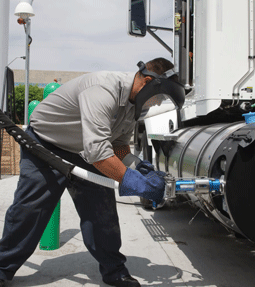
Liquified-natural-gas trucks are better suited to longer hauls thatn CNG, but their range maxes out at 600 miles or so and fueling stations are very expensive.
Once you start, the questions don't stop. Every answer begets another query. Sooner or later even some of the experts will pause, scratch their heads, and might even say something like, "Beats me."
The first question: How long will the diesel engine and its favorite fuel continue to haul the goods that keep America rolling?
Given countless variables, more likely to be political than technological, there really is no way to answer that one firmly. And data on actual oil reserves is scarce.
"Some 94% of the world's oil reserves are held by governments that don't know or won't reveal the size of their holdings," says Amory B. Lovins, co-founder, CEO, and chief scientist at Colorado's Rocky Mountain Institute, writing in The Economist. "But no matter how much oil there is, we should save it whenever doing so is cheaper than buying it, and nowadays that is always."
It's pretty safe to say that diesel engines will power most American trucks for some time to come. Cruising along our interstates and trundling around our cities, in big trucks and small, the good old diesel will continue to show off its legendary efficiency, its inherent strength, and its vaunted reliability.
But will it always run on petroleum-based fuels?
Diesel still king
"In spite of carbon-dioxide emissions, increasing costs and declining reserves, conventional diesel fuel -- gradually improved, including possibly synthetic fuel components -- will probably remain the dominant fuel for commercial vehicles for at least two decades," said Volvo Group CEO Leif Johansson at a recent conference.
"We expect diesel will remain the most significant transportation fuel for the foreseeable future," adds Volvo spokesman Brandon Borgna, "but petroleum is a finite resource and we must develop alternatives. There are many road bumps to overcome for alternative-fueled vehicles to be pervasive, most notably infrastructure development for refueling stations."
Can other fuels be used effectively in place of diesel? Is natural gas, for instance, really the answer? Is biodiesel, whether natural or synthetic, a solution for the long term?
"We believe the path toward diesel alternatives is a process," says Brian Daniels, product manager, powertrain, at Daimler Trucks North America.
Daniels says the company's strategy for "the future of mobility" encompasses three areas of focus:
1. optimization of its vehicles with advanced internal combustion engines.
2. further efficiency gains through hybridization.
3. emission-free driving with electric vehicles powered by the battery and the fuel cell.
"While we do not see diesel being displaced as the primary fuel for the foreseeable future, we do believe that in the short term, natural gas, hybrid and fully electric vehicles may provide alternatives for specific applications," Daniels says. "These platforms will provide a stepping stone to longer-term solutions, such as zero-emissions hydrogen technology."
Other fuels
With self-sufficiency as the most important national energy goal, the options are easily broken down into two fuel types: renewable and non-renewable. Using a combination of the two, that goal is in fact readily achievable. Not cheap, but doable.
For trucking, if it's not going to be diesel, think natural gas and a couple of the almost countless biofuel variants in the short to medium term. The two biofuels that seem to hold the most promise are dimethyl ether (DME) and algae-based biodiesel in the long run.
The latter is especially good in that regard because it grows -- we're talking pond scum -- faster than Washington can push out new rules.
In fact, one proponent of the algae option says if we devoted one-tenth the land mass of New Mexico to making such "scum" and then extracting the oil from it, we'd cover the entire country's transportation-fuel needs -- cars, trucks, trains and whatever else included.
There's another option, namely infinitely abundant hydrogen by way of fuel cells, and its biggest proponent is Daimler in Germany.
"Hydrogen is the fuel of the future," says a Daimler spokesperson in Stuttgart. "In driving mode itself, no harmful emissions are produced when hydrogen is used as a fuel for fuel-cell vehicles. The reaction product of hydrogen and oxygen in the fuel cell is only water/water vapor. If hydrogen is extracted from regenerative energy sources, the vision of emission-free, sustainable mobility can become a reality. In order to make driving fuel-cell vehicles more attractive for the user, hydrogen must be offered as fuel across a universal network of filling stations."
While there are fuel-cell vehicles operating now, including quite a few Mercedes Cito buses and even a few trucks in California, this option is still quite far away in mainstream terms.
Natural gas
There isn't much we don't know about natural gas already. Its use in commercial vehicles goes all the way back to Italy just after World War II, when natural gas was commandeered to power buses.
It's the cleanest-burning fossil fuel. When used for power generation, it emits up to 60% less CO2 than coal. It works just fine in trucks, for some applications.
And suddenly we've got lots of it, in part due to continuous exploration, but also because we now have technologies that can drag it out of the ground from places where conventional drilling wouldn't work. For the most part we're talking about so-called "shale" gas.
Natural gas proponents are led by T. Boone Pickens, head of the largest U.S. natural gas supplier, Clean Energy. Not surprisingly, he wants all 8 million trucks on U.S. roads to say goodbye to diesel and embrace the product he sells.
Each day, Pickens says, the world produces 85 million barrels of oil. The U.S. uses a quarter of that total, while having only 4% of the population. "That is not sustainable," he says. "We cannot continue to use that much oil."
The U.S. is in fact self-sufficient when it comes to natural gas for the foreseeable future. The Marcellus Shale deposits centered in the Appalachia region, for example, represent the second-largest gas field in the world (the largest is in Qatar), stretching up into New Brunswick, Canada. ExxonMobil and others are extracting shale gas there and elsewhere throughout North America.
It's found in very fine-grained sedimentary rock, tightly locked in very small spaces. The extraction process involves stimulating -- or fracturing, usually called "fracking" -- the gas-bearing zones. That allows the gas to flow to the well. Then the reservoirs are tapped in the same way as conventional gas wells. There are environmental concerns with all of this, but authorities are looking at them and promising safeguards.
A mainstream fuel?
Until very recently, natural gas was seen as a peripheral player. The conversion was expensive, the range of natural gas vehicles (NGVs) was quite short, and the infrastructure to support them was thin on the ground.
None of those things has really changed. NGVs still cost many, many thousands of dollars more than the diesel equivalent, though a bill before Congress would change that, creating a whopping $65,000 tax credit for the purchase of NGVs.
Compressed-natural-gas trucks do have a very short range, making them suitable only for local/regional work where they return to base at least daily. Liquified-natural-gas trucks are better suited to longer hauls, but their range maxes out at 600 miles or so, meaning there must be fueling facilities within at least that distance. While the infrastructure is growing quickly, lack of convenient CNG or LNG fueling stations remains a barrier.
Yet there are those who see natural gas as a mainstream truck fuel, and demand is growing. Peterbilt, for example, is now building several NGVs a day, most powered by what was originall
More Fuel Smarts

How Volvo Updated Its D13 for EPA 2027 [Watch]
Volvo’s updated D13 promises lower emissions without sacrificing performance or fuel economy. Take a closer look at what changed inside the engine in this HDT Spotlight video.
Read More →
Diesel Price Spike Shortens Payback for Natural Gas Trucks, Report Says
Energy Vision estimates fleets could recover the higher purchase price of an RNG-fueled Class 8 tractor in 1.3 to 2.8 years under current fuel-price scenarios.
Read More →
Calstart Becomes Catalyst Mobility, Reflecting Broader Focus
Calstart is now Catalyst Mobility, reflecting the nonprofit’s growing national role in clean transportation, including zero-emission trucks, infrastructure and incentive programs.
Read More →

Record Diesel Prices Squeeze Trucking Fleets
Average U.S. diesel prices have climbed to nearly $6 a gallon, surpassing the 2022 record as tight refinery capacity and Middle East disruptions keep fuel costs elevated.
Read More →
How Fuel Delivery Shapes Engine Performance
Fuel delivery depends on more than what happens at the injector. For fleet, maintenance and technical professionals, looking at the full path from pump to injector can provide useful context for understanding engine performance.
Read More →
East Coast Port Launches $45M Electric Truck Push
The Port Authority of New York and New Jersey announced millions in incentives for zero-emission drayage trucks, yard tractors, and new charging hubs near the port.
Read More →
California Bill Could Shed Light on Electric Truck Prices
Why do battery-electric Class 8 trucks remain so expensive? A California bill headed to Gov. Gavin Newsom would give fleets and state agencies more visibility into what manufacturers charge.
Read More →
Detroit Opens Orders for EPA 2027 Engines
Detroit isn’t starting from scratch to meet EPA 2027 diesel emissions standards. Its Gen 6 DD13 and DD15 engines keep much of today’s platform while updating the fuel and aftertreatment systems.
Read More →
Zero-Emission Truck Corridor Planned for West Coast
California, Oregon, Washington, British Columbia and Baja California are coordinating plans for truck charging and hydrogen fueling from Canada to Mexico.
Read More →
A Closer Look at Kenworth’s Electric T880E Vocational Truck [Video]
Learn more about Kenworth's T880E battery-electric vocational truck at the Paccar Technical Center, including its range, applications, upfitting considerations, and PTO options, in this HDT Spotlight video.
Read More →