




Port Strike Highlights Pay, Emissions Regulation Struggles
Southern California truck drivers and warehouse workers who serve the Ports of Los Angeles and Long Beach once again went on strike on June 19, protesting poor wages and labor practices.

Steven Martinez・Web Editor
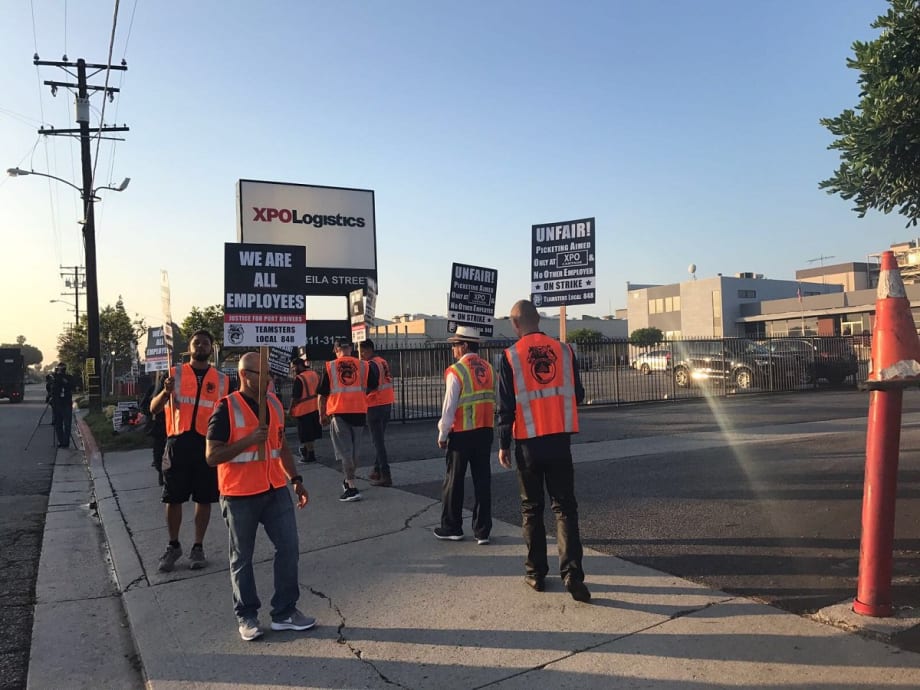
Picketers at XPO Logistics' port operations say port truck drivers should be classified as employees. Photo via Justice4PortDrivers Twitter
5 min to read
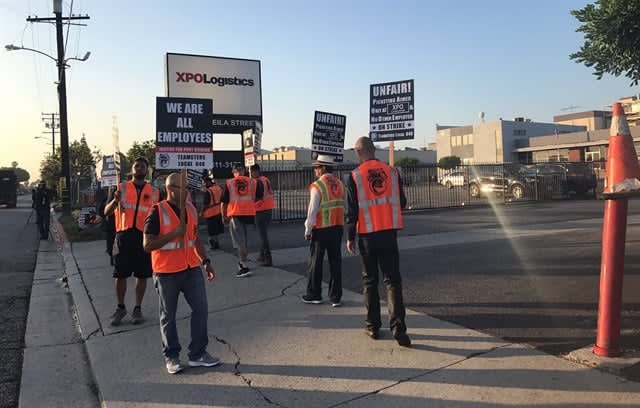
Picketers at XPO Logistics' port operations say port truck drivers should be classified as employees. Photo via Justice4PortDrivers Twitter
Southern California truck drivers and warehouse workers who serve the Ports of Los Angeles and Long Beach went on strike on June 19, protesting poor wages and labor practices.
The strike involves workers for Intermodal Bridge Transport, XPO Logistics, and California Cartage, and is just the latest in a series of wage and labor disputes surrounding the major Southern California ports complex.
In a letter from truckers to the clients of IBT that was released by the Teamsters Union, the drivers bring up the practice of hiring independent contractors to haul cargo to and from the ports as part of an “illegal business model."
“You cannot deny knowledge that your subcontractor is breaking the law as we have struck before, we have sent you letters, and the company’s illegal behavior has been widely reported in the news media,” the drivers stated.
The impact of the strike is expected to be minimal to the ports, according to the Harbor Trucking Association. Similar picketing actions have occurred as many as 15 times in the last three years, and security and port operations personnel are prepared.
“It’s not really a strike, it’s just ambulatory picketing and [the impact] tends to be minimal,” Weston LaBar, executive director for the HTA, told HDT in an interview. "The most I’ve seen a dozen picketers at one terminal, most of them have single digits or no picketers whatsoever.”
The driver misclassification issue cited by the protesters argues that although the port trucking companies classify their drivers as independent contractors, they are not truly independent from the companies they work for and should be classified as company employees and given requisite benefits and wages. This has led to several lawsuits from drivers over what they say are unpaid wages, costing port trucking companies millions of dollars in some cases. However, the Trump Administration recently rolled back Obama Administration Department of Labor guidance that had helped opened the floodgates on prosecuting misclassification cases.
The independent contractor drivers at the ports lease their vehicles from the companies they work for and are required to pay for maintenance and insurance on those same vehicles, while gaining no equity or working toward eventually owning the truck.
In an investigative reporting USA Today exposé last week, the newspaper uncovered the extremes of this working relationship, finding that some drivers were working long hours and taking home very little – in some cases none – of their paychecks after their lease payments and other expenses were deducted. The report claimed that in some cases drivers were being forced to work as much as 20 hours in a day, far past the maximum allowed by law, drivers alleging that their supervisors threatened to take their jobs or assigning lower-paying routes as punishment if they did not.
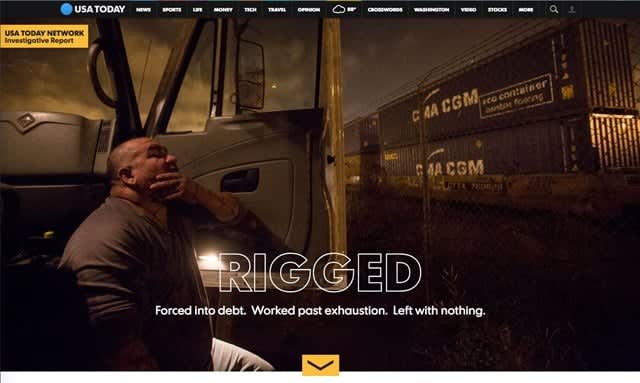
A screenshot from USA Today's investigative report on Southern California port drivers.
Representatives from the Harbor Trucking Association and a few port companies responded to USA Today, contesting the allegations of abuse and characterizing some of it as an attempt by unions to organize port workers.
In the report, USA Today found that many drivers were poor immigrants who paid nearly all of their paychecks to the trucking companies to keep their vehicles. In one reported case, a driver brought home only 67 cents of his paycheck for a week's work. In some cases missed time or vehicle payments could also mean termination and the loss of the leased truck.
However, the HTA told HDT that the cases in the USA Today report were cherry-picked for their extremeness or were not completely explained. For instance, LaBar said some of the complaints were coming from drivers who were not driving full time, which made it very hard to afford "basically the lease on your office," in reference to the leased vehicles.
"We've been dealing with this narrative for a long time; we feel that there has been a lot of latitude taken in the drawing of conclusions for some of these," said LaBar of the USA Today report. "It focuses on a very small subset of the industry, and what we forget to point out is the 90-plus percent of drivers who prefer to be independent contractors and have made that business model work."
The tough economics of the port are undeniable. The market dictates that work goes to the lowest bidder, according to the USA Today report, meaning a razor's edge for margins for companies or drivers transporting cargo.
Port drivers are also more unlikely to be able to buy a vehicle on their own thanks to emissions regulations requiring the use of newer, cleaner vehicles. For years, port truckers used old trucks to keep down costs of working at the ports as independent contractors, according to USA Today. However, environmental regulations have made it impossible for drivers to continue maintaining and using these old vehicles. That's why many trucking companies stepped in and bought cleaner trucks and leased them to their contractor drivers.
"What happens when you go from a $10,000 piece of equipment to a $100,000-plus piece of equipment, sometimes the companies had to issue lines of credit for the drivers to stay in the industry," explained LaBar of what happened after the Clean Trucks Program went into effect at the ports. "It created an interesting turning point for the industry, but the industry is pretty adaptive and was able to figure out how to make it work, and for many people it had great success."
New regulations continue to put pressure on companies and drivers to use the latest equipment. As recently as June 12, the mayors of Los Angeles and Long Beach signed a new pledge to reach zero emissions by 2035. This has spurred investment in alternative fuels and electric vehicles from companies such as Mack, Toyota, Kenworth, BYD, and Volvo Trucks North America. But how much more expensive that equipment will be is as yet unknown.
In an LA Times report on the strike, a representative from the Teamsters Local 848 told the newspaper that while the union supports the zero-emissions goal, the deal made no mention of its impact on drivers.
More Drivers

Truck Drivers Need More Than Another Alert
Fleets have more visibility into truck health, safety events, and driver activity than ever. The next challenge is turning all that information into useful guidance for the person who has to decide what to do next.
Read More →
FMCSA Removes 110 Truck Driver Training Schools from Certified ELDT List
Federal regulators also are targeting more than 160 additional training providers and launching a nationwide audit of third-party CDL skills testers as part of a broader crackdown on trucking fraud.
Read More →
Hours of Service Pilot Programs: FMCSA Readies for 2027 Rollout
Two pilot programs could eventually reshape hours-of-service rules, giving truck drivers options to pause their 14-hour clock or use longer split sleeper rest periods.
Read More →
Medical Cards, English Proficiency Reshape Roadcheck Violations
Medical-card violations jumped to the top of the driver out-of-service list during CVSA’s 2026 International Roadcheck, while English-language proficiency violations appeared among the leading violations for the first time.
Read More →
Driver Trust Can Make or Break the Success of Fleet Safety Technology
New Teletrac Navman research suggests that onboarding, transparency about driver data, and positive feedback can play a significant role in how commercial drivers respond to safety and coaching technology.
Read More →
EEOC Sues KLLM Over Alleged Sex Discrimination in Driver Training
KLLM is facing a federal sex-discrimination lawsuit over policies the EEOC alleges put female truck driver trainees at a disadvantage.
Read More →
FMCSA Moves to Codify English Language Requirements for Commercial Drivers
By changing regulations on English-language proficiency requirements for commercial drivers, rather than relying on a guidance memo, the FMCSA said future administrations won't be able to walk back the Trump administration's stricter enforcement with just a memo.
Read More →
Drivers Put Western Star Trucks to the Test at Star Nation Experience
Watch to get an inside look at the Western Star trucks, technology, and community behind the Star Nation Experience 2026!
Read More →
Trump Administration Looks to Put More Veterans Behind the Wheel
The Freedom Haulers program pulls together existing and expanded programs at several federal agencies to recruit veterans to drive commercial heavy-duty trucks and cut the red tape for them to get a CDL, training, and employment.
Read More →
Putting Mack’s Command Steer to the Test
A test drive of Mack’s Command Steer active steering system evaluates how it can make truck driving easier and less tiring.
Read More →