





How to Make Automatic Emergency Braking Right For Your Fleet
ATA: Revisiting GHG 3, Automatic Emergency Braking Under Trump 2.0
The American Trucking Associations outlined part of its regulatory wish list under the second Trump administration. And it's not all deregulatory.
March 12, 2025

The Trump administration has promised to roll back many regulations it sees as overreach.
Image: HDT Graphic
5 min to read
The new Trump administration is not the same administration as the first four years of Donald Trump, but from a policy perspective, one of the parallels is deregulation.
The American Trucking Associations has already been talking to the administration about addressing unrealistic greenhouse gas rules – but there also are new rules the association will be pushing for, such as automatic emergency braking.
That was the message of Dan Horvath, American Trucking Associations senior vice president of regulatory affairs and safety, speaking to a crowd of attendees of the ATA’s Technology & Maintenance Council annual meeting this week in Nashville, Tennessee.
“We saw that in the first four years of Donald Trump…. Remember that for every new regulation that was created, we had to identify two regulations that needed to come off the books. This time around, it's 10 for one.”
ATA, he said, has already begun identifying regulations, guidance documents, and so forth to see “what’s ripe for review and things we can suggest to the agencies to pull back.”
With input from its councils and member associations such as TMC, he said, ATA’s policymakers can “suggest things where there is an opportunity to look at burdens of regulations and things that just aren't working well.”
One Regulation ATA is Advocating For
“Just because we're in a deregulatory world doesn't mean we're not going to see any new regulations at all,” Horvath said.
“It also doesn't mean that ATA is going to give up the charge and advocating for some of the regulations that we believe have a true impact on safety, one of these being ADAS systems, specifically automatic emergency brakes.
In 2023, the Department of Transportation published a proposed rule that would require new commercial vehicles over 10,000 pounds to have automatic emergency braking systems.
The Bipartisan Infrastructure Law passed during the Biden administration required the agencies to put out a proposed rule.
“We have a lot of great feedback from TMC and others of why this makes a difference, not just for crash prevention, but the crash mitigation and reducing the severity of a crash, which I think is often missed when we're talking about [AEB].
“So we look forward to continuing those conversations. We've already been in to meet with FMCSA team and work on that.”
Related to ADAS, Horvath pointed to a TMC Study Group that has been working on guidelines for the best driver training for ADAS systems.
“And these are questions that we will get when we're up in front of lawmakers as far as drivers perspectives, and what is industry doing to make sure that we have that driver buy in?
“Being able to say that we have a dedicated study group that’s been working on this speaks volume when we're advocating for these items.”
Looking For Achievable Environmental Regulations
One of the big areas that ATA is looking to work with the new administration on involves environmental regulations and the Environmental Protection Agency.
“One of our top areas that we've been dealing with … is getting standards that are achievable for the industry through prioritizing the reopening of the Greenhouse Gas Phase 3.”
In fact, ATA’s policy team met with the EPA transition team before President Trump took office and has had continued meetings with leadership.
“This industry has made strides on the environmental front. And I always say it's not because they're being told they have to, but because they think it's the right thing to do, and to me, that is that's so critical when we're working with lawmakers on trying to address these standards, set achievable standards, and … standards that aren't going to change every four years.”
California’s Clean Air Act Exemption
ATA also is lobbying for EPA Action Would Allow Congress to Kill California's Clean Truck Rulesthrough the waiver process, an exemption that was part of the Clean Air Act.
In the Air Quality Act of 1967, later amended to the Clean Air Act, Congress preempted state governments from adopting their own air pollutant emissions standards for new motor vehicles and new motor vehicle engines.
However, Congress decided to provide an exemption for California, allowing the state to apply to the U.S. Environmental Protection Agency for a waiver from the federal preemption. The law says the EPA is to grant this waiver absent certain disqualifying conditions.
Amendments to the Clean Air Act in 1990 allowed other states to adopt California's vehicle emissions standards under certain conditions.
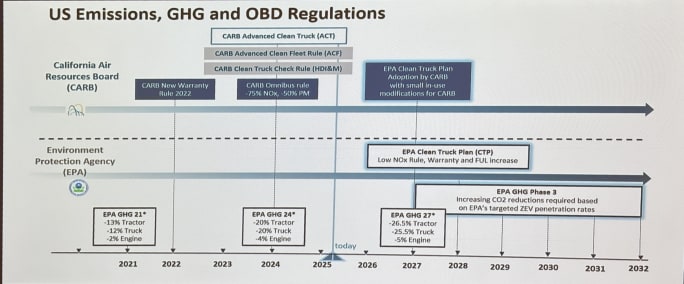
During another TMC session, "Catching Up With CARB," a slide showed the complexity of the overlapping EPA and California emissions regulations.
Source: TMC
Recent Successes in Regulatory Rollback
Horvath offered a couple of examples of recent association wins on policy.
“We had this little issue, which truly was a big issue. We had this rear underride guard labeling issue …. a regulation that's been on the books for years and years.”
It’s not uncommon for labels that fall off with age on trucks or trailers, he said, “and there’s no real solution to go and fix that.”
With feedback from TMC and others, ATA were able to work with the administration to putout updated guidance on the issue.
And in January, the FMCSA granting an exemption the associations had requested to alleviate the technician shortage.
Under the new policy, which ATA requested in 2020, technicians will be allowed to skip the federally required one-year of training or experience needed to conduct commercial vehicle inspections and brake-related repair and maintenance -- provided they received training based on TMC’s Recommended Practices.
“TMC has a fantastic RP program that goes well above and beyond the one year certification process,” Horvath noted.
The exemption applies to motor carriers, intermodal equipment providers and individuals, allowing them to self-certify that they have completed a training program based on TMC’s RPs.
More Fleet Management

Geotab Links Fleet Card to Vehicle Data
The new card combines fuel discounts with telematics-based purchase controls. Geotab’s analysis also points to potential savings from choosing lower-priced fuel stops.
Read More →
How MFA Helps Protect Trucking Fleets
Multi-factor authentication adds protection when passwords are stolen. Here’s how it works and where fleets should start.
Read More →
How Better Freight Data Helps Trucking Teams Get Ahead of Disruption
Trucking and logistics teams have plenty of data. The problem is getting the right information in front of the right people soon enough to act. Better-connected data can help teams spot trouble earlier and make smarter decisions before small problems become big ones.
Read More →

Trimble: Taking Artificial Intelligence in Trucking Beyond Faster Tasks
At Insight 2026, Trimble executives argued that fleets may need to redesign workflows to get more from AI as it introduced new products and enhancements. AI’s value will depend on how fleets combine automation with their people's knowledge.
Read More →
Sponsored•September 28, 2026
Build a bulletproof fleet: Uniting ELDs and dash cams for total compliance
An ELD can prove compliance, but it cannot always prove what happened on the road. Discover how uniting accurate ELD data with AI-powered dash cam video can help your fleet strengthen compliance, defend against liability, protect drivers and reduce operational costs.
Read More →
Nominations Open for HDT Emerging Leaders
Heavy Duty Trucking is looking for accomplished trucking fleet professionals under 40 who are making an impact and helping lead the industry forward.
Read More →
Why Private Fleets Are Taking More Freight
Private fleets are putting their own trucks on demanding customers and high-cost lanes as companies seek greater control over service, costs, and capacity.
Read More →
Sponsored•September 16, 2026
Color Match Smarter: Tools That Restore & Perform
For fleet managers and collision repair professionals keeping heavy-duty trucks on the road, getting the color right the first time isn't just about appearance — it's about efficiency, turnaround time, and bottom-line results. Discover how today's digital color tools are transforming the repair process from guesswork to precision.
Read More →
FMCSA Pauses Biennial-Update Enforcement Amid Motus Transition
Carriers whose updates were due on or after June 1 have more time, while FMCSA works to stabilize its new registration system and warns of phishing sites impersonating its new carrier registration system, Motus.
Read More →
Sponsored•September 14, 2026
2026 Blueprint for Countering Smarter Supply Chain Theft
Cargo theft is no longer just the cost of doing business. It's a multi-billion-dollar criminal enterprise exploiting vulnerabilities across your fleet, drivers, and supply chain.
Read More →