




Yokohama Rubber Testing Tire-Tapping Pressure Gauge
Yokohama Rubber is testing a pressure gauge that measures PSI based on the sound created by tapping a tire.

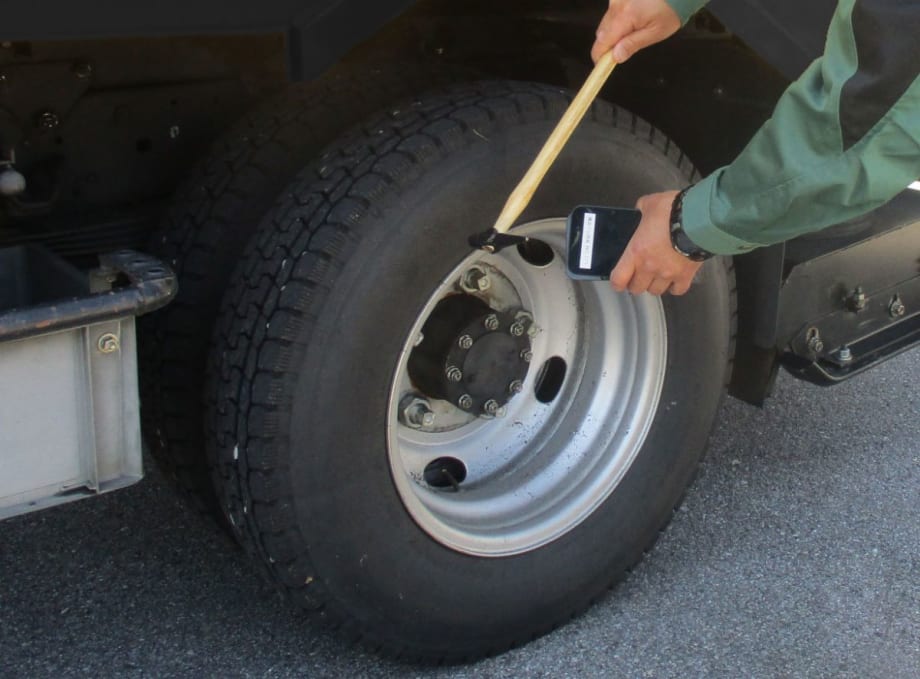
An experimental tire gauge being developed by Yokohama rubber uses AI to distinguish the sounds created by tapping a tire to determine air pressure.
Photo: Yokohama Rubber
Yokohama Rubber has begun practical testing of a technology that gauges air pressure from the sound made by tapping on a tire.
The company announced that it has developed an experimental pressure gauge that uses artificial intelligence (AI) to determine truck and tire pressure. The AI-enabled gauge measures the sound made by tapping the tire.
New Tech for Tire Thumpers
The use of “tire thumper” wooden sticks to check truck tire pressure has been a long-debated topic in North American trucking. Many industry experts insist thumping tires is a meaningless exercise that tells drivers nothing about the PSI in a tire.
However, the use of tire thumpers remains a common practice for drivers conducting pretrip inspections.
Previously, Yokohama noted, the method relied on the driver's experience and ear to judge proper tire pressure. And the development of a gauge that can accurately determine pressure based on sound will provide logistics companies with solutions to various issues. Among them are safe vehicle operation via improved air-pressure measurement, cost reductions and greater operational efficiency through labor-saving, and raising fuel efficiency by appropriately managing tire air pressure.
Moreover, the company noted, daily checks of the air pressure of truck and bus tires with pressure gauges can cause valve failure and air leakage. In addition, real-time monitoring can be costly.
As a result, tapping the tire with a hammer remains the main method for checking air pressure. However, determining whether a tire has appropriate air pressure by simply tapping the tire with a hammer can be difficult even for the most-experienced drivers. An easier and more accurate method for checking tire air pressure is needed.
A Sound-Based Solution
Responding to this need, Yokohama Rubber is working with Metrika to develop an AI algorithm that can distinguish the sounds created by tapping the tire from a variety of environmental sounds, determine when and how long the sound occurred (the sound interval), and estimate the tire’s air pressure based on the detected sound. In addition, Yokohama Rubber and Metrika have developed a prototype of specialized application and are currently conducting practical testing at a transportation-related company.
Using this technology, Yokohama said drivers will be able to visually grasp the tire’s air pressure and any need for adding pressure by recording on a smartphone app the sound made when tapping the tire. This technology will make it possible for anyone to perform a highly precise air-pressure check without the need for a special device or any special skill.
Yokohama Rubber will use the practical testing of the gauge to further improve the accuracy of the AI algorithm and the usability of the application.
In addition, Yokohama Rubber plans to incorporate this new technology into its proprietary next-generation Tire Management System (TMS), which uses the Internet of Things (IoT) to propose appropriate products and operational plans for transportation-related companies.
As part of its effort to strengthen its truck and bus tire business, Yokohama Rubber said it is accelerating the development of technologies and products that respond to the global shift to electric vehicles (EVs) and the expanding introduction of autonomous vehicles. In addition, the Company will continue to establish new tire solution services that contribute to the realization of sustainable logistics.
More Equipment

How Volvo Updated Its D13 for EPA 2027 [Watch]
Volvo’s updated D13 promises lower emissions without sacrificing performance or fuel economy. Take a closer look at what changed inside the engine in this HDT Spotlight video.
Read More →
Michelin Tire Improves Efficiency and Durability for Regional Fleets
The Michelin X Multi Energy D2 is a regional haul drive tire engineered to help fleets improve fuel efficiency, durability and traction in demanding stop-and-go operations.
Read More →
ZF Expands Commercial Vehicle Push in North America
ZF is expanding its North American commercial-vehicle presence with new transmission applications, electrification, trailer technology and autonomous-driving systems.
Read More →
Tesla Wants a Self-Driving Semi. Are Cameras Enough?
Could Tesla’s camera-only autonomous driving technology work on an 80,000-pound Semi? In this commentary, HDT's Deborah Lockridge takes a look at Tesla, Cybercab, and how autonomous trucks see the road.
Read More →
Kodiak: Driverless Long-Haul Truck Launch on Track for 2026
Kodiak AI says its driverless long-haul safety case is 93% complete and it remains on track to begin commercial operations by year-end 2026.
Read More →
What DOT’s Automated Vehicle Strategy Means for Trucking
The U.S. Department of Transportation issued a new automated-vehicle strategy that outlines plans for driverless-truck regulations, cross-state freight corridors, and federal safety standards.
Read More →
East Coast Port Launches $45M Electric Truck Push
The Port Authority of New York and New Jersey announced millions in incentives for zero-emission drayage trucks, yard tractors, and new charging hubs near the port.
Read More →
PlusAI Going Public to Fund Autonomous Truck Launch
A SPAC deal could provide PlusAI with up to $300 million as it works toward a 2027 commercial launch of factory-built autonomous trucks.
Read More →
NHTSA Moves to Rewrite Truck Fuel-Economy Rules
The National Highway Traffic Safety Administration says it lacks authority to regulate medium- and heavy-duty truck engines separately from complete vehicles, but the existing standards have not yet been eliminated.
Read More →
Detroit Opens Orders for EPA 2027 Engines
Detroit isn’t starting from scratch to meet EPA 2027 diesel emissions standards. Its Gen 6 DD13 and DD15 engines keep much of today’s platform while updating the fuel and aftertreatment systems.
Read More →