




Truck Driver’s Dilemma: Click, Twist or Swipe?
Whether 'tis safer to twist a knob or press a button than to swipe right then swipe down to scan the menu for your favorite playlist...? That's a question for the age.

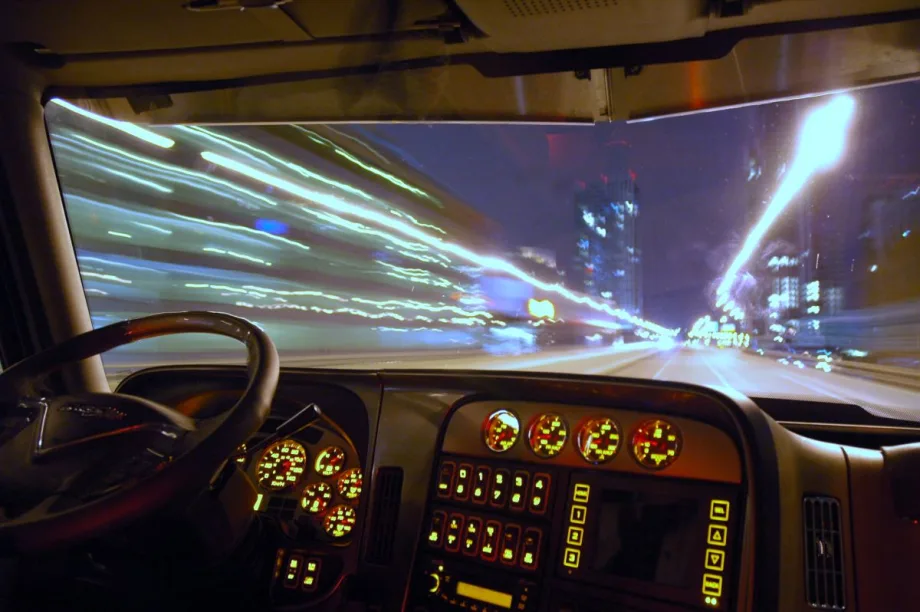
Drivers staring dazed and confused at digital displays can travel 500 feet or more without ever looking at the road
Photo: Jim Park
I'm 65 years old and I wear bifocals. I have for years. I have three pairs of the things: one for real-life, walking about reading signs, menus and the like; another pair for working on the computer here at my desk. I own a third pair dedicated to driving. That's the most challenging environment.
Obviously, I need to see out the windshield clearly, so the upper portion of the lens is adjusted for distance. But I also need to see the dashboard. The lower portion of the lens in my driving glasses is tuned for a distance slightly farther than arm's length -- essentially the distance the dash display is from my eye, and slightly below my main field of vision.
Those bifocals work well enough in my car, but it's a different story when I'm in a truck.
My vison is split between inside and out on a different plane than it is in my car. I prefer to sit tall in the seat, so I find myself looking down at the dash, which sometimes requires that I avert my gaze from the road ahead. The B-panel is a bit more complicated, especially in trucks with glass-panel dashboards.
There's often a lot of information on the B-panel display that can take a second or two to scan and identify. That's about 180 feet of travel where I was looking someplace other than out the front window.
Down the Submenu Rabbit Hole
It gets worse.
On some trucks, there's a row of electronic buttons displayed on the screen, but there's no tactile feel to the buttons, there are just graphics on a screen. To successfully press the button I want, I have to gaze down at the screen. A few more seconds go by while I visually scan the row of buttons. Another 180 feet, maybe more, if I miss my intended target on the first stab.
How long would it take me to find something buried two or more submenus deep? That's a lot of scanning and wishful thinking, hoping I can remember in which menu my target feature is located. Otherwise, I have to back out and start again.
Some trucks still have rows of physical switches to control various functions, like diff locks, power divider, air suspension dump, etc.
I like physical switches, but the problem for me in my advanced stage of decrepitude, I cannot clearly see the tiny little icons on the switches.
Remember the bifocals? I sometimes have to lean over and look down to get close enough to decipher the icons.
I'll bet there are a lot of drivers my age and older who have difficulty like this. My biggest pet peeve, back in the olden days, was radios mounted in the header above the windshield. We don't see that often anymore, but you can imagine the contortions I had to endure looking up through the bottom of my bifocals at the radio display.
Two Problems in One
Experts in the passenger car space have realized that drivers of different ages adopt to high-tech driving environments differently.
A study from 2019 took groups of drivers aged 21-36 and 55-75, put them into a 2018 model car and complete several tasks, such as programming music and a navigation system as well as placing a hands-free phone call.
Not surprisingly, researchers found that older drivers had a harder time with these tasks compared to the younger drivers. In general, it was determined that many older drivers simply found that "technology-laden cars have too much to focus on, leading to instances where the drivers were, for all intents and purposes, distracted by some basic infotainment system navigation.
Another study conducted in the UK produced some alarming results surrounding the use of Apple Car Play and Android Auto. The research was undertaken for IAM RoadSmart, the UK’s largest independent road safety charity.
Drivers in a simulated driving environment were tasked with using some of the basic functions of both smartphone apps while behind the wheel.
IAM RoadSmart called the results "worrying," saying "infotainment systems impair reactions times behind the wheel more than alcohol and cannabis use."
Among the scarier findings:
Controlling the vehicle’s position in the lane and keeping a consistent speed and headway to the vehicle in front suffered significantly when interacting with either Android Auto or Apple CarPlay, particularly when using touch control
Use of either system via touch control caused drivers to take their eyes off the road for longer than NHTSA (National Highway Traffic Safety Administration) recommended guidelines
Participants underestimated by as much as five seconds the time they thought they spent looking away from the road when engaging with Android Auto and Apple CarPlay via touch control.
Reaction time to a stimulus on the road ahead was higher when selecting music through Spotify while using Android Auto and Apple CarPlay
I found the point about Spotify intriguing, and I think the same can be said for YouTube Music. The landing page can be quite an eyeful. Tons of colorful little icons fighting for your attention. And really tiny print to read.
You can read the whole IAM RoadSmart report here.
Big Trucks and Older Drivers
I'm unaware if any studies have been done on the use of glass-panel dashes and various infotainment devices in big trucks, and their impact on driver attentiveness -- especially among older drivers.
But I'd bet there's lots of driver facing camera footage showing older drivers peering out through the bottoms of their bifocal as various spots on the dashboard and taking two or three stabs at various icons.
I'm quite sure no research has ever been done or published on how truck drivers respond to digital information systems and displays, again, especially among older truck drivers.
Given our industry demographics -- one of the oldest average-age workforces in the country, I think it's something worth looking at.
We've recently seen several OEM introduce glass-panel dashboards as standard equipment. I wonder if they looked deeply into how older drivers interact with such technology?
More Blog Posts
Even the Swedes are Doing Turnpike Doubles
The government doesn't seem to mind asking trucking to invest a trillion dollars toward a greener future. But they won't let us pull turnpike doubles making 30% less CO2. Which is insanity, says HDT's Jim Park in his On the Road blog.
Read More →
Is Your Recruiting Message on Point?
How does your recruiting and retention messaging compare with the reality at your company? Would your drivers agree with your own assessment? Jim Park explores those questions in his On the Road blog.
Read More →
You Can’t Blame Trucks for the Highland Rest Area Bus Crash [Commentary]
The causes of the Highland Park rest area crash go far beyond the parking shortage and the need for flexibility in hours of service — but those issues must be addressed, too, says Jim Park in his On the Road blog.
Read More →
Electric Trucks Seem Far Down the Road for Fleets Dealing with Today's Maintenance Challenges
While the push for zero-emissions trucks rings clear for regulators, advocates and even a small crowd of suppliers, ZEVs seem to have run out of steam down on Main Street, says HDT Equipment Editor Jim Park in his latest On the Road blog.
Read More →
Guinea Pigs 2.0: Can Trucking Comply with a Near Impossible NOx Reduction?
The EPA’s Final Rule on NOx reduction will be incredibly difficult if not nearly impossible for trucking to comply with. Rather than endure another round of equipment failures, downtime and loss of customer faith, industry needs to rally ‘round the OEMs and seek a solution to this wrong-headed rule.
Read More →
Is Downspeeding Bad for Brakes?
Is there a connection between downsped drivetrains and increased brake wear? There shouldn’t be. Downsped fleets seeing increased brake wear are probably not letting the technology do its job, explains HDT Equipment Editor Jim Park.
Read More →
Dig for the Gold Behind CVSA’s Out-of-Service Numbers
Published out-of-service rates don’t mean much until you dig into the why. With brake problems consistently placing in two of the top five spots, maybe we’re missing something in brake maintenance, writes HDT Equipment Editor Jim Park.
Read More →
Things That Go Poof in the Night
We’re in electric-truck heydays now. But like another famous heyday, the 1849 California Gold Rush, there will be a lot fewer winners than losers, says Jim Park in his On the Road blog.
Read More →
Do Your Truck Drivers Know How to Descend a Mountain Grade?
Where do drivers learn mountain-driving techniques? It's sure not from the typical state CDL manual. Jim Park shares what he learned following a deadly 2019 Colorado crash.
Read More →
Do Your Drivers Understand Their Brakes?
As a former driver, Equipment Editor Jim Park thinks many drivers could use some refresher training on how to inspect brakes on one knee or how to apply brakes when the ABS isn't working.
Read More →