




Do Your Drivers Understand Their Brakes?
As a former driver, Equipment Editor Jim Park thinks many drivers could use some refresher training on how to inspect brakes on one knee or how to apply brakes when the ABS isn't working.

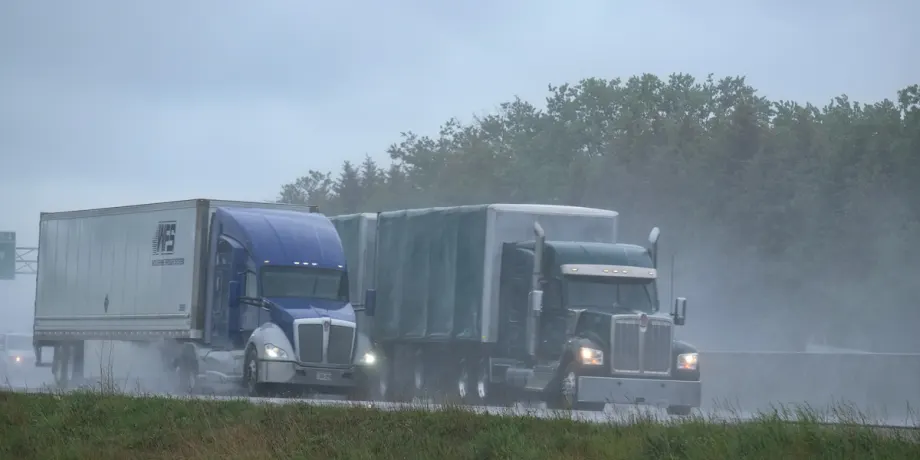
I have always believed that the basic air-brake training drivers receive in pursuit of a CDL overemphasizes the technical/mechanical side of the brake system while doing little to contextualize brakes as drivers experience them from the driver's seat.
Photo: Jim Park
Drivers are an integral link in the brake maintenance chain and thus the vehicle safety chain. They are hands-on with the equipment every day, while shop staff see trucks very much less frequently. Drivers see, hear, and feel the trucks in action, while technicians see only a static component. Do your drivers know enough about brake systems to help maintenance staff identify defective equipment?
Brakes pose an interesting diagnostic and maintenance challenge. On the whole, modern brake systems, drum or disk, operate reliably and trouble-free for hundreds of thousands of miles, so the de facto condition of brakes is good-to-go. On top of that, brakes are seldom stressed under normal operating conditions, so any underlying problems may never be detected. With engine brakes as effective as they are, brake applications above 20 or 30 psi are uncommon, yet it's at higher application pressure that problems can become more obvious.
Take brakes that pull to the right or left, for example. Drivers wouldn't notice a pull at low application pressures, but if a problem existed, they surely would notice something at 40 or 50 psi application pressure. There are several possible culprits for a pulling condition:
One or more brakes may be out of adjustment.
Brake clevis pins could be seized, inhibiting push-rod movement.
Cam bushings could be seized or damaged, inhibiting rotation of the cam rod.
Brake linings could be contaminated with oil caused by a failed wheel seal.
Brake chamber push rods cut to the wrong length could be hanging up on the mounting brackets, inhibiting travel.
Brake relay valves may be delivering unequal air pressure or volume to different wheel-ends.
Air lines that aren't matched to brake chamber type, or a restricted or leaking air line, could cause unequal air pressure or air volume to the brake chamber.
How would a driver know to report such a condition to the maintenance department if he or she had never experienced a symptom? Yet I'm sure you'd agree any of those conditions could be present on any number of your trucks.
Some cases where a truck pulls to one side or another may not be brake-related at all. Failed or worn suspension bushings will cause a temporary misalignment of the steer or drive axles when the brakes are applied, causing the unit to pull right or left.
A thorough visual inspection of the type performed by roadside inspectors during events like Brake Safety Week or Roadcheck would uncover some of those problems, but not all.
Are the Basics Enough?
I have always believed that the basic air-brake training drivers receive in pursuit of a CDL overemphasizes the technical/mechanical side of the brake system while doing little to contextualize brakes as drivers experience them from the driver's seat.
What's really more important in day-to-day operation: being able to point out on a schematic diagram which valves are relay valves, or what it feels like when the tractor brakes apply sooner than the trailer brakes?
In terms of their potential for calamity, which scenario would be worse: brake linings worn thin and close to the legal limit, or nice thick linings that never wear down because they are so hard and have a very low coefficient of friction? I've driven with such linings; they will last forever, but they hardly stop the truck. Would a rookie driver know the difference between hard linings and brakes that had gone beyond their adjustment limit? They feel about the same.
Given the number of brake violations uncovered at various organized inspection blitzes, I hardly think drivers are doing a good job at keeping ahead of the problems.
It's a near certainty that few drivers do mark-and-measure inspections every morning. They probably don't need to go that far every day, but cheap and easy-to-install brake stroke indicators would help turn the mark-and-measure inspection into a one-knee inspection where a driver could conveniently visually verify that the brakes are still reasonably close to being in proper adjustment.
But how many drivers would understand the difference between spring-applied brake stroke and an application of between 90 and 100 psi? Drivers need to be aware that the difference between the two could be upwards of half an inch of stroke length. If it's near the limit with the parking brakes applied, it will almost certainly be over when checked under full application pressure by a CVSA inspector at roadside.
How much coaching and brake update training do you offer your drivers?
Most of them are not mechanics or engineers, and they probably don't need to understand schematic diagrams, but it would sure be useful to get a few reminders in the company newsletter on how to inspect brakes on one knee or how to interpret a pulling sensation in the steering wheel when the brakes are applied.
How about a reminder of how to apply brakes when the ABS isn't working (ever noticed black electrical tape covering the dashboard ABS lamp)?
I'd bet that few drivers really understand their brake system in a practical sense. And if you think they are likely to have retained much of what they learned in CDL school two, five, or 10 years ago, you're fooling yourself.
If you're thinking that a brake refresher course for drivers might be a good thing, ask yourself, are we doing it to pass brake inspections or to improve road safety? That might inform what you decide to offer them.
More Blog Posts

Truck Driver’s Dilemma: Click, Twist or Swipe?
Whether 'tis safer to twist a knob or press a button than to swipe right then swipe down to scan the menu for your favorite playlist...? That's a question for the age.
Read More →
Even the Swedes are Doing Turnpike Doubles
The government doesn't seem to mind asking trucking to invest a trillion dollars toward a greener future. But they won't let us pull turnpike doubles making 30% less CO2. Which is insanity, says HDT's Jim Park in his On the Road blog.
Read More →
Is Your Recruiting Message on Point?
How does your recruiting and retention messaging compare with the reality at your company? Would your drivers agree with your own assessment? Jim Park explores those questions in his On the Road blog.
Read More →
You Can’t Blame Trucks for the Highland Rest Area Bus Crash [Commentary]
The causes of the Highland Park rest area crash go far beyond the parking shortage and the need for flexibility in hours of service — but those issues must be addressed, too, says Jim Park in his On the Road blog.
Read More →
Electric Trucks Seem Far Down the Road for Fleets Dealing with Today's Maintenance Challenges
While the push for zero-emissions trucks rings clear for regulators, advocates and even a small crowd of suppliers, ZEVs seem to have run out of steam down on Main Street, says HDT Equipment Editor Jim Park in his latest On the Road blog.
Read More →
Guinea Pigs 2.0: Can Trucking Comply with a Near Impossible NOx Reduction?
The EPA’s Final Rule on NOx reduction will be incredibly difficult if not nearly impossible for trucking to comply with. Rather than endure another round of equipment failures, downtime and loss of customer faith, industry needs to rally ‘round the OEMs and seek a solution to this wrong-headed rule.
Read More →
Is Downspeeding Bad for Brakes?
Is there a connection between downsped drivetrains and increased brake wear? There shouldn’t be. Downsped fleets seeing increased brake wear are probably not letting the technology do its job, explains HDT Equipment Editor Jim Park.
Read More →
Dig for the Gold Behind CVSA’s Out-of-Service Numbers
Published out-of-service rates don’t mean much until you dig into the why. With brake problems consistently placing in two of the top five spots, maybe we’re missing something in brake maintenance, writes HDT Equipment Editor Jim Park.
Read More →
Things That Go Poof in the Night
We’re in electric-truck heydays now. But like another famous heyday, the 1849 California Gold Rush, there will be a lot fewer winners than losers, says Jim Park in his On the Road blog.
Read More →
Do Your Truck Drivers Know How to Descend a Mountain Grade?
Where do drivers learn mountain-driving techniques? It's sure not from the typical state CDL manual. Jim Park shares what he learned following a deadly 2019 Colorado crash.
Read More →