




FedEx Testing AI Truck-Loading Robots
A robot that can touch, feel, think, and build a densely stacked wall of a wide variety of boxes in a truck or trailer? FedEx is working with a robotics company to test just such a system.
September 27, 2023

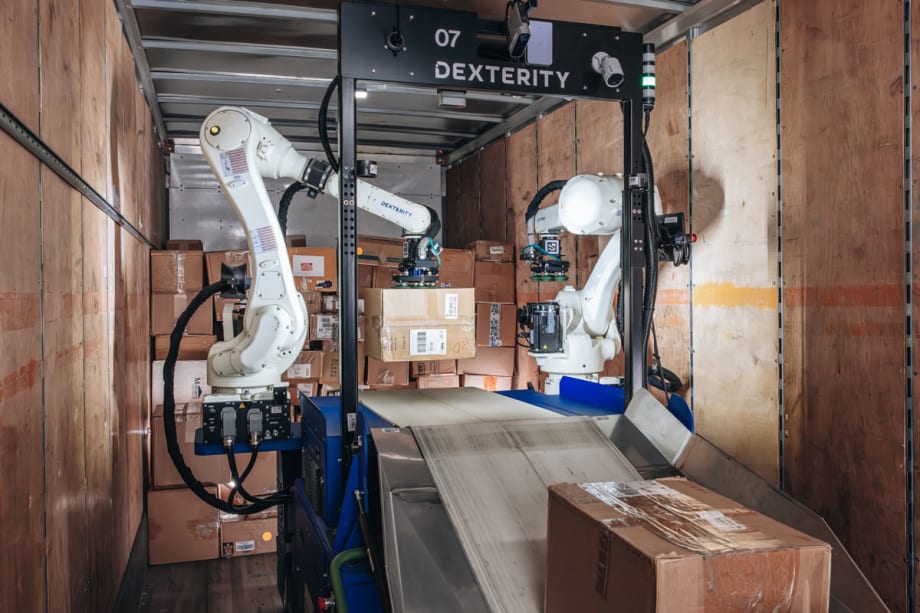
Dexterity AI-powered robots have a sense of touch so they can gently nudge boxes together in creating tightly packed walls.
Photo: DexterityAI
2 min to read
FedEx is collaborating with Dexterity AI to use artificial-intelligence robotic technology to load boxes into trucks and trailers.
Truck loading is one of the most challenging tasks in parcel hubs. Manual loading is taxing. Previous technology approaches have not been able to handle the complex decision-making required to stack the wide range of shipments encountered in the FedEx network, which vary in size, shape, weight, and packaging material.
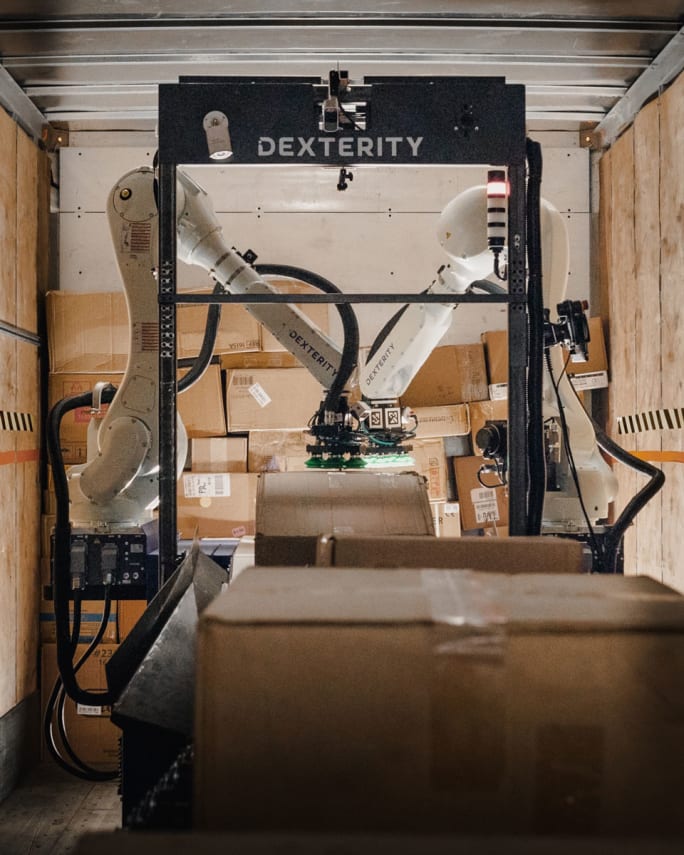
By integrating its own trajectory and motion planning, the Dexterity AI platform helps the DexR’s two arms move quickly inside trailers without colliding with each other or the truck walls.
Photo: DexterityAI
Dexterity AI focuses on the complexity of truck loading by giving mobile robots a suite of intelligence, with the ability to see, touch, think, and move quickly to pack trailers with stable, dense walls of boxes.
“Based on feedback from our operations team, we have been looking for a solution that helps alleviate the challenges of truck loading,” said Rebecca Yeung, corporate vice president of Operations Science and Advanced Technologies for FedEx, in a news release. “Collaborating with Dexterity AI to combine the latest in AI and robotics supports our operations team while meeting growing customer demand.”
Next-Generation AI for Intelligent Truck-Loading Robots
Dexterity AI’s proprietary mobile robot design, DexR, navigates autonomously to the back of trailers and connects to a powered conveyor system that feeds the robot boxes directly from the sortation system. The DexR’s two-arm design enables the robot to pick and pack boxes simultaneously, improving throughput.
Dexterity’s AI platform uses a broad set of intelligence, so it can be used to handle the complexities of truck loading required by operations.
Generative Wall Planning: With every new box presented to the DexR, Dexterity’s AI software takes 500 milliseconds or less to assess billions of wall build possibilities to pack trailers with tight, stable walls.
A Sense of Touch: Dexterity AI-powered force control gives robots a sense of touch so they know how to gently nudge boxes together in creating tightly packed walls.
Machine Learning-Based Pack Improvement: Machine learning helps ensure that with every box picked, the Dexterity AI truck loading software becomes even more efficient in handling a broader range of packing challenges.
Integrated Motion Planning: By integrating its own trajectory and motion planning, the Dexterity AI platform helps the DexR’s two arms move quickly inside trailers without colliding with each other or the truck walls.
Testing of the truck load technology is ongoing by FedEx to refine the technology and deploy it commercially in the future.
“FedEx shares our belief that innovation should solve the most difficult tasks in operations,” said Samir Menon, founder and CEO of Dexterity AI.
Dexterity is a Redwood City, California-based robotics company specializing in creating intelligent robots with human-like dexterity, with applications in logistics, warehousing, and supply chain operations.
More Fleet Management
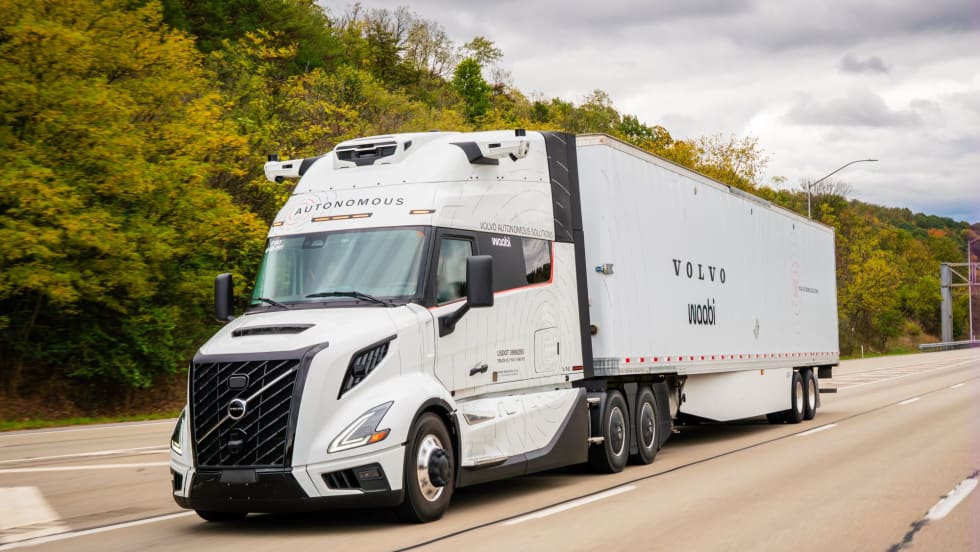
Volvo, Waabi Start Commercial Autonomous Operations in Texas
Volvo VNL Autonomous trucks, powered by the Waabi Driver, are hauling freight directly to third-party facilities for a customer in Texas.
Read More →
Samsara Launches Custom AI Agent Builder
Agent Studio lets fleets create AI tools for hours-of-service monitoring, reporting and driver support, including agents that communicate by phone.
Read More →
Geotab Links Fleet Card to Vehicle Data
The new card combines fuel discounts with telematics-based purchase controls. Geotab’s analysis also points to potential savings from choosing lower-priced fuel stops.
Read More →

How MFA Helps Protect Trucking Fleets
Multi-factor authentication adds protection when passwords are stolen. Here’s how it works and where fleets should start.
Read More →
How Better Freight Data Helps Trucking Teams Get Ahead of Disruption
Trucking and logistics teams have plenty of data. The problem is getting the right information in front of the right people soon enough to act. Better-connected data can help teams spot trouble earlier and make smarter decisions before small problems become big ones.
Read More →
Trimble: Taking Artificial Intelligence in Trucking Beyond Faster Tasks
At Insight 2026, Trimble executives argued that fleets may need to redesign workflows to get more from AI as it introduced new products and enhancements. AI’s value will depend on how fleets combine automation with their people's knowledge.
Read More →
Sponsored•September 28, 2026
Build a bulletproof fleet: Uniting ELDs and dash cams for total compliance
An ELD can prove compliance, but it cannot always prove what happened on the road. Discover how uniting accurate ELD data with AI-powered dash cam video can help your fleet strengthen compliance, defend against liability, protect drivers and reduce operational costs.
Read More →
Nominations Open for HDT Emerging Leaders
Heavy Duty Trucking is looking for accomplished trucking fleet professionals under 40 who are making an impact and helping lead the industry forward.
Read More →
Why Private Fleets Are Taking More Freight
Private fleets are putting their own trucks on demanding customers and high-cost lanes as companies seek greater control over service, costs, and capacity.
Read More →
Sponsored•September 16, 2026
Color Match Smarter: Tools That Restore & Perform
For fleet managers and collision repair professionals keeping heavy-duty trucks on the road, getting the color right the first time isn't just about appearance — it's about efficiency, turnaround time, and bottom-line results. Discover how today's digital color tools are transforming the repair process from guesswork to precision.
Read More →