





Read More: HDT Fact Book 2022: Fleets Adapt to Changing Safety, Regulatory Landscape
VisionTrack Launches AI-Powered Video Analysis Solution
AI telematics provider VisionTrack debuted a solution integrating telematics and artificial intelligence to help save lives and reinforce the company's road safety commitment to reduce traffic fatalities.
February 9, 2023
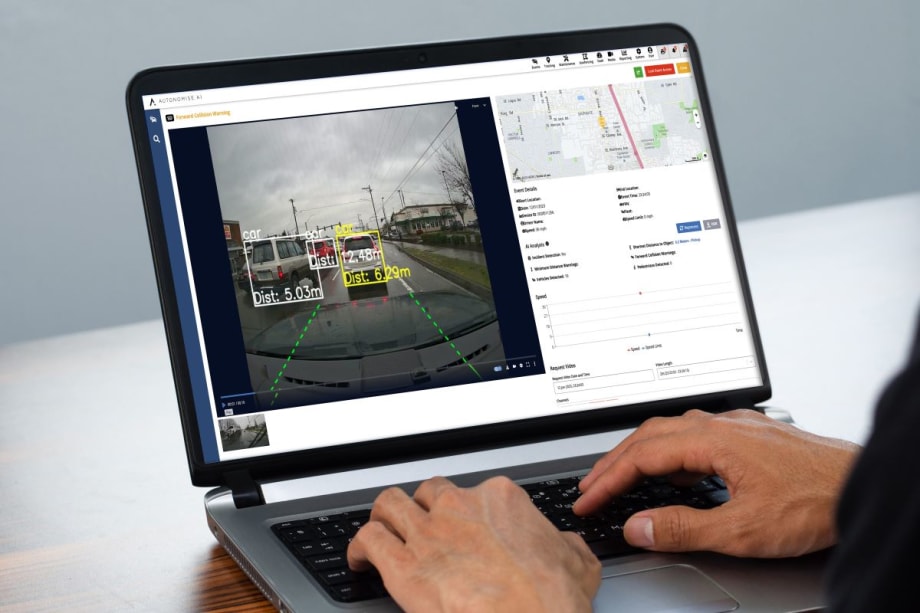
Compatible with any connected camera technology, the NARA solution provides proactive risk intervention and accurate incident validation to improve commercial fleet safety on the roads.
Photo: VisionTrack
2 min to read
VisionTrack, a provider of AI video telematics and connected fleet data, has launched an AI-powered post-analysis solution for commercial fleet safety, integrating vehicle camera footage and NARA (Notification, Analysis, and Risk Assessment) software to help vehicle operators reduce road deaths and injuries.
NARA is device agnostic so it can be integrated with existing connected camera technology – whether VisionTrack or third-party hardware – and adds another layer of analysis to AI vehicle cameras, installed with edge-based AI technology, that are often limited by the processing capacity of the device.
“Our cloud-based NARA software is a true game changer in the world of video telematics as it will help save time, costs, and most importantly lives, by providing proactive risk intervention and accurate incident validation,” explains Richard Kent, president of global sales at VisionTrack in a statement.
How NARA Works
NARA uses computer vision models with sensor fusion to assess footage of driving events, near misses, and collisions. This ensures the review process is manageable and timely, while eliminating human availability or error, so vehicle operators can make best use of video telematics insight to better protect road users and help prevent collisions.
During the testing phase, a 1,100-strong logistics fleet was found to be generating on average 2,000 priority videos a week, which would typically take someone over eight hours to review. NARA reduced the time needed to review events that require human validation to just minutes per day.
Advanced object recognition uses deep learning algorithms to automatically identify different types of vehicles, cyclists, and pedestrians. It will be able to distinguish between collisions, near misses, and false positives that can be generated by harsh driving, potholes, or speed humps. The software will also include Occupant Safety Rating that uses a range of parameters to calculate the percentage probability of injury and immediately identify if a driver needs assistance.
“NARA proactively removes false positives and monitors driver behavior, without the need for human involvement. With traditional video telematics solutions, commercial fleets can be experiencing hundreds of triggered daily events, so this will enable them to deliver more efficient working, while not compromising on road safety,” concludes Kent.
More Safety & Compliance

FMCSA Pauses Biennial-Update Enforcement Amid Motus Transition
Carriers whose updates were due on or after June 1 have more time, while FMCSA works to stabilize its new registration system and warns of phishing sites impersonating its new carrier registration system, Motus.
Read More →
ZF Expands Commercial Vehicle Push in North America
ZF is expanding its North American commercial-vehicle presence with new transmission applications, electrification, trailer technology and autonomous-driving systems.
Read More →
Truck Drivers Need More Than Another Alert
Fleets have more visibility into truck health, safety events, and driver activity than ever. The next challenge is turning all that information into useful guidance for the person who has to decide what to do next.
Read More →
Tesla Wants a Self-Driving Semi. Are Cameras Enough?
Could Tesla’s camera-only autonomous driving technology work on an 80,000-pound Semi? In this commentary, HDT's Deborah Lockridge takes a look at Tesla, Cybercab, and how autonomous trucks see the road.
Read More →
What DOT’s Automated Vehicle Strategy Means for Trucking
The U.S. Department of Transportation issued a new automated-vehicle strategy that outlines plans for driverless-truck regulations, cross-state freight corridors, and federal safety standards.
Read More →
NYC Expands Speed, Pedestrian Safety Tech Across Fleet
New York City is expanding intelligent speed assistance and pedestrian-alert systems across its municipal fleet, moving the technologies from pilot programs into vehicle procurement and retrofit requirements.
Read More →
FMCSA Removes 110 Truck Driver Training Schools from Certified ELDT List
Federal regulators also are targeting more than 160 additional training providers and launching a nationwide audit of third-party CDL skills testers as part of a broader crackdown on trucking fraud.
Read More →
Beyond DOT Compliance: What Makes a Trucking Fleet Truly Safe?
A trucking fleet can follow every rule and still make unsafe decisions. The real test comes when safety conflicts with freight, productivity, or cost.
Read More →
Hours of Service Pilot Programs: FMCSA Readies for 2027 Rollout
Two pilot programs could eventually reshape hours-of-service rules, giving truck drivers options to pause their 14-hour clock or use longer split sleeper rest periods.
Read More →
New Guide Offers Pet Safety Tips for Truck Drivers
Hundreds of thousands of pets travel in truck cabs. A new safety guide from Volvo Trucks and the Center for Pet Safety offers practical advice for truck drivers who bring dogs and cats along for the ride.
Read More →