





Want more?
U.S. Xpress' Shaun Sadler talked about technology as a 2021 HDT Truck Fleet Innovator.
U.S. Xpress, Kodiak Partner to Expand Autonomous Truck Deployment
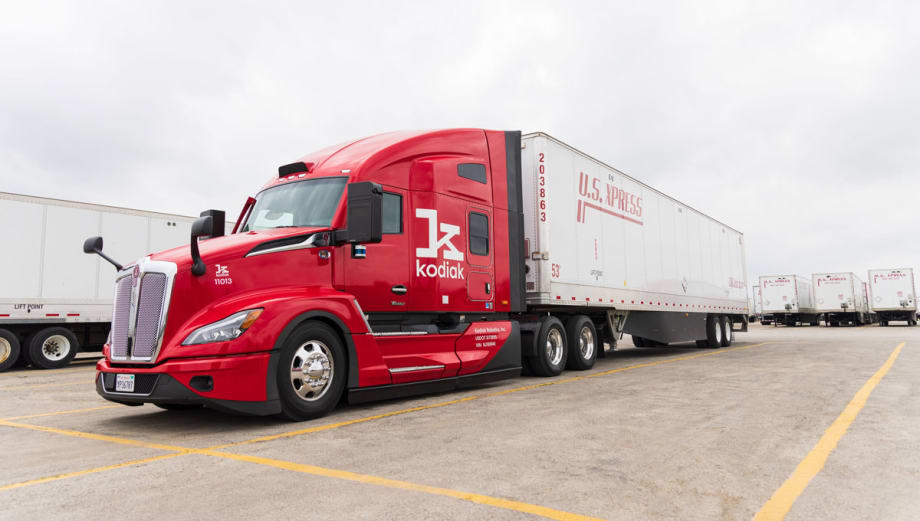
A Kodiak truck and U.S. Xpress trailers completed a pilot project hauling freight on four round-trips (eight segments), approximately 6,350 miles, between Dallas and Atlanta.
April 7, 2022
“We fundamentally believe that Kodiak’s autonomous technology will allow us to scale our fleet while increasing truck utilization compared to a human-driven truck," said U.S. Xpress President and CEO Eric Fuller.
Photo: Kodiak Robotics
3 min to read
Kodiak Robotics and U.S. Xpress have teamed up to launch Level-4 autonomous freight service between Dallas-Fort Worth and Atlanta using Kodiak’s self-driving trucks. This strategic partnership also marks the launch of the first commercial autonomous trucking lane to the East Coast.
U.S. Xpress will become the first cornerstone truckload partner in Kodiak’s Partner Deployment Program, working with Kodiak to deploy self-driving technology.
A Kodiak truck and U.S. Xpress trailers recently completed a pilot project hauling freight on four round-trips (eight segments), approximately 6,350 miles, delivering eight commercial loads between Dallas and Atlanta.
The truck ran 24 hours a day for 131 total hours, or nearly five-and-a-half full days. The results represent a more than 100% increase in utilization compared to a traditional truck and professional driver with an 11-hour legal limit on driving time. By increasing the number of hours a truck can be used per day to 20+ hours, autonomous trucks will allow carriers to haul more freight with fewer trucks, increasing revenue while decreasing costs, according to an announcement.
A Kodiak autonomous tractor picked up and delivered U.S. Xpress pre-loaded trailers. A rotating team of four professional Kodiak safety drivers oversaw the autonomous system.
“This pilot demonstrated to our operations teams and our customers the benefits that can come with autonomous technology,” said Eric Fuller, president and CEO of U.S. Xpress, in a news release. “We fundamentally believe that Kodiak’s autonomous technology will allow us to scale our fleet while increasing truck utilization compared to a human-driven truck. Our strategic partnership is helping both of our teams identify ways to quickly integrate and scale autonomous technology into our fleet once it is commercially available.”
U.S. Xpress is also working with other autonomous-truck developers, including Aurora and TuSimple.
Expanding Autonomous Freight Routes
Kodiak said the route between Dallas and Atlanta is a perfect entry point for continuous autonomous operations because it’s slightly longer than what a driver is permitted to operate in a day but is too short to economically run as a team. This pilot also represents the first-ever autonomous freight deliveries between Dallas and Atlanta, according to the news release.
“Our partnership with U.S. Xpress marks our service expansion to the East Coast,” said Don Burnette, founder and CEO of Kodiak. “We believe it is the furthest east any company has delivered multiple loads using autonomous technology.
“Having the capacity to sustain 24/7 operations across the more than 750 miles between Dallas and Atlanta — two of our nation’s busiest freight hubs — represents a giant step forward for Kodiak, and for the AV trucking industry as a whole. We chose to make U.S. Xpress a cornerstone partner in our Partner Deployment Program because we see U.S. Xpress and its Variant division as ideal long-term partners for the deployment and scaling of our autonomous long-haul solution.”
Kodiak will continue to haul freight with U.S. Xpress between Dallas and Atlanta, as well as other lanes within the Kodiak network. Kodiak has been delivering freight daily on the 240-mile lane from Dallas to Houston since mid-2019, and on the 280-mile lane between Dallas and San Antonio since mid-2021. The company uses a proprietary lightweight mapping solution to add new lanes, including the recently announced launch of commercial operations between Dallas and Oklahoma City in February.
More Fleet Management

Kodiak Lines Up Fleets for Driverless Trucking
An agreement for 75 trucks, a new Texas freight lane, and progress on safety validation move Kodiak closer to its planned driverless highway launch.
Read More →
ITS Logistics Settles Religious Harassment Case
The Nevada-based logistics firm agreed to pay more than $396,000 to settle a religious harassment charge involving an employee's Jewish identity.
Read More →
Your Trucks Are Busy. That Doesn’t Mean They’re Winning.
High utilization doesn’t always mean strong margins. Looking beyond the current load can help fleets make better dispatch decisions and get more value from each truck’s time.
Read More →
Why This Trucking Recovery Is Different
Freight demand remains sluggish, but rising costs and tougher enforcement have taken enough capacity out of the market to change the outlook for motor carriers.
Read More →
Platform Science Adds Dispatch and Safety Tools
Four additions to PS Fleet help fleets monitor loads, manage driver coaching, share truck locations and adjust video system settings.
Read More →
PrePass Intelligence Mines Fleet Bypass, Toll and Safety Data
PrePass Intelligence helps fleets measure bypass savings, flag potential toll overcharges, and spot suspicious transactions by combining data from separate systems.
Read More →
Motive Adds AI Agents for Fleet Operations
New tools automate follow-up on fleet data, from maintenance work orders to driver alerts, with two-way voice conversations planned for later this year.
Read More →
Can You Beat Our Trucking Trivia Challenge?
Test your truck knowledge with 19 trivia questions from Heavy Duty Trucking Exchange. Can you keep up with the fleet pros?
Read More →
BeyondTrucks Adds Rules Checks to Dispatch
New Compatibility Engine checks driver qualifications, equipment requirements and fleet policies before loads are dispatched.
Read More →
Diesel Prices Hijack Trucking’s Worry List
ATRI’s annual survey finds cautious optimism about freight, but diesel costs, litigation, and insurance continue to squeeze fleets. Drivers have different priorities on several issues.
Read More →