





You also might like: 4 Ways Fleets Can Lower Driver Turnover
Best Fleets to Drive For Names Top Carriers
Two for-hire fleets achieved the top honors in the 2022 Best Fleets to Drive For, after being among the Best Fleets Top 20 multiple times.
March 21, 2022
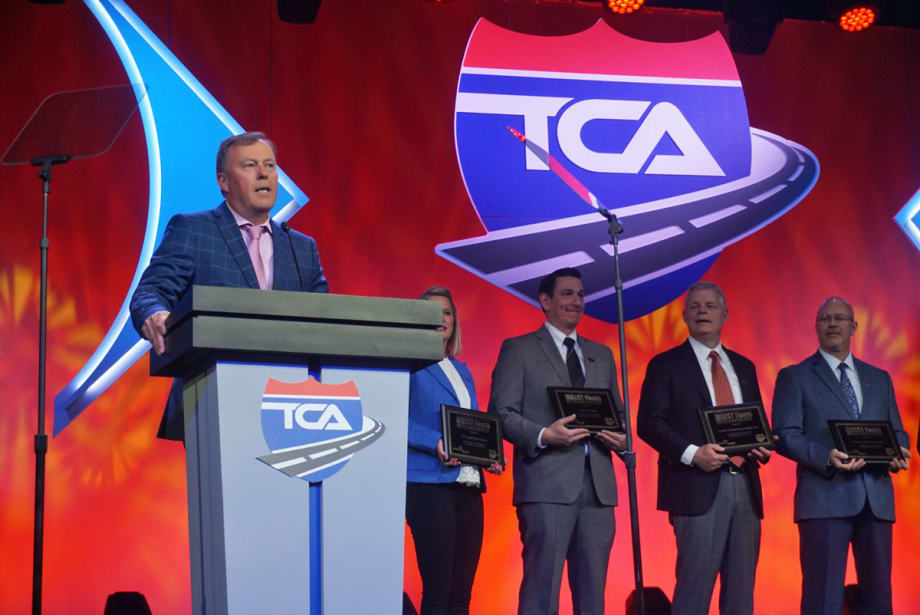
Jim Peeples, president and COO at Challenger Motor Freight, spoke upon receiving the large-carrier award.
File Photo: Vesna Brajkovic
3 min to read
Two for-hire fleets achieved the top honors in the 2022 Best Fleets to Drive For, after being among the Best Fleets Top 20 multiple times:
Best Overall Fleet in the small carrier category went to Garner Trucking of Findlay, Ohio.
Best Overall Fleet in the large carrier category was presented to Challenger Motor Freight of Cambridge, Ontario.
The Truckload Carriers Association and CarriersEdge presented the awards during TCA’s annual meeting in Las Vegas.
Now in its 14th year, Best Fleets to Drive For is an annual survey and contest that recognizes the North American for-hire trucking companies who provide the best workplace experience for their drivers.
To be considered, fleets must be nominated by a company driver or independent contractor working with them, after which they are evaluated across a broad range of categories reflecting current best practices in human resources.
The Top 20 finishers are identified as Best Fleets to Drive For and then categorized according to size. The highest-scoring fleet in each category is named overall winner.
Garner Trucking, with 83 drivers, is well-known for its efforts to improve the industry’s image. It also stood out for its new entrant program and diversity efforts, according to a Best Fleets to Drive For news release, as well as recognition and driver support programs typically only seen in much larger companies.
Challenger Motor Freight, with 1,052 drivers, was notable for its range of professional development programs that extend from driver apprenticeship through management training. Its investments in driver efficiency, cybersecurity, and military support also helped push it to front of the pack.
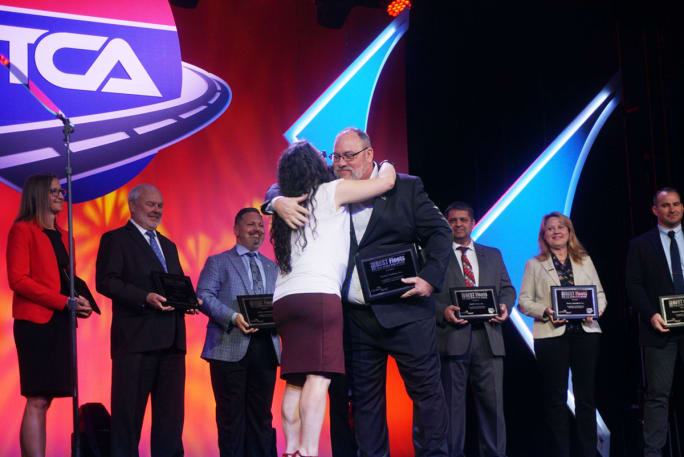
Tim Chrulski, chief operations officer for Garner Trucking, accepts the award for Best Fleet to Drive For in the small carrier category.
Photo: Vesna Brajkovic
CarriersEdge Chief Executive Officer Jane Jazrawy noted that both winners are seeing clear results from their efforts, with turnover under 35% and driver satisfaction above 94%.
“Both of these fleets have been in the Top 20 for several years, and we've seen how they continue to add new things year after year,” said Jazrawy. “With that steady effort, and a collaborative approach that includes drivers in the process, it’s no wonder they’re seeing the results they are.”
New Hall of Fame
New this year is the Best Fleets to Drive For Hall of Fame, which identifies carriers that have been named a Best Fleet for 10 consecutive years, or for seven consecutive years plus an overall Best Fleets to Drive For award.
“The Hall of Fame recognizes fleets demonstrating exceptional performance year after year,” said Jazrawy. “The inaugural entrants have continued to raise the bar for years, and their achievements demonstrate an enviable level of excellence.”
The fleets entering the 2022 Best Fleets Hall of Fame are:
Bison Transport, Winnipeg, Manitoba
Boyle Transportation, Billerica, Massachusetts
Central Oregon Truck Company, Redmond, Oregon
FTC Transportation, Oklahoma City, Oklahoma
Grand Island Express, Grand Island, Nebraska
Halvor Lines, Superior, Wisconsin
Nussbaum Transportation Services, Hudson, Illinois
Prime Inc., Springfield, Missouri
The Best Fleets to Drive For survey and contest is open to any for-hire fleet operating 10 or more trucks, regardless of TCA membership status. Nominated fleets are evaluated in areas such as driver compensation, pension and benefits, professional development, driver and community support, and safety record.
More Drivers

From One Generation to the Next: How Mentorship Builds Safer Truck Drivers
After three decades in trucking, Harold Perry shares what he's learned about driver safety, mentorship, and helping the next generation build confidence behind the wheel.
Read More →
Truck Drivers Need More Than Another Alert
Fleets have more visibility into truck health, safety events, and driver activity than ever. The next challenge is turning all that information into useful guidance for the person who has to decide what to do next.
Read More →
FMCSA Removes 110 Truck Driver Training Schools from Certified ELDT List
Federal regulators also are targeting more than 160 additional training providers and launching a nationwide audit of third-party CDL skills testers as part of a broader crackdown on trucking fraud.
Read More →
Hours of Service Pilot Programs: FMCSA Readies for 2027 Rollout
Two pilot programs could eventually reshape hours-of-service rules, giving truck drivers options to pause their 14-hour clock or use longer split sleeper rest periods.
Read More →
Medical Cards, English Proficiency Reshape Roadcheck Violations
Medical-card violations jumped to the top of the driver out-of-service list during CVSA’s 2026 International Roadcheck, while English-language proficiency violations appeared among the leading violations for the first time.
Read More →
Driver Trust Can Make or Break the Success of Fleet Safety Technology
New Teletrac Navman research suggests that onboarding, transparency about driver data, and positive feedback can play a significant role in how commercial drivers respond to safety and coaching technology.
Read More →
EEOC Sues KLLM Over Alleged Sex Discrimination in Driver Training
KLLM is facing a federal sex-discrimination lawsuit over policies the EEOC alleges put female truck driver trainees at a disadvantage.
Read More →
FMCSA Moves to Codify English Language Requirements for Commercial Drivers
By changing regulations on English-language proficiency requirements for commercial drivers, rather than relying on a guidance memo, the FMCSA said future administrations won't be able to walk back the Trump administration's stricter enforcement with just a memo.
Read More →
Drivers Put Western Star Trucks to the Test at Star Nation Experience
Watch to get an inside look at the Western Star trucks, technology, and community behind the Star Nation Experience 2026!
Read More →
Trump Administration Looks to Put More Veterans Behind the Wheel
The Freedom Haulers program pulls together existing and expanded programs at several federal agencies to recruit veterans to drive commercial heavy-duty trucks and cut the red tape for them to get a CDL, training, and employment.
Read More →