





More on Cargo Efficiency: How to Maximize Trailer Space
Doleco’s Self-Leveling Decking Beam Doubles Worker Efficiency
Carriers that use decking beams to extend trailer capacity know they are effective, but they can be awkward and time-consuming to manage. Doleco has a solution.
March 8, 2022
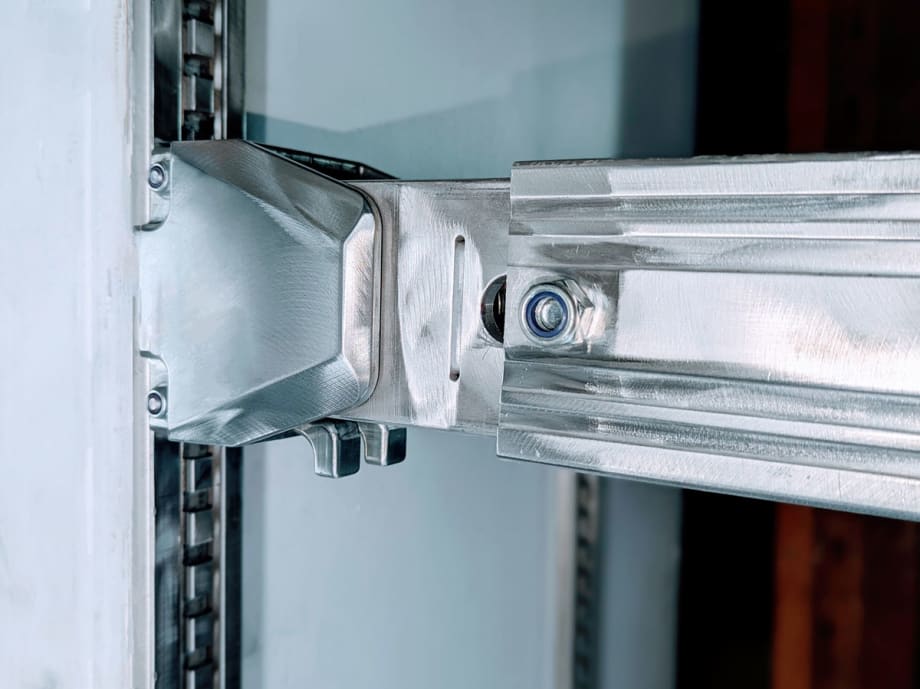
Unlike other captive systems that require users to walk to both sides of the beam and use a system-specific tool to release and adjust it, the Level Deck can be released and adjusted by hand from one side or the other.
Photo: Doleco
3 min to read
Carriers that use decking beams to extend trailer capacity know they are effective, but they can be awkward and time-consuming to manage. A new decking beam product from a new entrant to the load-securing technologies market, Doleco USA, could revolutionize cargo handling.
The Level Deck Self-Leveling Decking Beam was shown to industry for the first time during a press conference at the American Trucking Associations’ Technology & Maintenance Council annual meeting in Orlando, Florida.
Level Deck doubles efficiency by reducing operator step count by more than half, according to the company. Unlike other captive systems that require users to walk to both sides of the beam and use a system-specific tool to release and adjust it, the Level Deck can be released and adjusted by hand from one side or the other. No special tool is needed, and the beam can be released with a common dock hook or fifth wheel puller. Once released, the Level Deck beam can be moved freely, asymmetrically and easily up and down its tracks by hand. Once one side is at the desired set height, the opposite side can be slid up or down and automatically self-levels, locking itself into horizontal position.
The Level Deck Self-Leveling Decking Beam was developed by Steve Downing, a Lean Six Sigma Black Belt, during his time working with Con-way Freight. Downing statistically demonstrated the advantages of captive decking systems over no decking, load decks and loose E-beams, but following full adoption of captive beam systems throughout the company’s LTL operations, Downing uncovered a number of shortcomings in legacy captive decking technology and set out to resolve them.
“Previous decking beam systems required two operators on either end of the beam, to unlock, level and reset the bean prior to fixing it in place for the next use,” Downing told reporters. “Thanks to our patented locking and unlocking mechanism, setting and leveling of the decking beams is a one-person operation.”
When the beam is stowed near the ceiling, the operator can release one end of the beam with a standard dock-plate hook or a fifth-wheel release hook. With the locks on both sides disengaged, the fist end of the beam slides down as the other end unlocks and begins to descend. The beam is now essentially free to slide up and down in the track. When a set point is determined, that side is locked in, and the other side is raised or lowered to match. It will not lock into place until the beam is level.
One of the secrets to Level Deck’s fluid operation is that each of its foot assemblies is equipped with a spring-assist mechanism that essentially counterbalances the beam’s weight. As either side of the beam is pulled down, its spring is loaded, making upward movement nearly effortless –– so effortless, in fact, that if released with just the slightest upward pressure, the beam will automatically travel to its ceiling height storage position.
Level Deck system is also able to withstand all but the most severe forklift encounters. Its robust, die-cast nickel aluminum foot assembly minimizes damage from forklift strikes, and its locking mechanism is designed to prevent upward adjustments by forklifts, which are universally discouraged by all captive system manufacturers. The same locking feature prevents inadvertent beam travel, which can occur with some captive systems when loads bounce as vehicles encounter uneven terrain.
The Level Deck foot assembly is also several orders of magnitude quieter than other captive systems because the loud ratcheting sound has been eliminated. The assembly achieves its quiet, virtually wear-free operation by using direct contact rolling on Doleco’s LayerLok XP machined aluminum track, designed with beveled teeth instead of holes or slots.
“With its spring-assisted ergonomic adjustment efficiencies, self-leveling feature, quiet operation and forklift-resistant construction, Doleco’s Level Deck is truly a game-changing captive system,” said Ralph Abato, president and managing director of Doleco USA.
More Equipment

How Volvo Updated Its D13 for EPA 2027 [Watch]
Volvo’s updated D13 promises lower emissions without sacrificing performance or fuel economy. Take a closer look at what changed inside the engine in this HDT Spotlight video.
Read More →
Michelin Tire Improves Efficiency and Durability for Regional Fleets
The Michelin X Multi Energy D2 is a regional haul drive tire engineered to help fleets improve fuel efficiency, durability and traction in demanding stop-and-go operations.
Read More →
ZF Expands Commercial Vehicle Push in North America
ZF is expanding its North American commercial-vehicle presence with new transmission applications, electrification, trailer technology and autonomous-driving systems.
Read More →
Tesla Wants a Self-Driving Semi. Are Cameras Enough?
Could Tesla’s camera-only autonomous driving technology work on an 80,000-pound Semi? In this commentary, HDT's Deborah Lockridge takes a look at Tesla, Cybercab, and how autonomous trucks see the road.
Read More →
Kodiak: Driverless Long-Haul Truck Launch on Track for 2026
Kodiak AI says its driverless long-haul safety case is 93% complete and it remains on track to begin commercial operations by year-end 2026.
Read More →
What DOT’s Automated Vehicle Strategy Means for Trucking
The U.S. Department of Transportation issued a new automated-vehicle strategy that outlines plans for driverless-truck regulations, cross-state freight corridors, and federal safety standards.
Read More →
East Coast Port Launches $45M Electric Truck Push
The Port Authority of New York and New Jersey announced millions in incentives for zero-emission drayage trucks, yard tractors, and new charging hubs near the port.
Read More →
PlusAI Going Public to Fund Autonomous Truck Launch
A SPAC deal could provide PlusAI with up to $300 million as it works toward a 2027 commercial launch of factory-built autonomous trucks.
Read More →
NHTSA Moves to Rewrite Truck Fuel-Economy Rules
The National Highway Traffic Safety Administration says it lacks authority to regulate medium- and heavy-duty truck engines separately from complete vehicles, but the existing standards have not yet been eliminated.
Read More →
Detroit Opens Orders for EPA 2027 Engines
Detroit isn’t starting from scratch to meet EPA 2027 diesel emissions standards. Its Gen 6 DD13 and DD15 engines keep much of today’s platform while updating the fuel and aftertreatment systems.
Read More →