





You also might like Battery-Electric Trucks: Maintenance 101
Cummins Buying Meritor to Accelerate Electrification Development
Cummins is buying Meritor in a deal that will give the company a broad reach in traditional powertrains and components as well as accelerating its development of battery-electric and fuel-cell-electric propulsion systems.
February 22, 2022
Cummins said buying Meritor will help develop economically viable zero-carbon solutions for commercial vehicle applications.
Photo: Cummins
3 min to read
Cummins is buying Meritor in a deal that will give the company a broad reach in traditional powertrains and components as well as accelerating its development of battery-electric and fuel-cell-electric propulsion systems.
The $3.7 billion deal was announced Feb. 22. Cummins officials said the acquisition will position the company as one of the few able to provide integrated powertrain solutions across both internal-combustion and electric power applications.
Citing the two company’s “complementary strengths,” Tom Linebarger, Cummins chairman and CEO, said in a news release that the deal “will help us address one of the most critical technology challenges of our age: developing economically viable zero-carbon solutions for commercial and industrial applications.
“Climate change is the existential crisis of our time, and this acquisition accelerates our ability to address it," he continued. "Our customers need economically viable decarbonized solutions…. our communities and our planet depend on companies like Cummins to invest in and develop these solutions.”
Cummins believes e-axles will be a critical integration point in hybrid and electric drivetrains, and Meritor already has e-axles commercially available.
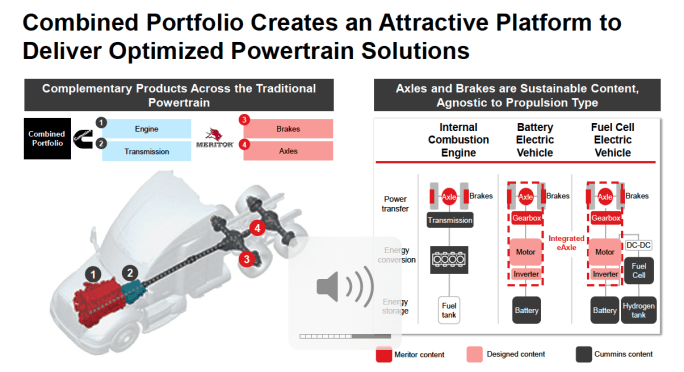
Cummins' acquisition of Meritor will position the company as one of the few able to provide integrated powertrain solutions across both combustion and electric power applications.
Photo: Cummins presentation
By accelerating Meritor’s investment in electrification and integrating development within Cummins' New Power business, Linebarger said, “we think we can be at the table for virtually every negotiation for who can supply what in the commercial/industrial sector. We want to be able to provide both systems and components” in the fast-moving electrification sector.
The deal also will “provide customers with more certainty they’ll have a viable product for years and years to come,” he added.
“Meritor has transitioned from a traditional drivetrain manufacturing company into an electric drivetrain company, and this is the next transition in our journey,” said Chris Villavarayan, CEO and president of Meritor, in a conference call for investors and analysts.
'Powertrain-Agnostic Components'
On the traditional powertrain side, Linebarger explained that Meritor’s core axle and brake business brings powertrain-agnostic components to Cummins, and it expects to use its global reach to raise growth rates in these businesses.
Meritor’s traditional axle and brake business fits well into Cummins’ component busines, Linebarger said, and it can grow that business on a global scale. “Cummins is in some places Meritor isn’t, in bigger ways. By bringing Meritor into places we are, we can develop their core business — and our components business becomes more powertrain-agnostic over time, providing a more sustainable source of revenue and profit.”
The acquisition announcement follows close on the heels of announcements of Cummins’ purchase of Jacobs Vehicle Systems, which will help it meet more stringent upcoming emissions standards, and of its approach to develop multiple lower-carbon alternative fuel versions of its internal combustion engines as an intermediary step on the path to zero emissions.
While Cummins will be investing in growing the electrification, at the same time, the companies have identified cost synergies, and by the end of the third year predict positive pre-tax synergies of $130 million. The transaction, which is subject to customary closing conditions, regulatory approvals, and shareholder approval, is expected to close by the end of the year.
We have reached out to Eaton and Cummins to find out if this deal will have any effect on the Eaton-Cummins joint venture in automated transmissions. Eaton on Feb. 22 announced its Vehicle Group has formed a new ePowertrain business unit.
More Equipment

How Volvo Updated Its D13 for EPA 2027 [Watch]
Volvo’s updated D13 promises lower emissions without sacrificing performance or fuel economy. Take a closer look at what changed inside the engine in this HDT Spotlight video.
Read More →
Michelin Tire Improves Efficiency and Durability for Regional Fleets
The Michelin X Multi Energy D2 is a regional haul drive tire engineered to help fleets improve fuel efficiency, durability and traction in demanding stop-and-go operations.
Read More →
ZF Expands Commercial Vehicle Push in North America
ZF is expanding its North American commercial-vehicle presence with new transmission applications, electrification, trailer technology and autonomous-driving systems.
Read More →
Tesla Wants a Self-Driving Semi. Are Cameras Enough?
Could Tesla’s camera-only autonomous driving technology work on an 80,000-pound Semi? In this commentary, HDT's Deborah Lockridge takes a look at Tesla, Cybercab, and how autonomous trucks see the road.
Read More →
Kodiak: Driverless Long-Haul Truck Launch on Track for 2026
Kodiak AI says its driverless long-haul safety case is 93% complete and it remains on track to begin commercial operations by year-end 2026.
Read More →
What DOT’s Automated Vehicle Strategy Means for Trucking
The U.S. Department of Transportation issued a new automated-vehicle strategy that outlines plans for driverless-truck regulations, cross-state freight corridors, and federal safety standards.
Read More →
East Coast Port Launches $45M Electric Truck Push
The Port Authority of New York and New Jersey announced millions in incentives for zero-emission drayage trucks, yard tractors, and new charging hubs near the port.
Read More →
PlusAI Going Public to Fund Autonomous Truck Launch
A SPAC deal could provide PlusAI with up to $300 million as it works toward a 2027 commercial launch of factory-built autonomous trucks.
Read More →
NHTSA Moves to Rewrite Truck Fuel-Economy Rules
The National Highway Traffic Safety Administration says it lacks authority to regulate medium- and heavy-duty truck engines separately from complete vehicles, but the existing standards have not yet been eliminated.
Read More →
Detroit Opens Orders for EPA 2027 Engines
Detroit isn’t starting from scratch to meet EPA 2027 diesel emissions standards. Its Gen 6 DD13 and DD15 engines keep much of today’s platform while updating the fuel and aftertreatment systems.
Read More →