





New Tactics in the Fight Against Nuclear Verdicts in Trucking
Driver Shortage Tops ATRI Top 10 Concerns Survey
To no one’s surprise, the driver shortage topped the trucking industry list of top concerns this year — but another issue broke into the top 10 list for the first time.
October 24, 2021

Companies such as U.S. Xpress are exploring new ways to attract and retain drivers as it remains the top industry concern.
Photo: U.S. Xpress
9 min to read
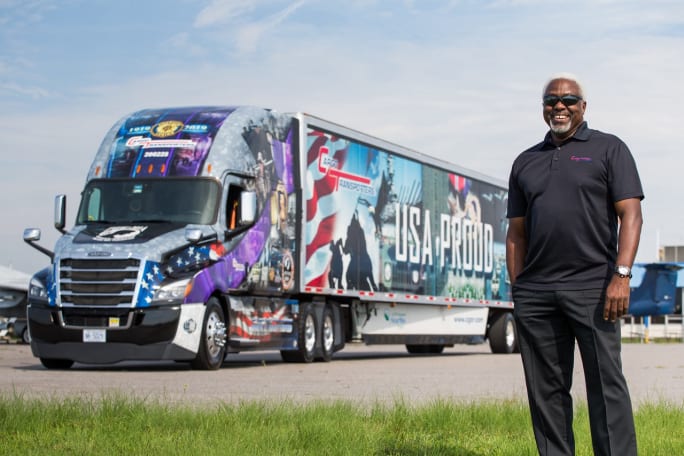
Attracting and retaining quality drivers remain the top industry concerns.
Photo: Trucking Moves America Forward
To no one’s surprise, the driver shortage and driver retention topped the trucking industry list of top concerns this year — but the diesel technician shortage broke into the top 10 list for the first time.
The American Transportation Research Institute announced the results of its 17th annual Top Industry Issues report during the American Trucking Association’s Management Conference and Exhibition in Nashville, Tennessee, Oct. 24.
For the fifth year in a row, the driver shortage topped the list of industry concerns, with more than four times as many first-place votes as the number two issue, driver retention, said Rebecca Brewster, ATRI president and COO.
The diesel technician shortage has shown up in the survey as what ATRI calls an “emerging issue,” those in the 11th, 12th, or 13th spot, for the first time in 2017.
While the driver shortage is very visible, “it’s probably just as frustrating, if not more so, to have a driver who can’t drive because the equipment is down,” said Hugh Eckberg, president and CEO of CRST International, during a panel discussion of the top issues.
More than 2,500 trucking industry stakeholders participated in this year’s survey, including motor carriers, drivers, and other “stakeholders” such as industry suppliers and law enforcement. "This year's large response shoows just how serious our industry is about identifying the most critical concerns and more importantly, figuring out how we collectively deal with each issue." To that end, the survey also asks respondents to evaluate possible strategies for each issue.
Nearly 25% of survey respondents were professional truck drivers, and for them, driver compensation and truck parking tied for the number one concern.
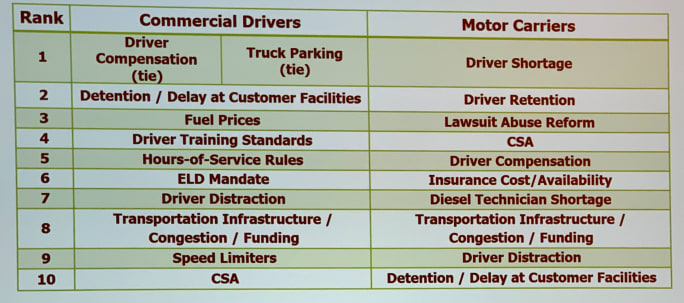
The top concerns of motor carriers and drivers were different, yet related.
Photo: Deborah Lockridge
1. Driver Shortage
According to ATA, the nation’s current shortage of 60,000 drivers could grow to over 160,000 by 2028, ATRI noted in its report. Myriad pressures are contributing to the shortage, including growing freight demand, an aging workforce, drivers who left the industry due to pandemic-related health concerns, new-entrant training and licensing backlogs from pandemic shutdowns, and drivers who are leaving the industry rather than go through the return-to-duty process after positive drug tests.
Survey respondents believe the best strategy for addressing this is bringing younger drivers into the industry. A major recruitment challenge is the federal requirement to be 21 years old before obtaining a commercial driver’s license to operate over state lines. The DRIVE Safe Act, first introduced in Congress in 2018 and re-introduced in 2021, would provide an avenue for 18- to 20-year old drivers to obtain CDLs.
ATRI is in development of a younger driver assessment tool to help the industry identify who has the best potential to be a safe professional driver. Beta results are promising, but the organization needs to bring in more drivers to this research, especially younger ones who are already driving intrastate.
“Because we can’t talk to high school students about a highway career, they leave high school and become an electrician or a carpenter,” said CRST's Eckberg. It’s difficult too attract them to the industry to become a driver three to four years later after they are already established in a career.
2. Driver Retention
Keeping drivers rose four positions in the survey to become the second most critical issue overall this year. According to ATA, driver turnover at large truckload fleets was 92% at the end of 2020.
A slight majority of respondents, 58%, believes that research is needed to quantify and disseminate the most successful retention strategies. Beyond increasing pay and benefits, many fleets are now relying on driver feedback to improve retention.
The panelists spoke about the importance of other issues in driver retention beyond pay.
Bill Hambrick, a professional driver for Werner Enterprises and a member of ATA’s America’s Road Team, said he could describe driver retention strategies in three areas: Consistency, transparency, and communication.
As Eckberg pointed out, “the things that make people leave or stay is about their relationships with the people they work with…. it’s about respect, about communication, about how we make drivers more successful, the fleet’s looking out for them and taking care of them.”
Hayden Cardiff, CEO and founder of Idelic, pointed out that the vast amount of turnover happens in 90 days. “It all comes down to communications and respect. If you can understand expectations set during recruiting, communicate those to operations teams onboarding that driver, and onboarding more than just a few days of orientation, more than a few weeks of training but into six, eight months of consistent engagement, you can start to create some of those relationships.”
3. Driver Compensation
For the third year in a row, driver pay is a top-10 issue in the survey. And one in three drivers said it was their number one concern, leading it to tie with truck parking for the top issue among drivers.
Many drivers believe pay is the reason for the driver shortage. Driver Hambrick pointed out that pay does not exist in a vacuum.
For one thing, there’s a difference between simply the per-mile rate and what a driver actually earns, and often much of that is out of a driver’s hands. “Many of our delays are the result of unachievable expectations,” he said, such as congestion and overly long detention at shippers and receivers. “Due to the dysfunctional system at all levels, it’s a driver’s main concern: Is this stress worth that dollar we’re trying to make?”
ATRI will have an expanded analysis of driver compensation in its annual operational costs of trucking study due out next month.
4. Lawsuit Abuse Reform
“The artist formerly known as tort reform,” quipped Brewster.
Last year was the first year this had appeared on the top 10 since 2011, and it moved up three spots this year. A 2020 ATRI nuclear verdicts study found a 967% increase in average verdict size from 2010 to 2018. Recently a jury in Florida handed down a $1 billion verdict against two trucking companies, she noted.
Eckberg said it might not be the number one concern, but “this one is the number one source of frustration and aggravation for me to deal with, because it doesn’t make sense. We all know cases where a vehicle crossed the centerline and hits our truck and the truck is held at fault.”
ATRI is now doing a study of smaller verdicts — not nuclear, but still a problem.
5. Truck Parking
“This is no stranger to the list,” Brewster said, being the 10th year that the lack of available truck parking made the list — and it tied for the top concern among drivers. “We’re forcing our professional drivers to have to sleep on the side of the road.”
One of the strategies ATRI proposed to deal with it is the creation of a new dedicated federal funding program to increase truck parking capacity at freight-critical locations. More than 38% of respondents believe that federal funding for truck parking is the best solution. However, the recent removal of a proposed $1 billion truck parking grant program from the House infrastructure bill makes this less likely.
6. CSA
The Federal Motor Carrier Safety Administration’s Compliance, Safety, Accountability program, which first went into effect in 2010 with the goal of helping the agency identify carriers to target in enforcement, has plagued the industry with inaccuracies and what are seen as unfair ways of assessing fleets.
By 2012 CSA was the top concern in the survey. Improvements have been made since then, and by 2019 it was down to eight. Last year it jumped up to four.
Eckberg said one of the frustrations his safety team has with CSA “is the way the program works, interaction with the drivers is more punitive and adversarial than it is helpful.” Although the agency did roll out a way to challenge non-preventable crashes, he said, it’s still difficult to be successful in those requests. In addition, he said, if a carrier makes an acquisition, because there’s an 18-month lifetime on the data included in the score, it doesn’t accurately reflect a growing fleet, he said.
7. Detention/Delay at Customer Facilities
This issue was up two spots from last year. Bill Hambrick, a professional driver for Werner Enterprises and a member of ATA’s America’s Road Team, pointed out that this problem plays into the driver retention issue. In fact, this was the number-two issue among the drivers who responded to the survey.
Not only does it reduce productivity for both the carrier and the driver, he said, “The driver is also experiencing a lack of amenities” while waiting. “Not to mention the complete disruption of our hours of service. What it does to the driver is it creates less pay and more stress.”
CRST’s Eckberg said carriers have had no choice but to increase detention charges to customers, not only to try to recoup some lost productivity, but also to try to encourage shippers and receivers to address the problems.
8. Transportation Infrastructure/Congestion/Funding
“This make me sad but happy,” Brewster said. Sad because the industry is again dealing with a congestion issue that was lessened during pandemic lockdowns last year, but happy because the issue truly needs the attention.
She pointed to this year’s closure of the I-40 bridge over the Mississippi between Tennessee and Arkansas after a large fissure was discovered during a routine inspection. An ATRI analysis of truck GPS data found this bridge closure and resulting detour (which also meant more congestion at the alternative bridge crossing) increased average transit times from eight minutes to 84, costing the industry $2.4 million every day it was closed.
9. Insurance Cost/Availability
Although insurance costs was in the top 10 in ATRI’s inaugural survey in 2005, after that it didn’t crack the overall top 10 until last year, when it was number five, Brewster said — although it had been on the list of just carriers surveyed. “It’s now down to nine, and I don’t think that’s because costs are going down but speaks to the pressing ranking of other issues,” she said.
She also noted that ATRI is wrapping up an analysis of the impact of rising insurance costs that will be available early next year.
CRST’s Eckberg expressed frustration that even as fleets improve their safety performance and invest in advanced safety technologies, insurance costs keep going up.
10. Diesel Technician Shortage
The U.S. Bureau of Labor Statistics estimates that there will be more than 28,000 openings for diesel service technicians and mechanics for each of the next 10 years. Median pay for diesel technicians in 2020 was just over 50,000, reported ATRI.
Hayden Cardiff, CEO and founder of Idelic, pointed out during the panel that while there is a lot of discussion of the need to bring younger drivers into the industry before they get started in another career, the same is true for technicians. “When you get people out of high school who get into a different career path, it’s hard to get them back into trucking.”
More Fleet Management

Sponsored•September 14, 2026
2026 Blueprint for Countering Smarter Supply Chain Theft
Cargo theft is no longer just the cost of doing business. It's a multi-billion-dollar criminal enterprise exploiting vulnerabilities across your fleet, drivers, and supply chain.
Read More →
Sponsored•September 1, 2026
How Telematics Improves Visibility, Control, and Performance in Refrigerated Fleets
Explore how telematics help refrigerated fleets improve visibility, uptime, efficiency, compliance, and cargo protection across connected cold chain operations.
Read More →
What the U.S.-Canada Trade War Means for Trucking
Escalating U.S.-Canada tariffs could disrupt cross-border freight, reduce truck volumes, raise costs, and create new uncertainty for carriers on both sides of the border.
Read More →

What Are Trucking’s Top Concerns for 2026?
The American Transportation Research Institute wants to know what's worrying trucking fleet managers, drivers, and other stakeholders in its annual Industry Issues survey.
Read More →
American Trucking Associations Looks for a New Leader
ATA President and CEO Chris Spear abruptly left his job at the association on August 21, at a pivotal time for the trucking industry.
Read More →
Public Wi-Fi Cybersecurity Risks: How Truck Drivers and Fleets Can Protect Their Data
Public Wi-Fi can expose truck drivers and fleets to credential theft, malware, and other cyber threats. Here’s how to reduce the risk on the road.
Read More →
For Nicky Cupp, Fleet Innovation Starts With Frustration
HDT Truck Fleet Innovator Nicky Cupp turns everyday pain points at Fraley & Schilling into opportunities for better technology and smarter processes.
Read More →
Adam Buttgenbach’s Approach to Electric Trucks: Start With Where They Fit
HDT Truck Fleet Innovator Adam Buttgenbach helped PepsiCo build one of North America’s largest EV fleets by focusing on where electric trucks make operational sense.
Read More →
Deen Albert: Let Automation Do the Math, People Make the Decisions
HDT Truck Fleet Innovator Deen Albert makes sure people are still at the heart of operations at Grand Island Express, even while adopting artificial intelligence tools. AI-assisted dispatch helped boost revenue 25% with the same number of trucks.
Read More →
Trimble’s New AI Agent Takes Aim at Fleet Back-Office Busywork
Arc Agent works across Trimble TMS products to automate repetitive tasks such as freight orders, maintenance, invoices, fuel costs and more.
Read More →