




Truck Drivers, Techs Most Satisfied at Smaller Fleets
WorkHound’s mid-year report of driver feedback revealed that drivers, technicians and office workers at trucking companies prefer smaller companies where workers are accustomed to more frequent and personal communication.

WorkHound’s mid-year report of driver feedback revealed that drivers, technicians and office workers at trucking companies prefer smaller companies.
File Photo: Lytx
Drivers, technicians and office workers in the trucking industry are more likely to be satisfied at small- or medium-sized companies, according to WorkHound’s mid-year report.
WorkHound’s mid-year report results, presented during a Truckload Carriers Association webinar on Aug. 31, outlines the trends in driver feedback so far in 2021. The feedback were gathered weekly through anonymous submissions from over 10,000 drivers, technicians and office staff from 77 trucking companies.
The report revealed that drivers tend to prefer smaller companies (under 500 workers), where drivers, techs and office workers reported more positive comments, more praise, and reported a higher satisfaction with their career
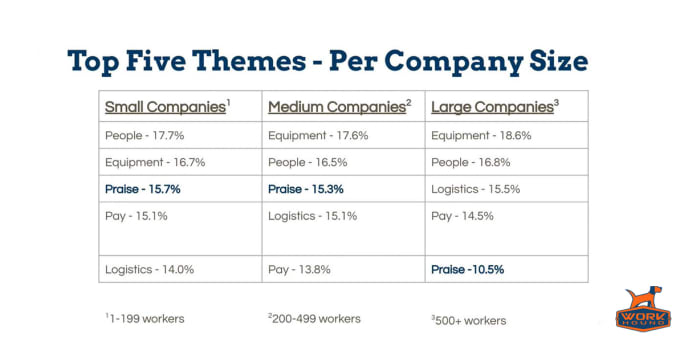
Praise was one of the top themes recorded in feedback by small, medium and large companies.
Graphic: WorkHound
Praise was one of the top themes recorded in feedback by small, medium and large companies. However, workers at large companies are less likely to share feedback that includes praise for their company and coworkers. Small companies received 50% more praise than large companies.
“Praise is a culture indicator,” said Max Farrell, CEO and co-founder of WorkHound, during the TCA webinar. “The substantial lack of praise at large companies is possibly a symptom of communication.”
At small companies, workers are accustomed to more frequent and personal communication, which suggests that workers at companies of all sizes may benefit from being contacted more frequently, Farrell said.
“When you’re trying to scale an operation, oftentimes what would be consider the ‘personal touch’ — the ability of people reaching out to other people — I think that gets diminished as you attempt to scale up,” explained Kim Daigel, vice president of human resources at P&S Logistics. “Oftentimes, [scaling up] means automating things, and creating systems in order to solve problems, instead of having that people aspect of solving problems. I think the people side of larger business gets lost beneath all that automation.”
How Can Large Fleets Maintain a “Small Village” Culture?
At P&S Logistics, Daigel says as they’ve grown into a large company they’ve been trying to maintain aspects of the culture that made them successful as a smaller business.
To do so, Daigel says P&S Logistics empowers driver managers to solve driver problems and make decisions, as well as aims to keep the number of drivers per driver manager lower.
“In some larger companies they get into a rut of not thinking of the driver, but thinking of the truck,” explains Daigle. “They almost make the person into a piece of equipment. I think that they do that so they can put more drivers with fewer office folks. It’s a point of growth difficulty, in that you have to keep adding more people as you’re adding more drivers. But by trying to solve that by increasing the number of drivers you have on a driver manager, is really where you end up losing that personal touch.”
More Drivers

Truck Drivers Need More Than Another Alert
Fleets have more visibility into truck health, safety events, and driver activity than ever. The next challenge is turning all that information into useful guidance for the person who has to decide what to do next.
Read More →
FMCSA Removes 110 Truck Driver Training Schools from Certified ELDT List
Federal regulators also are targeting more than 160 additional training providers and launching a nationwide audit of third-party CDL skills testers as part of a broader crackdown on trucking fraud.
Read More →
Hours of Service Pilot Programs: FMCSA Readies for 2027 Rollout
Two pilot programs could eventually reshape hours-of-service rules, giving truck drivers options to pause their 14-hour clock or use longer split sleeper rest periods.
Read More →
Medical Cards, English Proficiency Reshape Roadcheck Violations
Medical-card violations jumped to the top of the driver out-of-service list during CVSA’s 2026 International Roadcheck, while English-language proficiency violations appeared among the leading violations for the first time.
Read More →
Driver Trust Can Make or Break the Success of Fleet Safety Technology
New Teletrac Navman research suggests that onboarding, transparency about driver data, and positive feedback can play a significant role in how commercial drivers respond to safety and coaching technology.
Read More →
EEOC Sues KLLM Over Alleged Sex Discrimination in Driver Training
KLLM is facing a federal sex-discrimination lawsuit over policies the EEOC alleges put female truck driver trainees at a disadvantage.
Read More →
FMCSA Moves to Codify English Language Requirements for Commercial Drivers
By changing regulations on English-language proficiency requirements for commercial drivers, rather than relying on a guidance memo, the FMCSA said future administrations won't be able to walk back the Trump administration's stricter enforcement with just a memo.
Read More →
Drivers Put Western Star Trucks to the Test at Star Nation Experience
Watch to get an inside look at the Western Star trucks, technology, and community behind the Star Nation Experience 2026!
Read More →
Trump Administration Looks to Put More Veterans Behind the Wheel
The Freedom Haulers program pulls together existing and expanded programs at several federal agencies to recruit veterans to drive commercial heavy-duty trucks and cut the red tape for them to get a CDL, training, and employment.
Read More →
Putting Mack’s Command Steer to the Test
A test drive of Mack’s Command Steer active steering system evaluates how it can make truck driving easier and less tiring.
Read More →