




Global News Roundup: Hydrogen Fuel Cell Truck Development
ICYMI: A roundup of trucking industry news from European Fuel Cells and Hydrogen Joint Undertaking, Isuzu, Hino, and Toyota, Scania, Hyzon, Daimler, Plus and more.

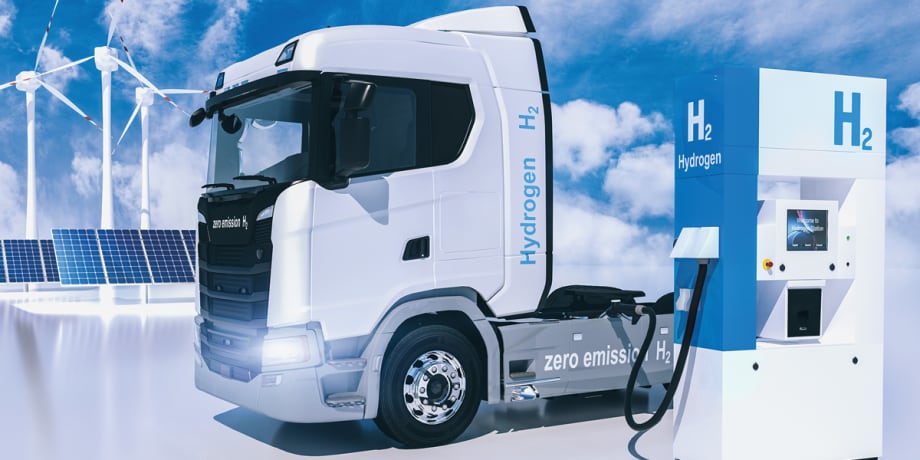
Because a total “ecosystem” is needed for the widespread adoption of fuel-cell-powered heavy trucks, companies are working together to accelerate the needed technologies.
Photo: Gettyimages.com/audioundwerbung
Companies around the globe are forming consortiums and other group projects to help advance fuel-cell technology for heavy-duty applications.
In the European Union, the European Fuel Cells and Hydrogen Joint Undertaking (FCH 2 JU) is funding two consortium projects.
The StasHH consortium of 25 organizations in the hydrogen sector will define, develop and test the first European standard for fuel cell modules for heavy-duty applications. It is made up of 11 fuel cell module suppliers, nine original equipment manufacturers, and five research, test, engineering and/or knowledge institutes.
They plan to work together to standardize physical dimensions, flow and digital interfaces, test protocols and safety requirements of fuel cell modules that can be stacked and integrated into heavy-duty applications such as buses, trucks, trains, ships, and construction equipment.
Another consortium funded under FCH 2 JU is called Immortal. The three-year project will develop new materials for fuel cell components specific to heavy-duty truck applications. The goal is to develop higher-performance fuel cell components for heavy-duty trucks with a predicted lifetime of at least 30,000 hours.
The four large industrial partners are major stakeholders in Europe’s fuel cell supply, OEM and end user chain, including makers of the membrane electrode assembly (MEA, the core component of a fuel cell that helps produce the electrochemical reaction needed to separate electrons), fuel-cell stack and system makers, and use of the fuel cell powertrains in heavy-duty long-haul trucks.
Hydrogen fuel cell and vehicle maker Hyzon Motors has founded the Hyzon Zero Carbon Alliance, which aims “to create hydrogen ecosystems in parallel with vehicle deployments” globally. By aligning the supply and demand side of the sector, the alliance is designed to overcome some of the biggest hurdles faced by the hydrogen industry to date, making zero-emission fleet operations a reality in the very near term.
To be established as a nonprofit membership-based entity, the Alliance will specifically identify and target opportunities across priority regions worldwide based on customer demand. Hyzon, headquartered in Rochester, New York, has operations in Europe, Singapore, Australia and China.
In Japan, a group of companies established the Japan Hydrogen Association (JH2A), an association dedicated to the promotion of a global hydrogen-based eco-system. Among the Japanese companies that have joined the organization as founding members are shipping companies, vehicle manufacturers, energy companies, a financial group, and others.
JH2A aims to promote collaboration in the development of new technologies and standards for hydrogen, establish a strong supply-chain and lobby for favorable government policies.
New Briefs from Around the World
In Japan, Isuzu Motors, Hino Motors, and Toyota Motor Corp. have agreed on a new partnership in commercial vehicles to work on Toyota’s CASE technologies: connected vehicles, autonomous/automated driving, shared, and electric. They plan to jointly work on the development of battery electric vehicles and fuel cell electric vehicles, autonomous driving technologies, and electronic platforms for small commercial trucks.
Swedish truck maker Scania (part of Traton) will start building heavy commercial vehicles in China in early 2022 after the recent acquisition of Chinese truck maker Nantong Gaokai Auto Manufacturing. This may be the first time a foreign truck OEM has acquired more than 50% of a Chinese truck builder, following the announcement of reforms to China’s foreign ownership restrictions.
Fuel cell truck manufacturing startup Hyzon Motors of Rochester, New York, has been selected by green hydrogen generator Hiringa Energy of New Zealand to supply hydrogen fuel cell-powered trucks. To be assembled at Hyzon’s European facility in The Netherlands, the first trucks are expected to enter service in New Zealand by the end of 2021.
Daimler Trucks North America named Marcela Barreiro president and CEO of Daimler Trucks Mexico. Barreiro is a 13-year veteran of Daimler Trucks Mexico, most recently as head of human resources. She is the first woman to run Daimler Trucks Mexico and is a strong proponent of diversity, equity and inclusion.
Autonomous-tech developer Plus is partnering with Italian truck-maker Iveco to jointly develop autonomous trucks that will be deployed across Europe, China, and other areas.
DHL Express plans to have more than 14,000 electric vans in operation in Europe by 2030. It recently purchased the first 100 units of Fiat’s new E-Ducato electric van.
SKF is testing a self-driving electric truck with the tech company Einride to transport goods on a public road between the factory and the warehouse in Gothenburg, Sweden.
More Fuel Smarts

How Volvo Updated Its D13 for EPA 2027 [Watch]
Volvo’s updated D13 promises lower emissions without sacrificing performance or fuel economy. Take a closer look at what changed inside the engine in this HDT Spotlight video.
Read More →
Diesel Price Spike Shortens Payback for Natural Gas Trucks, Report Says
Energy Vision estimates fleets could recover the higher purchase price of an RNG-fueled Class 8 tractor in 1.3 to 2.8 years under current fuel-price scenarios.
Read More →
Calstart Becomes Catalyst Mobility, Reflecting Broader Focus
Calstart is now Catalyst Mobility, reflecting the nonprofit’s growing national role in clean transportation, including zero-emission trucks, infrastructure and incentive programs.
Read More →

Record Diesel Prices Squeeze Trucking Fleets
Average U.S. diesel prices have climbed to nearly $6 a gallon, surpassing the 2022 record as tight refinery capacity and Middle East disruptions keep fuel costs elevated.
Read More →
How Fuel Delivery Shapes Engine Performance
Fuel delivery depends on more than what happens at the injector. For fleet, maintenance and technical professionals, looking at the full path from pump to injector can provide useful context for understanding engine performance.
Read More →
East Coast Port Launches $45M Electric Truck Push
The Port Authority of New York and New Jersey announced millions in incentives for zero-emission drayage trucks, yard tractors, and new charging hubs near the port.
Read More →
California Bill Could Shed Light on Electric Truck Prices
Why do battery-electric Class 8 trucks remain so expensive? A California bill headed to Gov. Gavin Newsom would give fleets and state agencies more visibility into what manufacturers charge.
Read More →
Detroit Opens Orders for EPA 2027 Engines
Detroit isn’t starting from scratch to meet EPA 2027 diesel emissions standards. Its Gen 6 DD13 and DD15 engines keep much of today’s platform while updating the fuel and aftertreatment systems.
Read More →
Zero-Emission Truck Corridor Planned for West Coast
California, Oregon, Washington, British Columbia and Baja California are coordinating plans for truck charging and hydrogen fueling from Canada to Mexico.
Read More →
A Closer Look at Kenworth’s Electric T880E Vocational Truck [Video]
Learn more about Kenworth's T880E battery-electric vocational truck at the Paccar Technical Center, including its range, applications, upfitting considerations, and PTO options, in this HDT Spotlight video.
Read More →