




COVID-19 Complaints Raise Risk for Fleet Managers
Management failures to act or adapt to the times during the COVID-19 pandemic have led to workplace litigation.

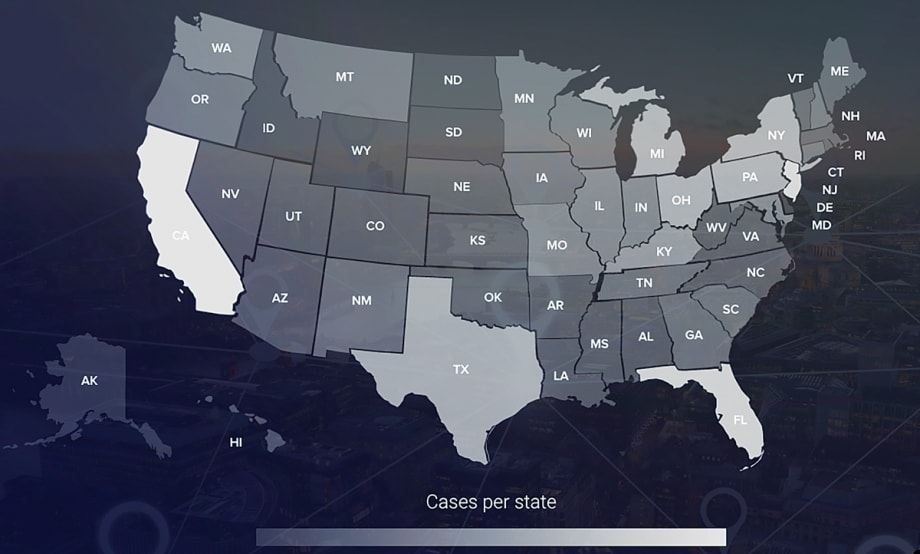
The number of coronavirus-related employment complaints filed across the country has already sailed well over 1,000.
Map: Barnes & Thornburg LLP
It’s been barely a year since the reality of the COVID-19 pandemic set in. Yet the number of coronavirus-related employment complaints filed across the country has already sailed well over 1,000. That means how the pandemic negatively affects trucking’s workers — especially drivers on the front lines of America’s response to the crisis — is becoming a risk factor for fleet managers.
Google the topic, and it will soon be abundantly clear that law firms are all over this issue, with some providing free informational resources on their websites.
One such could be labeled “Cautionary Tales,” as it goes into detail on how lawsuit after lawsuit came into being due to the pandemic, yes, but also in many cases due to management failures to act or adapt to the times.
Here are some compelling entries from the COVID-19 Related Workplace Litigation Tracker posted by Barnes & Thornburg LLP:
Watts v. Estes Express Lines Inc.
A dockworker alleged he requested permission not to report to work while coworkers remained contagious, and that he was ordered to return to work the next day. He then requested to only work an eight-hour shift to minimize the risk of contracting COVID-19 from first-shift employees. He claims that he was terminated for refusing to return to work to avoid exposure to an area that had been occupied by coworkers who had contracted COVID-19. He also alleges the company failed to properly clean the area, thereby intentionally exposing him to COVID-19.
Samuel v. JB Hunt Transport Inc.
A truck driver alleges he was terminated in violation of the New Jersey Conscientious Employee Protection Act (CEPA). The plaintiff alleges that, in conflict with a state-issued order, drivers were not being provided adequate PPE or wearing masks. He also claims that he was forced to work around other drivers who had symptoms of COVID-19. The plaintiff alleges that his “complaints about the health and safety of workers was ignored.” Later, the plaintiff was involved in a work-related accident, which he claims was not his fault but that his employer determined was “preventable.” A few days later, he was terminated allegedly “in retaliation for the complaints he made about health and safety issues in violation of the CEPA.”
Luna v. Penske Logistics LLC et al.
The plaintiff, on behalf of himself and a putative class of current and former non-exempt employees in California, sued his employer for various violations of the California Labor Code. In particular, the plaintiff alleges that non-exempt employees are not paid for time spent waiting in line to be screened for COVID-19 with temperature checks. Based on that and other allegations, the plaintiff claims the defendant failed to pay both minimum and overtime wages due, and thus failed to provide accurate wage statements. The plaintiff also alleges that after complaining about the company’s failure to take the appropriate precautionary measures and adhere to COVID-19 public safety guidance, he was terminated shortly after. The plaintiff alleges, on his own behalf, that he was wrongfully terminated in violation of public policy.
More Fleet Management

Color Match Smarter: Tools That Restore & Perform
For fleet managers and collision repair professionals keeping heavy-duty trucks on the road, getting the color right the first time isn't just about appearance — it's about efficiency, turnaround time, and bottom-line results. Discover how today's digital color tools are transforming the repair process from guesswork to precision.
Read More →
FMCSA Pauses Biennial-Update Enforcement Amid Motus Transition
Carriers whose updates were due on or after June 1 have more time, while FMCSA works to stabilize its new registration system and warns of phishing sites impersonating its new carrier registration system, Motus.
Read More →
2026 Blueprint for Countering Smarter Supply Chain Theft
Cargo theft is no longer just the cost of doing business. It's a multi-billion-dollar criminal enterprise exploiting vulnerabilities across your fleet, drivers, and supply chain.
Read More →


How Telematics Improves Visibility, Control, and Performance in Refrigerated Fleets
Explore how telematics help refrigerated fleets improve visibility, uptime, efficiency, compliance, and cargo protection across connected cold chain operations.
Read More →
What the U.S.-Canada Trade War Means for Trucking
Escalating U.S.-Canada tariffs could disrupt cross-border freight, reduce truck volumes, raise costs, and create new uncertainty for carriers on both sides of the border.
Read More →
What Are Trucking’s Top Concerns for 2026?
The American Transportation Research Institute wants to know what's worrying trucking fleet managers, drivers, and other stakeholders in its annual Industry Issues survey.
Read More →
American Trucking Associations Looks for a New Leader
ATA President and CEO Chris Spear abruptly left his job at the association on August 21, at a pivotal time for the trucking industry.
Read More →
Public Wi-Fi Cybersecurity Risks: How Truck Drivers and Fleets Can Protect Their Data
Public Wi-Fi can expose truck drivers and fleets to credential theft, malware, and other cyber threats. Here’s how to reduce the risk on the road.
Read More →
For Nicky Cupp, Fleet Innovation Starts With Frustration
HDT Truck Fleet Innovator Nicky Cupp turns everyday pain points at Fraley & Schilling into opportunities for better technology and smarter processes.
Read More →
Adam Buttgenbach’s Approach to Electric Trucks: Start With Where They Fit
HDT Truck Fleet Innovator Adam Buttgenbach helped PepsiCo build one of North America’s largest EV fleets by focusing on where electric trucks make operational sense.
Read More →