




Safety Advocates, Teamsters Challenge Hours of Service Changes
Less than two weeks before revised hours of service rules are set to take effect, they have been challenged in court by a coalition of safety advocacy groups that are often seen as anti-trucking, along with the Teamsters union.

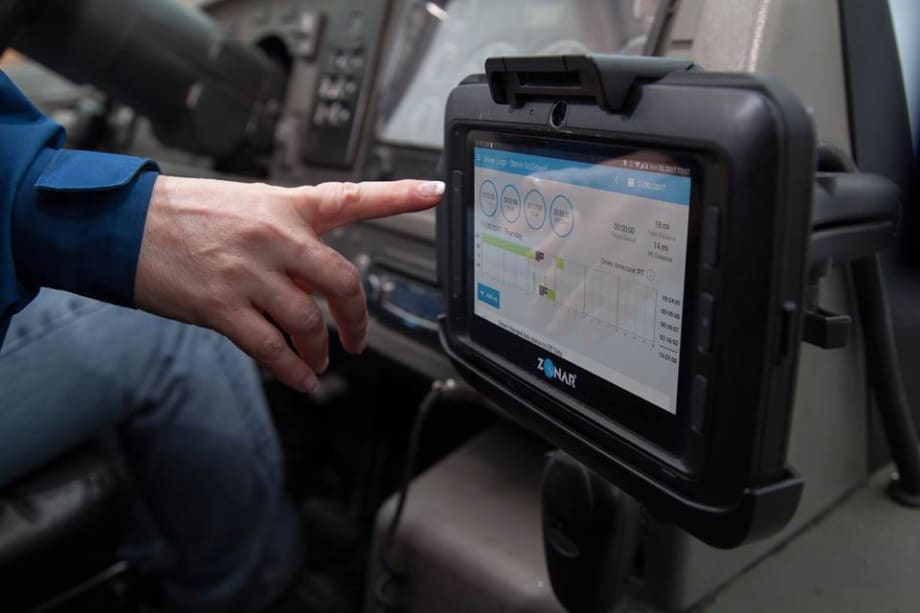
FMCSA says mandatory ELDs made more flexible hours-of-servie rules necessary. Critics don't buy it.
Photo: Zonar
Less than two weeks before revised hours of service rules are set to take effect, they have been challenged in court by a coalition of safety advocacy groups that frequently target trucking, along with the Teamsters union.
Advocates for Highway and Auto Safety, the International Brotherhood of Teamsters, Parents Against Tired Truckers, and Citizens for Reliable and Safe Highways filed a petition Sept. 16 with the U.S. Court of Appeals for the District of Columbia Circuit seeking to invalidate the rule. The parties are represented by Public Citizen Litigation Group.
The hours of service changes were announced in May and scheduled to go into effect Sept. 29. They were welcomed by many in trucking as a way to get more flexibility under the electronic logging device mandate.
However, according to a release, the groups charge that “the changes will further exacerbate the already well-known threat of fatigue among commercial motor vehicle drivers by significantly weakening current HOS rules. Specifically, provisions that ensured drivers receive a brief 30-minute break after being on duty for eight hours and that govern the operations of drivers who start and return to the same location and remain within a defined geographic area known as “short haul” operations were significantly altered. In proposing these revisions, the FMCSA contradicted its own prior conclusions on these very issues and failed to undertake a proper analysis of the impacts the rule will have on truck drivers and the motoring public.”
Teamsters General President James Hoffa said in a release, “By issuing this HOS regulation FMCSA has bowed to special trucking industry interests at the expense of highway safety, seeking longer workdays for drivers who are already being pushed to the limit.”
The final rule was published in the Federal Register on June 1. The safety groups filed a joint petition for reconsideration of the final rule with FMCSA on July 1, which FMCSA denied on Aug. 25, according to the legal filing.
Why Do These Groups Oppose the HOS Changes?
In the petition to the FMCSA for reconsideration, the safety groups said, “In eviscerating numerous critical provisions of the HOS rules, the agency repeatedly relies on the baseless claim that driver fatigue and the crashes it causes will not increase because the Final Rule does not permit additional driving time beyond the limits provided in the current Regulations… The revisions to the HOS regulations contained in the Final Rule are based on nothing more than unfounded claims, misinterpretations, and incorrect reinterpretation of research. In fact, a number of statements contained in the Final Rule and the NPRM directly contradict earlier agency findings.”
The groups take issue with the agency’s explanation in the rule that more flexibility was needed because electronic logging device mandate “highlighted the rigidity of HOS provisions and the practical ramifications drivers faced.”
The petition for reconsideration says, “the striking and candid acknowledgment by the FMCSA that the introduction of ELDs, which did not change the HOS rules, is the main impetus for this rulemaking raises significant safety concerns. The falsification of paper log books has been long identified as a serious problem. Thus, if the primary justification the agency can muster for further eviscerating the HOS rules is that CMV drivers now have to accurately record their driving time and can no longer falsify their logs, the Final Rule is fatally flawed and clearly in violation of the agency’s mission of protecting public safety. Of further concern is the fact that the FMCSA has exempted a large swath of the industry from having to use ELDs as part of this rulemaking.”
Here, they’re referring to the expansion of the short-haul exemption. This is one area where another trucking group, which is pro-ELDs and other safety mandates, also has concerns.
We asked the Alliance for Driver Safety and Security, known more commonly as the Trucking Alliance, for its reaction to this litigation. While it has not reviewed the litigation, it responded, “we have consistently opposed a portion of these rule changes, which allows drivers in short-haul carrier operations to expand their on-duty number of hours to the same limits as long-haul drivers, but yet these short haul drivers aren't required to install electronic logging devices in the trucks to verify compliance. FMCSA missed the safety mark on that one,” said Lane Kidd, managing director, in an email.
Under the new rules, short-haul carriers, which are not subject to the ELD mandate, will now be permitted to return to their normal work reporting location within 14 hours instead of the present limit of 12 hours, and the definition of short-haul operations has been extended from 100 air miles to 150 air miles.
The safety groups say the rule “dismisses a sound and thoughtful analysis conducted by the well-renowned and well-respected Insurance Institute for Highway Safety (IIHS) which identified that a sample of trucks actually using the short-haul exemption exhibited an increased crash risk of 383%.”
The change to the 30-minute break rules also drew criticism; these changes call for the break to be taken after eight hours of driving time, not on-duty time as with the current rule; and allow any non-driving status to qualify as a break. The petition for reconsideration said the rules “defy logic and suggest that the agency considers all on-duty work (including loading/unloading vehicles, stocking shelves, making deliveries) non-fatiguing. Under this objectionable and ill-advised change to the regulation, a driver could conduct on-duty non-driving work for 10 hours straight without any break and then get behind the wheel of an 80,000-pound CMV and drive for four hours (or more if “adverse driving conditions” were encountered).”
The petitioners also oppose the proposed changes to the split sleeper berth provision, which will allow drivers to split their required off-duty time into two periods. The shorter must be no longer than 3 hours and can be off-duty time, with the longer period being sleeper berth time.
“Lowering the minimum length of the anchor (longer) split sleeper berth period from eight to seven hours risks reduces the opportunity for drivers to obtain the rest necessary to combat fatigue,” says the petition. “In addition, the Final Rule fails to adequately address the concerns raised by drivers that these changes could allow carriers to demand or coerce drivers to maintain fatiguing schedules.”
What FMCSA Said
FMCSA told HDT it could not comment on litigation. However, HDT obtained a copy of the agency’s response to the petition for reconsideration.
“The agency has completed its review of the petition and compared the arguments you made with those submitted to the rulemaking docket in response to the August 22, 2019, Notice of Proposed Rulemaking. Your petition does not present any new data or information concerning the rulemaking, and we stand by the statements and analyses made in the preamble of the Final Rule.
“FMCSA acknowledges your concerns. However, the agency continues to believe that the changes adopted by the Final Rule will not result in adverse safety consequences. None of the revisions allows truck drivers additional driving time beyond the current regulations. Except for the adverse driving conditions provision, none of the revisions allows drivers to operate a commercial motor vehicle after the 14th hour after coming on duty. None of the revisions allows the use of multiple or intermittent off-duty breaks to extend the work-shift. Furthermore, none of the revisions relieves motor carriers and drivers of the explicit prohibitions against (1) operating commercial motor vehicles while ill or fatigued, or (2) coercing drivers to violate Federal safety rules. Therefore, the basic parameters of the HOS rule that are essential to safety remain unchanged.”
One source who did not wish to be identified told HDT that given the last-minute nature of this litigation and the need to show that the new rules would cause irreparable harm, it seems unlikely that an emergency stay would be ordered.
Sean McNally, spokesman for the American Trucking Associations, told HDT in an email, “This final rule was subject to nearly two years of discussion through public listening sessions and more than 8,000 public comments from carriers, drivers and other stakeholders. It does not change the fundamental hours of service rules—it simply provides needed flexibility within the existing rule set. None of the changes under this final rule will allow additional driving time beyond current regulations.
“The easiest thing to do in Washington is to say no. For those objecting to this rule, it should come as no surprise, as this is all they do.”
Updated 1 p.m. EDT 9/21/2020 to add ATA comment and clarify "safety groups."
More Safety & Compliance

From One Generation to the Next: How Mentorship Builds Safer Truck Drivers
After three decades in trucking, Harold Perry shares what he's learned about driver safety, mentorship, and helping the next generation build confidence behind the wheel.
Read More →
FMCSA Pauses Biennial-Update Enforcement Amid Motus Transition
Carriers whose updates were due on or after June 1 have more time, while FMCSA works to stabilize its new registration system and warns of phishing sites impersonating its new carrier registration system, Motus.
Read More →
ZF Expands Commercial Vehicle Push in North America
ZF is expanding its North American commercial-vehicle presence with new transmission applications, electrification, trailer technology and autonomous-driving systems.
Read More →
Truck Drivers Need More Than Another Alert
Fleets have more visibility into truck health, safety events, and driver activity than ever. The next challenge is turning all that information into useful guidance for the person who has to decide what to do next.
Read More →
Tesla Wants a Self-Driving Semi. Are Cameras Enough?
Could Tesla’s camera-only autonomous driving technology work on an 80,000-pound Semi? In this commentary, HDT's Deborah Lockridge takes a look at Tesla, Cybercab, and how autonomous trucks see the road.
Read More →
What DOT’s Automated Vehicle Strategy Means for Trucking
The U.S. Department of Transportation issued a new automated-vehicle strategy that outlines plans for driverless-truck regulations, cross-state freight corridors, and federal safety standards.
Read More →
NYC Expands Speed, Pedestrian Safety Tech Across Fleet
New York City is expanding intelligent speed assistance and pedestrian-alert systems across its municipal fleet, moving the technologies from pilot programs into vehicle procurement and retrofit requirements.
Read More →
FMCSA Removes 110 Truck Driver Training Schools from Certified ELDT List
Federal regulators also are targeting more than 160 additional training providers and launching a nationwide audit of third-party CDL skills testers as part of a broader crackdown on trucking fraud.
Read More →
Beyond DOT Compliance: What Makes a Trucking Fleet Truly Safe?
A trucking fleet can follow every rule and still make unsafe decisions. The real test comes when safety conflicts with freight, productivity, or cost.
Read More →
Hours of Service Pilot Programs: FMCSA Readies for 2027 Rollout
Two pilot programs could eventually reshape hours-of-service rules, giving truck drivers options to pause their 14-hour clock or use longer split sleeper rest periods.
Read More →