




ZF Unveils Autonomous Driver Safety System
A new slate of products from ZF shows the German OE supplier integrating vehicle systems to create complimentary safety, BEV and steering solutions.

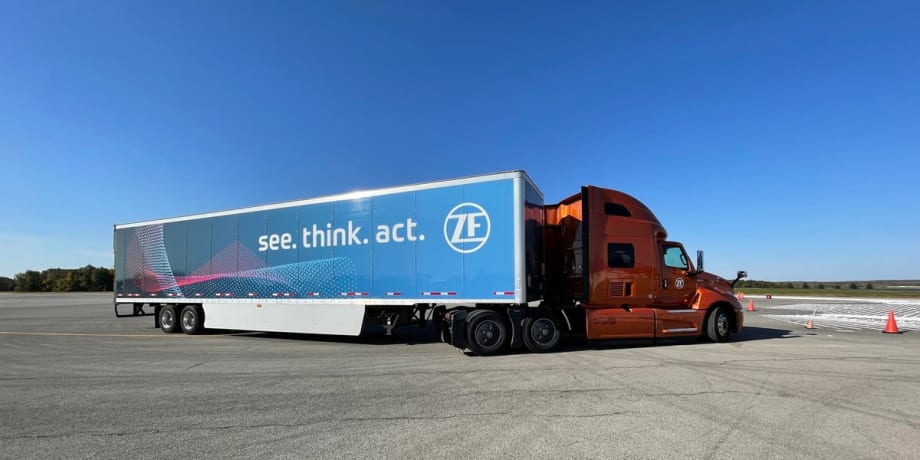
This International LT tractor fitted with ZF’s full suite of OnGuard ADAS uses cameras, radar and autonomous controls to help drivers avoid rear-end collisions and accidents with pedestrians and cyclists.
Photo: Jack Roberts
At the ZF Technology Day, held on Oct. 11 at the Transportation Research Center outside of Columbus, Ohio, ZF engineers showcased its latest slate of new commercial vehicle products. Those included a supercharged, autonomous-based, advanced driver safety system and an all-electric power steering system that the company feels could be the next standard in steering control systems for heavy-duty trucks.
On display was ZF’s new eBeam, an electric drive axle slated for medium-duty applications, as well as the latest versions of the Powerline automatic transmission.
ZF also introduced its OnGuardMax autonomous emergency braking system. OnGuardMax is a culmination of a Wabco safety control system merged with ZF’s autonomous vehicle control technologies.
According to Dan Williams, ZF’s director of ADAS and Autonomy, the system uses complimentary camera and radar sensors which are sophisticated enough to detect and react to pedestrians, bicyclists and motorcycles.
OnGuardMax is also designed to help drivers manage complex driving situations with advanced object detection and classification.
OnGuardMax can be paired with OnGuardActive, which detects moving, stopped and stationary objects and provides visual, audible and haptic warnings. If necessary, OnGuardActive will apply the brakes to avoid or mitigate a forward collision.
OnGuardActive also features adaptive cruise control, which tracks and monitors intervals with vehicles in front of the truck. The system then remains a safe (3.6 seconds) following distance behind a vehicle and automatically will adjust its selected speed to remain that same distance behind. The system can detect vehicles up to 650 feet ahead, and, Williams said, it is reliable anytime, including inclement weather.
ZF’s blind spot detection system, dubbed OnSide, can also be integrated with OnGuardMax and OnGuardActive. This is a radar-based blind spot detection system that supports drivers merging into adjacent, passenger side lanes by checking them for clearance.
OnSide activates and alerts drivers of moving vehicles in the blind spot at speeds of 15 mph and above, while the radar continuously detects a wide variety of stationary and moving objects in the vehicle's blind spot. The algorithm filters out the stationary objects to allow the system to warn the driver only of moving objects. The system is calibrated to provide a 160-degree field of view with reach of up to 33 feet rearwards.
“We felt it was important to offer these systems so that fleets can pick and choose which options best fit their needs,” Williams said. “Every fleet has specific safety needs and budget concerns. But we are confident that once they opt for one system, the value of integrating additional ZF ADAS into their vehicles will become apparent very quickly.”
Electric Power Steering System: A Whole New Way to Steer
ZF is also excited about the prospects for it’s new electric power steering (EPS) system, which Williams believes has the potential to completely transform commercial vehicle steering systems by moving away from hydraulic-boosted controls to full drive-by-wire electric steering control.
“Hydraulic power steering is 75-year-old technology,” Williams explained. “We think the time has come for a new way to steer commercial vehicles. Moreover, we see EPS as a cornerstone technology for the industry’s transformation towards electrification, while providing a building block for next generation advanced driver assistance systems, supporting the industry’s ambitions towards autonomous driving. The system is applicable to all powertrain concepts, while seamlessly matching the requirements of electric commercial vehicles and fits to a broad range of medium- and heavy-duty trucks and buses.”
Williams said the EPS builds off of the Reax electric-over-hydraulic steering system, which he said ZF also considered a stepping-stone technology on the path to full electronic steering control for Class 8 trucks.
From an OEM perspective, Williams points out hydraulic power steering systems are complex, heavy and maintenance-intensive.
“From a vehicle assembly standpoint, we’re taking the need to put anywhere from seven to 12 different components – including pumps, belts, brackets and hoses – on the vehicle,” he explains. “From the fleet perspective, this is a wholly safe and redundant system that can be adjusted to provide the steering control fleets want. And it is a 100% maintenance-free system for the life of the truck.”
Hydraulic power steering systems do most of their work at lower speeds, Williams added.
“But at highway speeds, you’re wasting horsepower to simply keep that pump spinning – while it’s not contributing anything to control of the truck,” he says.
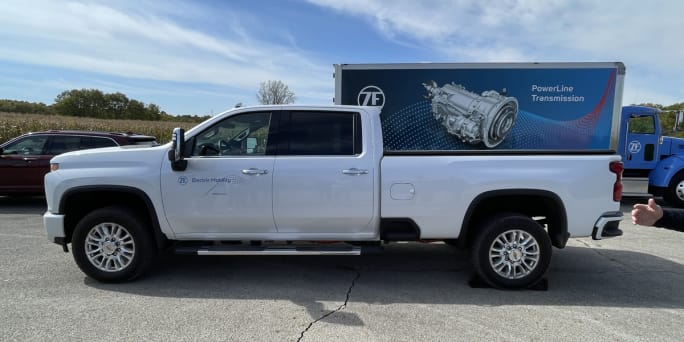
This 2021 Chevrolet Silverado has been converted into a test vehicle demonstrating ZF’s new eBeam electric drive axle, intended for medium-duty applications.
Photo: Jack Roberts
That’s why Williams said ZF believes EPS will be particularly attractive to OEMs as the next round of U.S. Environmental Protection Agency diesel exhaust and greenhouse gas emissions standards take effect in 2027.
“It’s true that you’re not losing a great deal of parasitic horsepower loss at highways speeds,” he said. “But even two or three horsepower recouped at those speeds can make a contribution to overall fuel economy and emissions reductions. Moreover, replacing hydraulic steering removes waste heat generated by the system from the engine bay while taking complexity and weight out of the powertrain. It’s just a more efficient and maintenance-friendly approach to commercial vehicle steering.”
Williams said EPS is currently slated for production sometime in the 2025 – 2026 timeline.
“But, frankly,” he added, “about 10 years after that, we believe you’ll have to look long and hard to find a new truck with hydraulic steering in the industry. There may be a few severe-duty models that retain hydraulic steering. But we think the vast majority of line-haul trucks will be using electric steering control like EPS.”
More Equipment

How Volvo Updated Its D13 for EPA 2027 [Watch]
Volvo’s updated D13 promises lower emissions without sacrificing performance or fuel economy. Take a closer look at what changed inside the engine in this HDT Spotlight video.
Read More →
Michelin Tire Improves Efficiency and Durability for Regional Fleets
The Michelin X Multi Energy D2 is a regional haul drive tire engineered to help fleets improve fuel efficiency, durability and traction in demanding stop-and-go operations.
Read More →
ZF Expands Commercial Vehicle Push in North America
ZF is expanding its North American commercial-vehicle presence with new transmission applications, electrification, trailer technology and autonomous-driving systems.
Read More →
Tesla Wants a Self-Driving Semi. Are Cameras Enough?
Could Tesla’s camera-only autonomous driving technology work on an 80,000-pound Semi? In this commentary, HDT's Deborah Lockridge takes a look at Tesla, Cybercab, and how autonomous trucks see the road.
Read More →
Kodiak: Driverless Long-Haul Truck Launch on Track for 2026
Kodiak AI says its driverless long-haul safety case is 93% complete and it remains on track to begin commercial operations by year-end 2026.
Read More →
What DOT’s Automated Vehicle Strategy Means for Trucking
The U.S. Department of Transportation issued a new automated-vehicle strategy that outlines plans for driverless-truck regulations, cross-state freight corridors, and federal safety standards.
Read More →
East Coast Port Launches $45M Electric Truck Push
The Port Authority of New York and New Jersey announced millions in incentives for zero-emission drayage trucks, yard tractors, and new charging hubs near the port.
Read More →
PlusAI Going Public to Fund Autonomous Truck Launch
A SPAC deal could provide PlusAI with up to $300 million as it works toward a 2027 commercial launch of factory-built autonomous trucks.
Read More →
NHTSA Moves to Rewrite Truck Fuel-Economy Rules
The National Highway Traffic Safety Administration says it lacks authority to regulate medium- and heavy-duty truck engines separately from complete vehicles, but the existing standards have not yet been eliminated.
Read More →
Detroit Opens Orders for EPA 2027 Engines
Detroit isn’t starting from scratch to meet EPA 2027 diesel emissions standards. Its Gen 6 DD13 and DD15 engines keep much of today’s platform while updating the fuel and aftertreatment systems.
Read More →