




Zero-Emission Trucks Could be Part of I-710 Zero-Emission Corridor
Zero-emission trucks, such as hybrid-electric trucks receiving power along major roadways (similar to light-rail trains and buses in some cities), could be in demonstration in the next few years and eventually be part of a zero-emission corridor along the busy I-710 Freeway leaving the Ports of Los Angeles, according to a recent study.
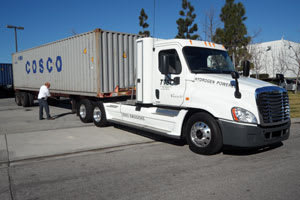
One zero-emission truck being tested at LA_area ports is this hydrogen-fuel-cell Tyrano, made by Vision Motor Corp. of El Segundo, Calif.
Zero-emission trucks, such as hybrid-electric trucks receiving power along major roadways (similar to light-rail trains and buses in some cities), could be in demonstration in the next few years and eventually be part of a zero-emission corridor along the busy I-710 Freeway leaving the Ports of Los Angeles, according to a recent study.
The findings by Calstart, an independent California-based organization that evaluates and works to commecialize clean transportation technology, supports assumptions that have been presented at community meetings for the I-710 Corridor Project.
Long a problem area for traffic congestion and poor air quality, the busy I-710 Corridor is a major truck route between the LA-area ports and the Burlington Northern Santa Fe/Union Pacific rail yards in the cities of Commerce and Vernon. Among key community concerns is how proposed transportation projects address and/or improve diesel particulate emissions from diesel trucks.
A Draft Environmental Impact Report/Environmental Impact Statement for the I-710 Corridor, released at the end of June, presents transportation alternatives that can improve future conditions in the I-710 Corridor. This effort is conducted by Metro and six partner agencies and is focused on 18 miles of the 710 between the Ports of long Beach and Los Angeles and the Pomona Freeway (SR-60).
The I-710 Draft EIR/EIS contains alternatives that address air quality, safety, mobility; two alternatives include a freight corridor to be used by trucks with zero tailpipe emissions (zero-emission trucks).
To better inform the public on zero-emission trucks, Calstart was tasked to evaluate if zero-emission trucks are technically feasible and if they are, how soon could they be commercially available. Funding for the report was provided by Metro and the South Coast Air Quality Management District.
The Calstart report found that the technology needed to produce zero-emission trucks already exists and that there are a few zero and near-zero emission truck demonstration projects throughout the country currently being evaluated. Furthermore, if an alternative requiring zero-emission trucks is selected, commercial production of zero-emission trucks can occur between the years of 2018 and 2034.
The study, "Technologies, Challenges & Opportunities I-710 Zero-Emission Freight Corridor Vehicle Systems" is available via Metro's Countywide Zero-Emission Truck Collaborative Web page.
Related Stories:
Caltrans proposes Truck-Only Expressway on I-710
5/4/2012 Hydrogen Fuel Cells Could be SoCal Fleet's Future
More Drivers

Hours of Service Pilot Programs: FMCSA Readies for 2027 Rollout
Two pilot programs could eventually reshape hours-of-service rules, giving truck drivers options to pause their 14-hour clock or use longer split sleeper rest periods.
Read More →
Medical Cards, English Proficiency Reshape Roadcheck Violations
Medical-card violations jumped to the top of the driver out-of-service list during CVSA’s 2026 International Roadcheck, while English-language proficiency violations appeared among the leading violations for the first time.
Read More →
Driver Trust Can Make or Break the Success of Fleet Safety Technology
New Teletrac Navman research suggests that onboarding, transparency about driver data, and positive feedback can play a significant role in how commercial drivers respond to safety and coaching technology.
Read More →
EEOC Sues KLLM Over Alleged Sex Discrimination in Driver Training
KLLM is facing a federal sex-discrimination lawsuit over policies the EEOC alleges put female truck driver trainees at a disadvantage.
Read More →
FMCSA Moves to Codify English Language Requirements for Commercial Drivers
By changing regulations on English-language proficiency requirements for commercial drivers, rather than relying on a guidance memo, the FMCSA said future administrations won't be able to walk back the Trump administration's stricter enforcement with just a memo.
Read More →
Drivers Put Western Star Trucks to the Test at Star Nation Experience
Watch to get an inside look at the Western Star trucks, technology, and community behind the Star Nation Experience 2026!
Read More →
Trump Administration Looks to Put More Veterans Behind the Wheel
The Freedom Haulers program pulls together existing and expanded programs at several federal agencies to recruit veterans to drive commercial heavy-duty trucks and cut the red tape for them to get a CDL, training, and employment.
Read More →
Putting Mack’s Command Steer to the Test
A test drive of Mack’s Command Steer active steering system evaluates how it can make truck driving easier and less tiring.
Read More →
Competition Heating Up for Truck Drivers
New report reveals rising driver hiring costs, the return of sign-on bonuses, growing AI advantages, and the operational factors shaping driver retention.
Read More →
How Fraley & Schilling Improved Logbook Compliance by Over 50%
Fraley & Schilling needed a way to close a compliance workflow gap in its ELD system without adding more work from driver training, reminders, and back-office follow-ups. It found the answer in a custom driver app.
Read More →