




XRS, Samsung Integrated Software-Device Package Addresses BYOD Problems
MINNEAPOLIS -- XRS Corp. kicked off its XUE 2013 user conference Monday in Minneapolis by announcing it had entered a partnership with Samsung Telecommunications America that will deliver XRS fleet management products through Samsung mobile devices.


Jay Coughlan, CEO and president of XRS Corp., said his company remains committed to the mobile strategy announced last year.
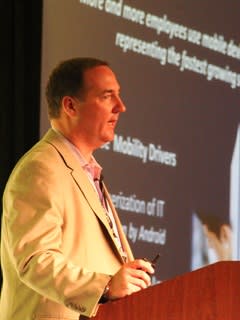
The “next big thing in transportation is right here in this room,” said Dave Lowe, executive vice president enterprise sales, Samsung.
MINNEAPOLIS -- XRS Corp. kicked off its XUE 2013 user conference Monday in Minneapolis by announcing it had entered a partnership with Samsung Telecommunications America that will deliver XRS fleet management products through Samsung mobile devices.
Saying the “next big thing in transportation is right here in this room,” Dave Lowe, executive vice president enterprise sales, Samsung, said enterprise mobility and the “consumerization of IT” was largely driven by the Android operating system and the proliferation of business apps for smartphones. “More and more employees use mobile devices for work purposes, with BYOD (bring your own device) representing the fastest growing segment.”
Mobile apps have become popular among truck drivers as well. Christian Schenk, XRS senior vice president product strategy and market growth, noted that when his company first started developing the mobile version of its fleet management software, they found about 400 or so trucking-related applications available for smart devices.
“Now there are 40,000 trucking-related apps,” he said, primarily because drivers use smartphones and created a demand for trucking/driver-related applications.
Addressing Bring-Your-Own-Device Challenges
Last year at its user conference, XRS announced it was moving to a mobile, cloud-based platform and began promoting the BYOD concept. Released in March of this year, XRS’s mobile platform runs on more than 50 types of devices.
Since then, there have been some questions about the BYOD approach. One objection is the lack of control companies have over devices provided by their drivers. With so many options available, how can a company’s IT department certify and support them all? Other questions have involved security and reliability of the devices. Fleet management and compliance are critical operations and fleets need to know that the system they are using is reliable and secure. Then there is the “fragmentation” in the Android world, with multiple versions of the operating system, multiple devices that use it, as well as multiple wireless carriers.
To overcome these objections, Lowe said Samsung developed SAFE, or Samsung for Enterprise, which is composed of four main components: corporate email/calendar/contacts, on-device encryption, virtual private network and mobile device management.
According to Lowe, SAFE defragmented the Android world by providing a consistent level of compliance across multiple versions of the operating system. “SAFE simplifies the certification process,” Lowe said. “If you test and approve one Samsung device, all other SAFE devices can be included on a corporation’s supported device list.”
The BYOD strategy is further enabled with Samsung KNOX – a security enhanced version of Android that can establish “dual personas” within a single Samsung device by using separate containers for business applications/data and personal data.
“You can take all of the work apps and put it in a container,” Lowe said. All the personal stuff, such as a driver’s pictures, personal emails or other data, is in another "container" that the company’s IT department can’t touch. When a driver leaves a job, the work container is deleted, while his personal information is retained.
These advances make Android devices more acceptable in an enterprise environment and allow them to take advantage of the BYOD strategy. In fact, Lowe said, Samsung devices have been used in a number of governmental applications as well as industries such as aviation, medical and manufacturing.
BYOD and Trucking
For trucking, the mobile/BYOD strategy makes sense for a number of reasons, Schenk said. At least 90% of truck drivers already use a mobile device, according to industry estimates, so it’s redundant to have an onboard computer in the truck when the driver is carrying one in his pocket, he said. Secondly, there are already millions of devices in circulation capable of running XRS’s fleet management software. Add to that the fact that the average age of a new smartphone user is 12 years old. “Those are tomorrow’s drivers,” he said.
The partnership between XRS and Samsung came about because “we sort of stumbled upon one another,” Lowe said. “Our focus is on the hardware; our focus is on the enterprise and to enable BYOD. We have desirable devices but were lacking industry-specific solutions.”
“From our perspective, we needed to create a strategic advantage for customers,” Schenk said. “Samsung was the key.”
As for the durability of mobile devices, Schenk agreed there were some applications where ruggedized devices were probably a better option. Lowe said Samsung is ready to introduce more rugged devices, one which can withstand being immersed in water for up to 30 minutes and another that will meet military specs for ruggedness.
The integrated package will be available later this year.
Committed to Mobility

Jay Coughlan, CEO and president of XRS Corp., said his company remains committed to the mobile strategy announced last year.
Jay Coughlan, CEO and president of XRS Corp., said his company remains committed to the mobile strategy, noting that there has been a convergence of four concepts: mobile, social, cloud and information.
The cloud means companies don’t have to spend money to keep their infrastructure up to date. Mobile means accessing data from anywhere and getting rid of all the equipment on a truck to use a fleet management solution. Information is the result of the link between the mobile device, the cloud and the fleet management software and includes engine data, location data, compliance data and other important data. There is something like six terabytes of data every year per truck, he said, and trucking companies want more. The social is how drivers stay in touch. It used to be the CB radio. Now it’s Facebook, Twitter, Yelp and other social sites, all accessed via mobile devices.
Changes come quickly in the technology world, and often companies aren’t prepared for it, Coughlan noted, commenting on the companies that at one time were major players when computers first came on the scene. Those companies built and supported mainframe computers and today, most are either no longer in the computer business or out of business altogether. He mentioned a quote from the CEO of one of these companies, that there was no reason for a person to have a computer in their home. Then along came PCs. Then came laptops, and now there are mobile devices. Along the way, many other companies went out of business as well. The same holds for the smartphone market. Older established leaders such as Nokia, Palm, or Blackberry are on the ropes.
“Today it’s about mobility and scalability,” he said. “We have to develop our products with this in mind.”
Odell Tuttle, chief technology officer, XRS, reiterated that fact. When the company decided to develop a new platform, he said that “the existing platform was hard-wired, bolted to the truck with no mobility. It was a single-purpose application, proprietary, locked-in and inflexible, and was hosted on an aging infrastructure.”
Their objective was to develop a system that was easy to operate or the driver and dispatcher, easy to install without a technician and one that could receive updates over the air.
“We didn’t want to build a platform like the one we had,” he said. The XRS mobile platform features a cloud infrastructure and a mobile device connected in a network. As for the smartphones themselves, Tuttle said that the “phone is the least used feature of a smartphone device. We are all carrying a personal computer in our pocket.”
More Drivers

Trucker Path Expands Reserved Parking Network
Trucker Path has added close to 6,000 more truck parking spaces to its Trucker Path Reserved Parking Network with the addition of Safe Truck Parking.
Read More →
EEOC Sues Texas Trucking Company Over Driver Age Limits
The agency says Trancasa USA rejected applicants over 65 and applied tougher driving-record standards to those over 60.
Read More →
Nussbaum, Roehl Announce Second Driver Pay Increase This Year
This year has seen a swath of major truck driver pay increases as freight capacity has tightened.
Read More →
From One Generation to the Next: How Mentorship Builds Safer Truck Drivers
After three decades in trucking, Harold Perry shares what he's learned about driver safety, mentorship, and helping the next generation build confidence behind the wheel.
Read More →
Truck Drivers Need More Than Another Alert
Fleets have more visibility into truck health, safety events, and driver activity than ever. The next challenge is turning all that information into useful guidance for the person who has to decide what to do next.
Read More →
FMCSA Removes 110 Truck Driver Training Schools from Certified ELDT List
Federal regulators also are targeting more than 160 additional training providers and launching a nationwide audit of third-party CDL skills testers as part of a broader crackdown on trucking fraud.
Read More →
Hours of Service Pilot Programs: FMCSA Readies for 2027 Rollout
Two pilot programs could eventually reshape hours-of-service rules, giving truck drivers options to pause their 14-hour clock or use longer split sleeper rest periods.
Read More →
Medical Cards, English Proficiency Reshape Roadcheck Violations
Medical-card violations jumped to the top of the driver out-of-service list during CVSA’s 2026 International Roadcheck, while English-language proficiency violations appeared among the leading violations for the first time.
Read More →
Driver Trust Can Make or Break the Success of Fleet Safety Technology
New Teletrac Navman research suggests that onboarding, transparency about driver data, and positive feedback can play a significant role in how commercial drivers respond to safety and coaching technology.
Read More →
EEOC Sues KLLM Over Alleged Sex Discrimination in Driver Training
KLLM is facing a federal sex-discrimination lawsuit over policies the EEOC alleges put female truck driver trainees at a disadvantage.
Read More →