





4 Ways Corporate Culture Can Help Retain Women at Your Fleet
WIT: Fleets Should Adopt Same-Gender Driver Training Policies
While most commercial truck drivers believe their cabs are safe, they also indicated knowledge of women falling victim to harassment or assault while sharing a cabin during over-the-road training.
January 27, 2022
After receiving their commercial driver’s license, aspiring professional drivers typically accompany an experienced one on their route.
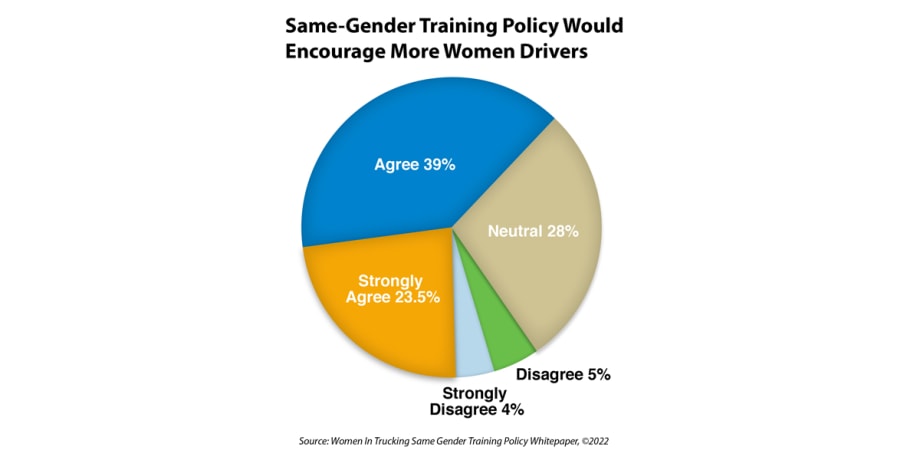
Graph: WIT
2 min to read
While most commercial truck drivers believe their cabs are safe, they also indicated knowledge of women falling victim to harassment or assault while sharing a cabin during over-the-road training. This is why same-gender cab sharing has been a primary concern of current and prospective female truck drivers, according to an industry survey conducted by the Women In Trucking Association.
After receiving their commercial driver’s license, aspiring professional drivers typically accompany an experienced one on their route to become more confident, safer, and capable on the road, according to Ellen Voie, president and CEO of WIT. This not only could mean working exclusively with a stranger in close quarters for long hours during the day, it also means the potential of needing to sleep in the same vehicle.
Given that 46% of the more than 430 professional drivers WIT surveyed about their perceptions and experiences involving and safety and harassment in the trucking industry indicated that they have had an unwanted physical advance made toward them at least once and another 52% know of someone who had an unwanted physical advance made toward them, it is understandable why the prospect of cab sharing with a member of the opposite gender concerns many women, Ellen Voie, president and CEO of WIT.
The survey was completed from July through September 2021. Of those drivers that completed the survey about 66% of the drivers identified as female, 32% as male, and nearly 2% as non-binary.
There are a number of corporate policy recommendations on same-gender training that Voie recommends:
Adopt a same-gender training policy that enables female professional drivers to have the option for a same-gender trainer when involved in on-the-road training activities.
When having a same-gender trainer isn’t an option in instances involving female drivers, develop alternatives to help reduce or eliminate issues, such as ensuring that when sleeping arrangements need to be made that one of the parties has the ability to have a paid hotel room available to avoid the need to sleep together in the same cab.
Encourage driving teams where partners who are friends, spouses, or in a committed relationship alternate their time behind the wheel on the same route.
Upgrade in-cab safety technology where trucks are equipped with sound-enabled in-cab cameras and panic/emergency buttons in the sleeper and cabin areas.
More Drivers

Truck Drivers Need More Than Another Alert
Fleets have more visibility into truck health, safety events, and driver activity than ever. The next challenge is turning all that information into useful guidance for the person who has to decide what to do next.
Read More →
FMCSA Removes 110 Truck Driver Training Schools from Certified ELDT List
Federal regulators also are targeting more than 160 additional training providers and launching a nationwide audit of third-party CDL skills testers as part of a broader crackdown on trucking fraud.
Read More →
Hours of Service Pilot Programs: FMCSA Readies for 2027 Rollout
Two pilot programs could eventually reshape hours-of-service rules, giving truck drivers options to pause their 14-hour clock or use longer split sleeper rest periods.
Read More →
Medical Cards, English Proficiency Reshape Roadcheck Violations
Medical-card violations jumped to the top of the driver out-of-service list during CVSA’s 2026 International Roadcheck, while English-language proficiency violations appeared among the leading violations for the first time.
Read More →
Driver Trust Can Make or Break the Success of Fleet Safety Technology
New Teletrac Navman research suggests that onboarding, transparency about driver data, and positive feedback can play a significant role in how commercial drivers respond to safety and coaching technology.
Read More →
EEOC Sues KLLM Over Alleged Sex Discrimination in Driver Training
KLLM is facing a federal sex-discrimination lawsuit over policies the EEOC alleges put female truck driver trainees at a disadvantage.
Read More →
FMCSA Moves to Codify English Language Requirements for Commercial Drivers
By changing regulations on English-language proficiency requirements for commercial drivers, rather than relying on a guidance memo, the FMCSA said future administrations won't be able to walk back the Trump administration's stricter enforcement with just a memo.
Read More →
Drivers Put Western Star Trucks to the Test at Star Nation Experience
Watch to get an inside look at the Western Star trucks, technology, and community behind the Star Nation Experience 2026!
Read More →
Trump Administration Looks to Put More Veterans Behind the Wheel
The Freedom Haulers program pulls together existing and expanded programs at several federal agencies to recruit veterans to drive commercial heavy-duty trucks and cut the red tape for them to get a CDL, training, and employment.
Read More →
Putting Mack’s Command Steer to the Test
A test drive of Mack’s Command Steer active steering system evaluates how it can make truck driving easier and less tiring.
Read More →