





From Last Year's Outlook: Omnitracs CEO Wants Fleets to Focus on Time, Not Miles
Why Omnitracs Wants to Move Beyond In-Cab Devices
The company that was the first to put a computer in the cab of a truck is now working to move beyond being a hardware provider, said Omnitracs CEO Ray Greer, kicking off the company’s annual user conference – the need for which was highlighted by an outage last year.
February 18, 2020
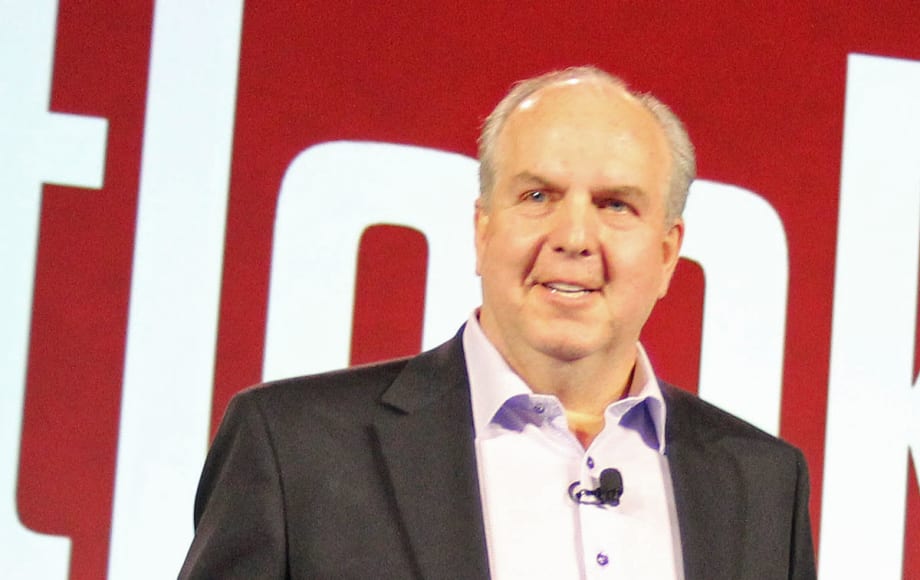
Ray Greer, Omnitracs CEO, addresses customers and partners at the opening session on the company’s Outlook 2020 User Conference.
Photo: Jim Beach
4 min to read
The company that was the first to put a computer in the cab of a truck is now working to move beyond being a hardware provider, said Omnitracs CEO Ray Creer, kicking off the company’s annual user conference – the need for which was highlighted by an outage last year.
More than 900 customers, staff and vendor partners convened in Las Vegas Feb. 16-22 for Outlook 2020. Greer opened the event with a review of the company’s past, present and future.
He said Qualcomm put the first computer in a truck cab (1988); Xata, now known as XRS, put the first Android device in a truck cab for dispatch and hours-of-service (2009); and RoadNet Systems developed the first on-premise routing and scheduling system (1983). All of those companies are now part of Omnitracs.
“This is a company that has been a leader in every era, and we are moving toward cloud computing.”
“Big things happened in 2019,” Greer said, noting that a strategic relationship with Red Hat helped the company develop the first phase of the Omnitracs One platform, available in the market late last year.
The company's acquisition of Blue Dot Solutions last year led to Omnitracs Drive, a new offering that provides drivers with a streamlined mobile user interface that helps improve workflow. Their customer base increased 9% in 2019 with 1,189 new customers.
But it “wasn’t all a bed of roses” he added, referring to a system outage last November that affected Omnitracs’ MCP in-cab devices.
In-Cab Devices Don’t Last Forever
Turns out the outage was due to some chips embedded within the devices that had reached their end-of-life point. The company hired Price Waterhouse to do an analysis on the failure that determined the outage was in fact due to an embedded system failure.
The experience taught them a few things. One, he said, was that the industry got so dependent on expensive equipment that companies wanted to install it and keep it forever. “For some reason, the industry is OK with keeping a driver on a 10-year-old device. It doesn’t make sense.”
“Our answer is we need to bring hardware costs down to a price point that allows it to be refreshed.”
He wants to get to the point where truck owners refresh these devices every time they buy a new truck. “You are not having to worry about putting the old into the new.”
The experience led Omitracs to accelerate its work with vehicle OEMs to embed hardware devices on trucks that can easily be loaded with Omnitracs software.
The other thing the company discovered was that end-of-life planning has not existed in the industry. That is critical when one considers that the 3G wireless protocol sunsets at the end of next year. In the Internet of Things space, the majority of devices use 3G technology. The disruption this could cause may be severe, unless companies address the issue now.
These issues point to a natural tension between supporting legacy technologies and innovating new ones. Greer said Omnitracs spent 300 man-years incorporating ELDs into its legacy system – hours that could have gone toward innovation. “Somewhere, as an industry, we need to find a balance between these two things.”
Becoming Data-Driven
In the future, Greer said, the company needs to become more data-driven and software-focused and not think as much about hardware. There are more and more devices, all generating data. “At some point you have to ask, ‘how many devices do you need on a truck?’”
The company also wants to help its customer address the Amazon effect, where shippers are penalizing carriers when they don’t meet a 30-minute delivery window, what’s known as on-time in full (OTIF).
Displaying the names of all the various providers within the industry, he said, you can see how complex it is. It creates a “data overload,” with no single source of truth which makes interoperability difficult.
“What we are doing is creating open APIs, that allow customers and third-parties to be able to integrate,” and also create a data hub that becomes the center of things. “The days of not integrating with others, those days are over.” The result will be an open, hardware-agnostic Omnitracs.
Gathering more data allows the company to develop new products, such as a truly automated tax filing application introduced at the conference. Beyond that, the company now has data on six million locations where trucks deliver or pickup, how trucks get into these locations, where the docks are and other information. The company is building algorithms to crunch this data and then predict how long a truck will be at these locations. That intelligence will allow fleets to plan better.
Finally, Greer said that has the of pace of technological change continues to pick up speed, so too will Omnitracs pace of developing new products that make use of these new technologies. And he said must do all it can to help their customers maintain more up-to-date refresh schedules so that they can take full advantage of the new technologies.
More Fleet Management

Sponsored•September 16, 2026
Color Match Smarter: Tools That Restore & Perform
For fleet managers and collision repair professionals keeping heavy-duty trucks on the road, getting the color right the first time isn't just about appearance — it's about efficiency, turnaround time, and bottom-line results. Discover how today's digital color tools are transforming the repair process from guesswork to precision.
Read More →
FMCSA Pauses Biennial-Update Enforcement Amid Motus Transition
Carriers whose updates were due on or after June 1 have more time, while FMCSA works to stabilize its new registration system and warns of phishing sites impersonating its new carrier registration system, Motus.
Read More →
Sponsored•September 14, 2026
2026 Blueprint for Countering Smarter Supply Chain Theft
Cargo theft is no longer just the cost of doing business. It's a multi-billion-dollar criminal enterprise exploiting vulnerabilities across your fleet, drivers, and supply chain.
Read More →


Sponsored•September 1, 2026
How Telematics Improves Visibility, Control, and Performance in Refrigerated Fleets
Explore how telematics help refrigerated fleets improve visibility, uptime, efficiency, compliance, and cargo protection across connected cold chain operations.
Read More →
What the U.S.-Canada Trade War Means for Trucking
Escalating U.S.-Canada tariffs could disrupt cross-border freight, reduce truck volumes, raise costs, and create new uncertainty for carriers on both sides of the border.
Read More →
What Are Trucking’s Top Concerns for 2026?
The American Transportation Research Institute wants to know what's worrying trucking fleet managers, drivers, and other stakeholders in its annual Industry Issues survey.
Read More →
American Trucking Associations Looks for a New Leader
ATA President and CEO Chris Spear abruptly left his job at the association on August 21, at a pivotal time for the trucking industry.
Read More →
Public Wi-Fi Cybersecurity Risks: How Truck Drivers and Fleets Can Protect Their Data
Public Wi-Fi can expose truck drivers and fleets to credential theft, malware, and other cyber threats. Here’s how to reduce the risk on the road.
Read More →
For Nicky Cupp, Fleet Innovation Starts With Frustration
HDT Truck Fleet Innovator Nicky Cupp turns everyday pain points at Fraley & Schilling into opportunities for better technology and smarter processes.
Read More →
Adam Buttgenbach’s Approach to Electric Trucks: Start With Where They Fit
HDT Truck Fleet Innovator Adam Buttgenbach helped PepsiCo build one of North America’s largest EV fleets by focusing on where electric trucks make operational sense.
Read More →