





Freight rates are "stably horrible for the most part, over the last several years, well below people's operating costs, in many cases."
Why Derek Leathers Says Trucking’s Longest Downturn Could Spark a Lasting Upturn
Werner Enterprises CEO Derek Leathers warned that freight rates remain “stably horrible,” but outlined industry challenges could prevent overcapacity from derailing the next upcycle.
October 2, 2025
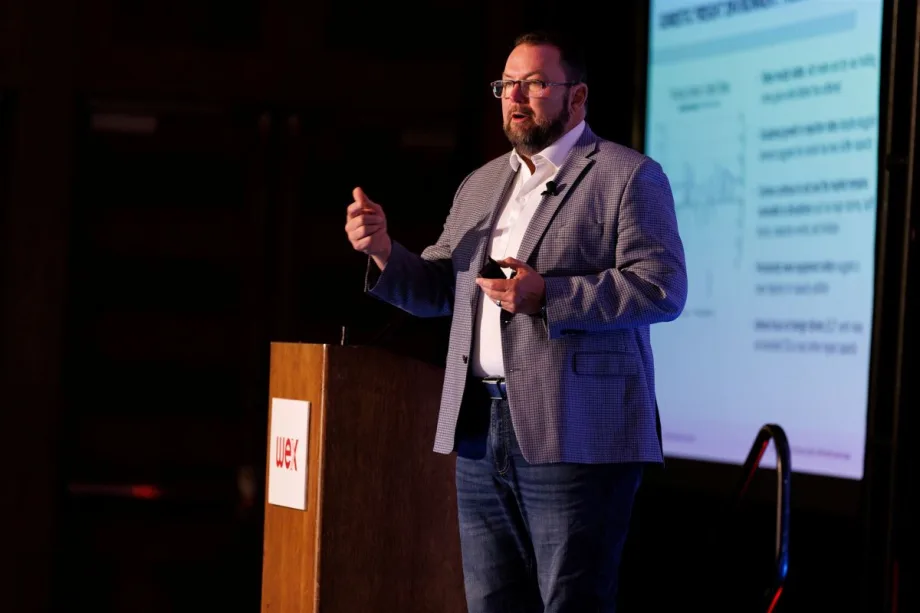
"The industry needs a significant rate increase," said Derek Leathers, Werner CEO, in the keynote speech at the Wex OTR Summit.
Photo: McLendon Photography/WEX
5 min to read

When Werner Enterprises CEO Derek Leathers told attendees of the WEX OTR Summit, “It’s been very tough to be a trucker,” he wasn’t telling anyone in the room something they weren’t already keenly aware of.
However, he said he believes when the industry comes out of this sustained freight recession, the stage is set for a long-lasting upcycle.
Leathers was the keynote speaker at the first Summit event WEX has held specifically for the trucking market, in San Antonio, Texas, October 2. Wex is a global commerce platform for fuel and fleet, employee benefits, and business payments.
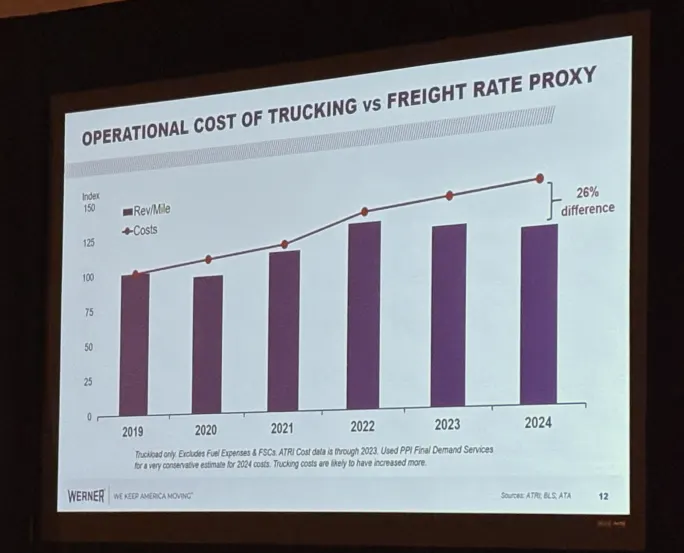
Showing a slide illustrating freight environment trends, Leather said, although it labeled rates as stable, “they're stably horrible for the most part, over the last several years, well below people's operating costs, in many cases,” he said.
At the same time, the costs of running a trucking company have risen every single year since before the Covid-19 pandemic, “and the rates and revenues the truckers are bringing in are down considerably for what is now a three-year straight period. You cannot make this up over time.
“And so we are seeing capacity start to downsize, where people just simply cannot survive any longer in a marketplace like this.”
He pointed to a spate of recent bankruptcies of carriers operating at least 250 trucks.
“When you have 17 of them go under and file bankruptcy in one quarter, that really tells you that we're kind of at a tipping point where people just can't take it anymore, and you can't support this rate structure for any longer.”
When Will This Freight Cycle Turn?
Leathers talked about the typical trucking cycle we have seen over and over again:
Demand outstrips the capacity supply in the industry, and rates go up.
Trucking companies buy more trucks, and new trucking operations join the fray, to take advantage of those rates.
But when demand slows, now the industry has too many trucks, or overcapacity, and rates drop.
The low rates force capacity out of the business, and eventually the supply-demand equation drives rates back up again.
Rinse and repeat.
But this current down cycle has gone on longer than any before, partly because the overcapacity has lingered.
“I get asked all the time, why did the attrition take so long this time?” Leathers said.
He said during the Covid-19 pandemic, fleets did make a little more money than normal when we saw rates spike when everyone was at home and buying goods rather than services. On top of that, many received stimulus money.
“But those are exhausted now, and now you gotta make money based on what you brought in last week and what you have to pay next week,” Leathers said. “Or in our industry, unfortunately, it's actually kind of the opposite. Your payments go out before you ever get paid.
“And so that gap is what's causing this duress.”
What the Up Cycle Might Look Like
This time, he thinks the cycle might be different.
The demand for Class 8 trucks has been weak for so long, Leathers said, that when demand rises, it will take time for truck makers to ramp production back up to meet that demand.
“When truck makers downsized their production capabilities during Covid out of health precautions and other reasons, it took them nearly two years to get back up to normalized production levels,” he said.
“Well, right now, they're downsized every bit as much, actually, more in most cases, than they were during Covid. So it's a couple of year build back to even get back to replacement level builds from OEMs.”
At the same time, he said, motor carriers will be looking to refresh their now-aging fleets, and grow on top of that to take advantage of better rates. Whether they will be able to get the trucks they want, whether they will even be able to afford it, are big questions.
“If you want to grow and refresh, you're going to spend about twice as much money as you would during a normal cycle,” he said. “And there's not that money there to be spent because they haven't made it over the last several years.
Lower freight rates and higher trucking operating costs are driving motor carriers out of business.
Photo: Deborah Lockridge
A Formula for Tight Trucking Capacity
“So as we get to this turning point, whenever it may occur, it would be my view that you're going to have a sustained, consistent, tight capacity market for a multi-year period," Leathers said.
"The trucking community can't screw it up this time, because you won't be able to get the trucks to screw it up, because [OEMs are] going to be constrained on their ability to build them as they build back their own capabilities.”
On top of that, he said, all the uncertainty of emissions regulations, electric vehicles, tariffs and so on may make carriers hesitant to jump right into expanding their fleets. And these factors will drive up the cost of new trucks.
“The one thing that does appear to be true is trucks will be more expensive at a time, at the time we can least afford for them to be more expensive,” he said.
“I think it sets the stage for a pretty decent turn and a sustained up cycle.”
What Could Throw a Monkey Wrench In That Upcycle
Just how long it takes to get to that upturn is still a large unknown.
Leathers, who has a degree in economics, expressed concern about how the tariffs may affect inflation. So far, much of the cost of tariffs has been absorbed by the importers and the additional companies down the line, without causing prices to increase dramatically to the end consumer.
“I just don't know where it goes from here and how much more that might creep in, but I think it's something we all have to be aware of,” Leathers said.
“We could be in a situation where enough capacity leaves the market for the market to kind of tighten, but if the bogey changes on what is the market, meaning there is all of a sudden less demand, that's a problem.
“And then we've got to realize that this thing could extend, by default, just a little bit longer.”
More Fleet Management

Geotab Links Fleet Card to Vehicle Data
The new card combines fuel discounts with telematics-based purchase controls. Geotab’s analysis also points to potential savings from choosing lower-priced fuel stops.
Read More →
How MFA Helps Protect Trucking Fleets
Multi-factor authentication adds protection when passwords are stolen. Here’s how it works and where fleets should start.
Read More →
How Better Freight Data Helps Trucking Teams Get Ahead of Disruption
Trucking and logistics teams have plenty of data. The problem is getting the right information in front of the right people soon enough to act. Better-connected data can help teams spot trouble earlier and make smarter decisions before small problems become big ones.
Read More →

Trimble: Taking Artificial Intelligence in Trucking Beyond Faster Tasks
At Insight 2026, Trimble executives argued that fleets may need to redesign workflows to get more from AI as it introduced new products and enhancements. AI’s value will depend on how fleets combine automation with their people's knowledge.
Read More →
Sponsored•September 28, 2026
Build a bulletproof fleet: Uniting ELDs and dash cams for total compliance
An ELD can prove compliance, but it cannot always prove what happened on the road. Discover how uniting accurate ELD data with AI-powered dash cam video can help your fleet strengthen compliance, defend against liability, protect drivers and reduce operational costs.
Read More →
Nominations Open for HDT Emerging Leaders
Heavy Duty Trucking is looking for accomplished trucking fleet professionals under 40 who are making an impact and helping lead the industry forward.
Read More →
Why Private Fleets Are Taking More Freight
Private fleets are putting their own trucks on demanding customers and high-cost lanes as companies seek greater control over service, costs, and capacity.
Read More →
Sponsored•September 16, 2026
Color Match Smarter: Tools That Restore & Perform
For fleet managers and collision repair professionals keeping heavy-duty trucks on the road, getting the color right the first time isn't just about appearance — it's about efficiency, turnaround time, and bottom-line results. Discover how today's digital color tools are transforming the repair process from guesswork to precision.
Read More →
FMCSA Pauses Biennial-Update Enforcement Amid Motus Transition
Carriers whose updates were due on or after June 1 have more time, while FMCSA works to stabilize its new registration system and warns of phishing sites impersonating its new carrier registration system, Motus.
Read More →
Sponsored•September 14, 2026
2026 Blueprint for Countering Smarter Supply Chain Theft
Cargo theft is no longer just the cost of doing business. It's a multi-billion-dollar criminal enterprise exploiting vulnerabilities across your fleet, drivers, and supply chain.
Read More →