




What’s Going on with Trucking Jobs Numbers?
How can we reconcile recent freight market weakness with January's strong employment statistics? FTR's Avery Vise digs into the jobs numbers.
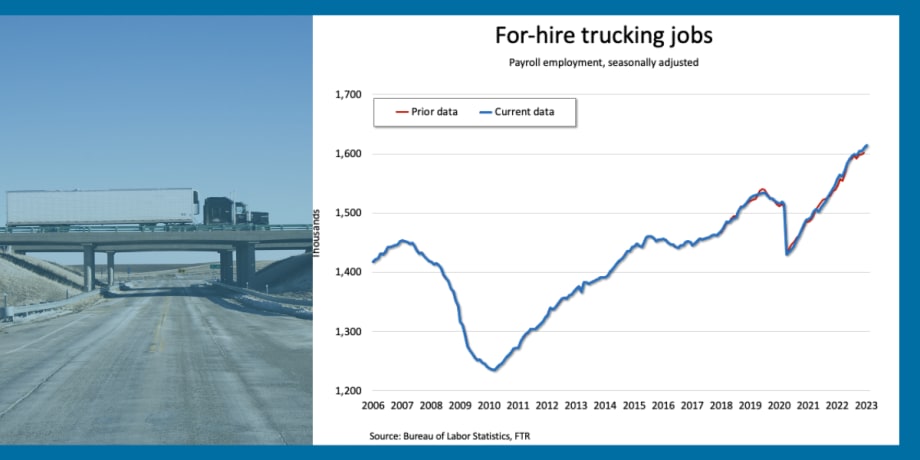
Trucking employment for January 2023
Image: FTR/Canva

Payroll employment in for-hire trucking in January was a record 1.615 million when seasonally adjusted.
Source: FTR/BLS
Despite clear indications of a weak freight environment, the payroll employment situation in for-hire trucking remained rather rosy in January. The preliminary estimate from the Bureau of Labor Statistics showed a seasonally adjusted increase of 4,100 jobs in January.
The monthly gain was not especially large compared to some that have occurred over the past year, but it was solid for a period that might seem to call for weaker — and perhaps even declining — payrolls. On a not seasonally adjusted basis, trucking lost nearly 20,000 jobs in January, but it is invariably one of the weakest months for the industry in terms of employment.
The January increase month over month is only part of the story, however. Each year, BLS revises recent years’ figures based on more comprehensive data than is available in the monthly survey. This annual benchmark revision resulted in a notably stronger payroll jobs figure for trucking than had been portrayed before the data released on Feb. 3. BLS revised data back to 2018, but the changes were marginal until around 18 months ago.
The benchmark revision generally shows slightly stronger employment levels than previously indicated, starting in September 2021. The net of all those changes resulted in the preliminary December 2022 estimate being revised upward by 9,100 jobs.
The upshot is that payroll employment in for-hire trucking in January was a record 1.615 million, seasonally adjusted. That is 95,100 jobs more, or 6.3% higher, than the pre-pandemic month of February 2020. Although the not seasonally adjusted data is more volatile, the unadjusted January figure was 93,700 jobs ahead of February 2020. The unadjusted employment peak for trucking was 1.62 million in October.
But What About the Weak Freight Market?
How can we reconcile recent freight market weakness with these figures?
The key point is that the BLS data reflects only those jobs covered by the unemployment insurance tax system. That means that it does not capture leased owner-operators. Nor does it capture the vast majority of very small carriers operating under their own authority, such as independent owner-operators.
The ranks of the latter in particular swelled in late 2020 and 2021, and even into early 2022. Then surging diesel prices and falling spot rates combined to force many of those small independents out of business. While many of those drivers joined larger carriers as leased owner-operators, many also joined larger carriers as employee drivers, thus feeding the job growth that occurred in 2022.
Carrier exits were at near-record levels in late 2022, and starting in October, the industry has consistently seen more carriers fail than enter the market. The monthly net declines in the carrier population since October have been among the largest on record. If this dynamic continues and freight volume remains stagnant, it is likely that many drivers associated with those carriers will be unable to find work with larger carriers and will be forced to move on to other endeavors.
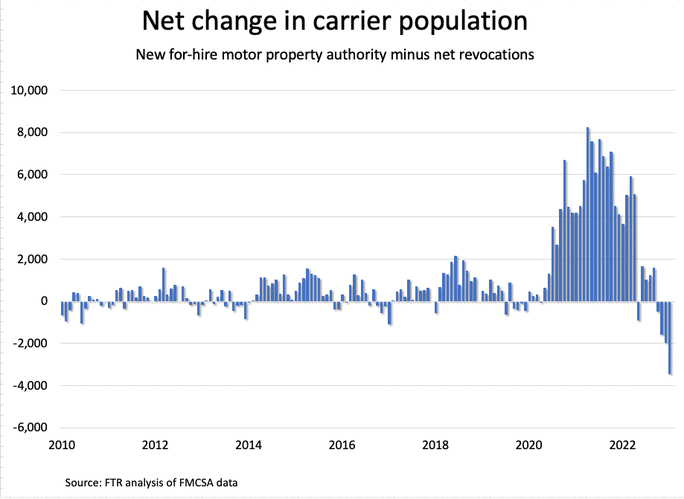
BLS data reflects only jobs covered by unemployment insurance, meaning the shift in independent owner-operators is a factor in the jobs numbers.
Source: FTR/FMCSA
Other Changes in the Employment Numbers
Trucking was not the only sector related to freight transportation to see changes related to the annual benchmark revision. Parcel and local delivery (formally called couriers and messengers) saw a small boost. However, warehousing and storage saw an enormous upward revision. The revised December payroll job level of 1.94 million was about 212,000 jobs higher than the preliminary estimate December.
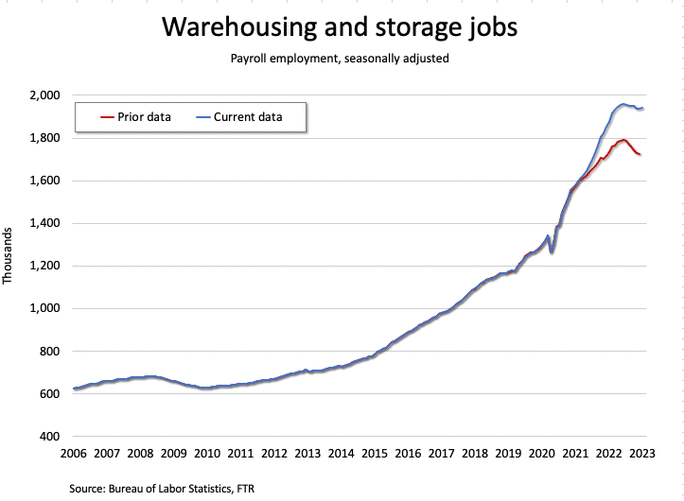
Warehousing and storage jobs saw an enormous upward revision.
Source: FTR/BLS
For the economy as a whole, the benchmark revision netted 813,000 more jobs in December than had been reflected in the initial BLS estimate. On top of that, the economy produced 517,000 new jobs, seasonally adjusted, in January for the strongest gain since July.
The labor market is outperforming the broader economy, probably because of sectors like leisure and hospitality and health care that are still seeing large deficits in employment relative to where they were before the pandemic.
Avery Vise is FTR’s vice president of transportation.For more information, visit www.FTRintel.com/HDT or call FTR at 888-988-1699.
Correction 2/7/2023 4:20 pm EDT: Payroll employment in for-hire trucking in January was 95,100 jobs more than the pre-pandemic month of February 2020, not 91,100 as an earlier version of this story indicated. The percentage increase remains the same.
Updated 2/10/2023 to replace net carrier revocations graph with updated information.
More Fleet Management

Nominations Open for HDT Emerging Leaders
Heavy Duty Trucking is looking for accomplished trucking fleet professionals under 40 who are making an impact and helping lead the industry forward.
Read More →
Why Private Fleets Are Taking More Freight
Private fleets are putting their own trucks on demanding customers and high-cost lanes as companies seek greater control over service, costs, and capacity.
Read More →
Color Match Smarter: Tools That Restore & Perform
For fleet managers and collision repair professionals keeping heavy-duty trucks on the road, getting the color right the first time isn't just about appearance — it's about efficiency, turnaround time, and bottom-line results. Discover how today's digital color tools are transforming the repair process from guesswork to precision.
Read More →


FMCSA Pauses Biennial-Update Enforcement Amid Motus Transition
Carriers whose updates were due on or after June 1 have more time, while FMCSA works to stabilize its new registration system and warns of phishing sites impersonating its new carrier registration system, Motus.
Read More →
2026 Blueprint for Countering Smarter Supply Chain Theft
Cargo theft is no longer just the cost of doing business. It's a multi-billion-dollar criminal enterprise exploiting vulnerabilities across your fleet, drivers, and supply chain.
Read More →
How Telematics Improves Visibility, Control, and Performance in Refrigerated Fleets
Explore how telematics help refrigerated fleets improve visibility, uptime, efficiency, compliance, and cargo protection across connected cold chain operations.
Read More →
What the U.S.-Canada Trade War Means for Trucking
Escalating U.S.-Canada tariffs could disrupt cross-border freight, reduce truck volumes, raise costs, and create new uncertainty for carriers on both sides of the border.
Read More →
What Are Trucking’s Top Concerns for 2026?
The American Transportation Research Institute wants to know what's worrying trucking fleet managers, drivers, and other stakeholders in its annual Industry Issues survey.
Read More →
American Trucking Associations Looks for a New Leader
ATA President and CEO Chris Spear abruptly left his job at the association on August 21, at a pivotal time for the trucking industry.
Read More →
Public Wi-Fi Cybersecurity Risks: How Truck Drivers and Fleets Can Protect Their Data
Public Wi-Fi can expose truck drivers and fleets to credential theft, malware, and other cyber threats. Here’s how to reduce the risk on the road.
Read More →