




Western Star Transports Massive World War II Bomber to New Home
A Western Star 4900SF tractor was recently given the honor of hauling a World War II era Martin Mars Bomber to its new home at the British Columbia Aviation Museum in Victoria, British Columbia.


Nickel Bros. Trucking from Nanaimo, British Columbia, used a Western Star 4900SF truck to haul an iconic Martin Mars bomber Victoria airport to the BC Aviation Museum.
Photo: Western Star
Western Star recently had the honor of transporting a piece of aviation history to the aviation museum in Victoria, British Columbia.
Martin Mars bombers were the largest aircraft in the world when they debuted in the 1940s.
The gigantic seaplanes were roughly the size of a Boeing 747. They were built for U.S. military service and utilized during and after World War II for about six years before being retired.
Only seven were built. The planes were converted to water bombers in the early 1960’s to fight forest fires.
A Highly Specialized Haul
Coulson Aviation hired Nickel Bros from Nanaimo who used a Western Star 4900SF truck to haul the iconic 120-foot-long aircraft from the Victoria airport to the BC Aviation Museum. There it will be part of a permanent historical exhibit at the museum, commemorating a 50-year legacy in Canadian aviation forest firefighting.
The converted Martin Mars bombers fought forest fires up and down the coast from California to British Columbia for the last 60 years.
The plane has a 7,200-gallon tank with retractable pick-scoops to allow for uploading water while the aircraft was taxiing. The scoops could load 37 tons of water on board in 22 seconds. When the water was deployed, it would cover an area up to 4 acres.
The Martin Mars bombers were used less in recent years in favor of smaller, more agile bombers.
“It’s not often that you get to say you were part of something historic,” said Alex Martin-Banzer, Western Star Brand marketing and communications manager. “The aircraft has a wingspan of 200 feet and weighs approximately 76,000 pounds when it’s empty. Western Star is honored to have been able to provide a heavy haul truck that could carefully guide this amazing aircraft to its final home.”
Inches to Spare
Tim Nickel of Nickel Brothers Moving explained, “The Martin Mars bomber has to land on the water, so the aircraft had to go through a very tight marine operation before being placed on the transport to the museum. We modified our truck to accommodate the weight of the aircraft by adding two additional 8-tire axles to allow for ground loading requirements. We also had to secure the aircraft in multiple locations to ensure the integrity of the hull and the stability of the transport.” Nickel went on to say, “Nickel Brothers Moving is known for being able to handle these types of moves, but this was probably one of the most memorable and monumental moves of my career.”
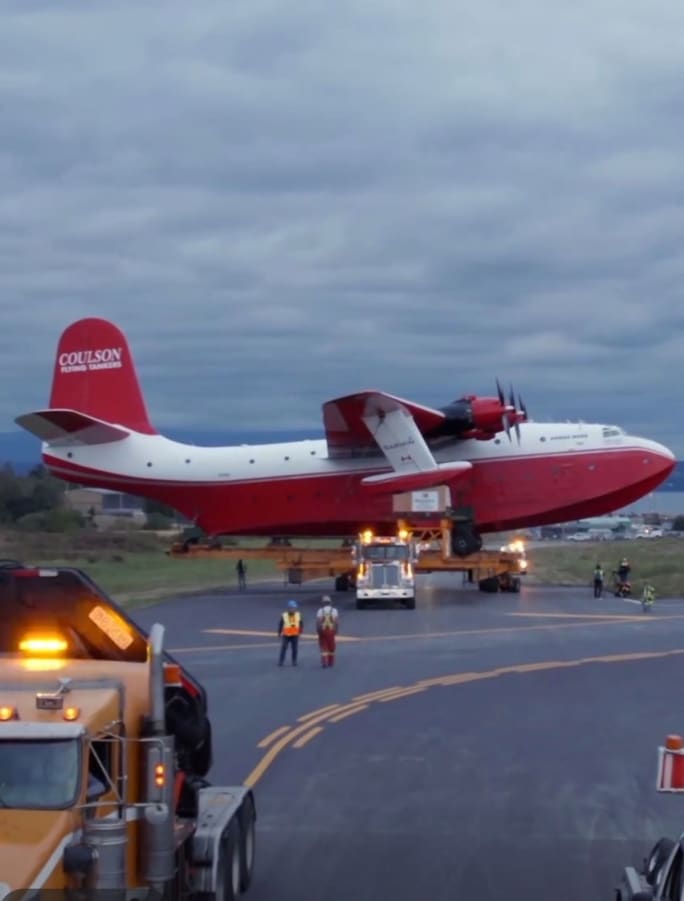
Martin Mars bombers were gigantic seaplanes roughly the size of a modern-day Boeing 747.
Photo: Western Star
The aircraft was loaded onto a 360-turning trailer secured seven feet above the ground. It crawled across the active Victoria Airport taxiways just under two miles to the BC Aviation Museum. “There were some moments where we passed fences and poles with an inch or two to spare,” said Tim Nickel, Nickel Brothers Moving. “It may have been nail-biting for the onlookers, but it was just another day at the office for our movers.”
Just two Martin Mars bombers remain today.
The “Hawaii Mars” was retired from flight in 2015 and has been meticulously maintained by Coulson Aviation. It took to the air one final time on August 11, 2024, and flew from Sproat Lake near Port Alberni on Vancouver Island to the Victoria airport, escorted by the Canadian Military acrobatic team, the “Snow Birds” on its way to the BC Aviation Museum.
To learn more about the Hawaii Mars exhibit at the BC Aviation Museum, visit https://bcam.net/the-hawaii-mars-water-bomber-finally-arrives-at-its-forever-home-the-bc-aviation-museum/
More Equipment

How Volvo Updated Its D13 for EPA 2027 [Watch]
Volvo’s updated D13 promises lower emissions without sacrificing performance or fuel economy. Take a closer look at what changed inside the engine in this HDT Spotlight video.
Read More →
Michelin Tire Improves Efficiency and Durability for Regional Fleets
The Michelin X Multi Energy D2 is a regional haul drive tire engineered to help fleets improve fuel efficiency, durability and traction in demanding stop-and-go operations.
Read More →
ZF Expands Commercial Vehicle Push in North America
ZF is expanding its North American commercial-vehicle presence with new transmission applications, electrification, trailer technology and autonomous-driving systems.
Read More →
Tesla Wants a Self-Driving Semi. Are Cameras Enough?
Could Tesla’s camera-only autonomous driving technology work on an 80,000-pound Semi? In this commentary, HDT's Deborah Lockridge takes a look at Tesla, Cybercab, and how autonomous trucks see the road.
Read More →
Kodiak: Driverless Long-Haul Truck Launch on Track for 2026
Kodiak AI says its driverless long-haul safety case is 93% complete and it remains on track to begin commercial operations by year-end 2026.
Read More →
What DOT’s Automated Vehicle Strategy Means for Trucking
The U.S. Department of Transportation issued a new automated-vehicle strategy that outlines plans for driverless-truck regulations, cross-state freight corridors, and federal safety standards.
Read More →
East Coast Port Launches $45M Electric Truck Push
The Port Authority of New York and New Jersey announced millions in incentives for zero-emission drayage trucks, yard tractors, and new charging hubs near the port.
Read More →
PlusAI Going Public to Fund Autonomous Truck Launch
A SPAC deal could provide PlusAI with up to $300 million as it works toward a 2027 commercial launch of factory-built autonomous trucks.
Read More →
NHTSA Moves to Rewrite Truck Fuel-Economy Rules
The National Highway Traffic Safety Administration says it lacks authority to regulate medium- and heavy-duty truck engines separately from complete vehicles, but the existing standards have not yet been eliminated.
Read More →
Detroit Opens Orders for EPA 2027 Engines
Detroit isn’t starting from scratch to meet EPA 2027 diesel emissions standards. Its Gen 6 DD13 and DD15 engines keep much of today’s platform while updating the fuel and aftertreatment systems.
Read More →