




Washington State Files Lawsuit Against Trucker, Carrier Over Bridge Collapse
The Washington State Department of Transportation on Monday filed a $17 million lawsuit to recoup the costs of response and repair following the 2013 over-height truck collision that caused a portion of the Skagit River Bridge on Interstate 5 to collapse.
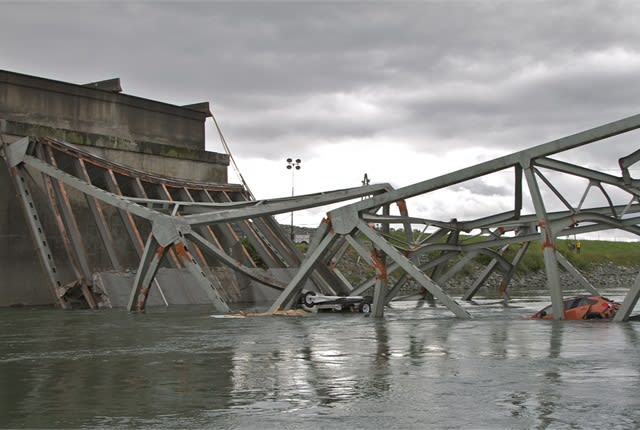
Water level view of the accident scene. Photo: NTSB
Water level view of the accident scene. Photo: NTSB
The Washington State Department of Transportation on Monday filed a $17 million lawsuit to recoup the costs of response and repair following the 2013 over-height truck collision that caused a portion of the Skagit River Bridge on Interstate 5 to collapse.
The suit, filed in Skagit County Superior Court, named as defendants: William Scott, the truck driver; his employer, Mullen Trucking LP; Tammy Detray, the pilot-car driver and her company, G&T Crawlers; and the owner of the metal shed being transported, Saxon Energy Services Inc.
On May 23, 2013, a large tractor trailer combination with an over-height load slammed into multiple overhead braces of the I-5 Skagit River Bridge, about 60 miles north of Seattle The force of those strikes severely damaged the bridge and forced its collapse into the river. Two vehicles also fell into the water. Three people suffered minor injuries while there were no deaths. The bridge has since been repaired.
The Washington State Patrol Major Accident Investigative Team cited the truck driver for “negligent driving, stating the bridge collapse resulted from a series of miscalculations, mistakes and errors by the truck driver and his employer,” according to a release from the Washington State DOT.
The investigative team also claimed the truck driver did not know the accurate height of his oversized load, and received a permit for a load two inches lower than the one he carried plus failed to research the route to ensure it could accommodate his over-height load.
“Had he taken the advanced safety steps required of all drivers who haul oversized loads, he would have known the left southbound lane of the bridge provided adequate vertical clearance for the load,” the department said.
The investigative team also determined pilot-car driver was on the phone as she crossed the bridge and did not notify the truck driver of the height clearance pole striking the bridge, while the truck driver was following the pilot car too closely and would not have been able to stop in time even if the pilot-car driver had notified him of the pole strikes.
According to the state DOT, the owner of the shed that struck the bridge, also is financially responsible for the catastrophic damage caused by this collision, under state law.
According to the Associated Press, Canada-based Mullen Trucking would not comment on the lawsuit, but did confirm the driver still works for the company, who is reportedly on assignment in the Arctic. He was also not available for comment. Attempts to get comments from the cargo owner and the pilot car driver were also unsuccessful.
Last July the National Transportation Safety Board issued a report blaming the bridge collapse multiple sources, including the truck driver, Mullen and the pilot car driver, but also found problems with the Washington State DOT and its permitting process for oversize loads.
In November, investigators from the Washington State Patrol issued their report that blamed the truck driver.
More Safety & Compliance

FMCSA Pauses Biennial-Update Enforcement Amid Motus Transition
Carriers whose updates were due on or after June 1 have more time, while FMCSA works to stabilize its new registration system and warns of phishing sites impersonating its new carrier registration system, Motus.
Read More →
ZF Expands Commercial Vehicle Push in North America
ZF is expanding its North American commercial-vehicle presence with new transmission applications, electrification, trailer technology and autonomous-driving systems.
Read More →
Truck Drivers Need More Than Another Alert
Fleets have more visibility into truck health, safety events, and driver activity than ever. The next challenge is turning all that information into useful guidance for the person who has to decide what to do next.
Read More →
Tesla Wants a Self-Driving Semi. Are Cameras Enough?
Could Tesla’s camera-only autonomous driving technology work on an 80,000-pound Semi? In this commentary, HDT's Deborah Lockridge takes a look at Tesla, Cybercab, and how autonomous trucks see the road.
Read More →
What DOT’s Automated Vehicle Strategy Means for Trucking
The U.S. Department of Transportation issued a new automated-vehicle strategy that outlines plans for driverless-truck regulations, cross-state freight corridors, and federal safety standards.
Read More →
NYC Expands Speed, Pedestrian Safety Tech Across Fleet
New York City is expanding intelligent speed assistance and pedestrian-alert systems across its municipal fleet, moving the technologies from pilot programs into vehicle procurement and retrofit requirements.
Read More →
FMCSA Removes 110 Truck Driver Training Schools from Certified ELDT List
Federal regulators also are targeting more than 160 additional training providers and launching a nationwide audit of third-party CDL skills testers as part of a broader crackdown on trucking fraud.
Read More →
Beyond DOT Compliance: What Makes a Trucking Fleet Truly Safe?
A trucking fleet can follow every rule and still make unsafe decisions. The real test comes when safety conflicts with freight, productivity, or cost.
Read More →
Hours of Service Pilot Programs: FMCSA Readies for 2027 Rollout
Two pilot programs could eventually reshape hours-of-service rules, giving truck drivers options to pause their 14-hour clock or use longer split sleeper rest periods.
Read More →
New Guide Offers Pet Safety Tips for Truck Drivers
Hundreds of thousands of pets travel in truck cabs. A new safety guide from Volvo Trucks and the Center for Pet Safety offers practical advice for truck drivers who bring dogs and cats along for the ride.
Read More →