




Walmart Shows Off Futuristic Tractor-Trailer
Turbine-electric powertrain and carbon-fiber trailer sides are not yet used in commercial motor trucks, but a concept Walmart tractor's COE layout and trailer's rounded nose hark back to previous times while at the same time evoking a "Jetsons" futuristic feel.

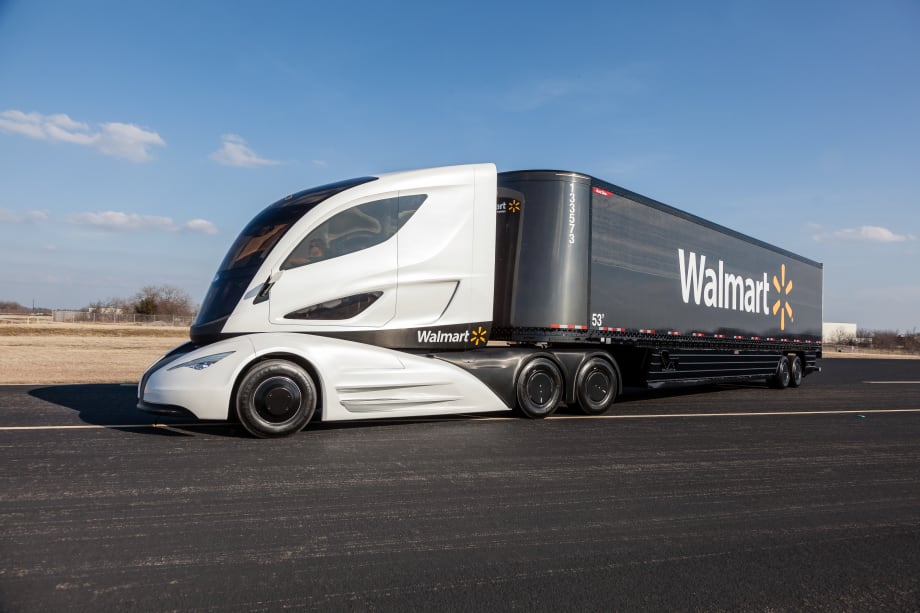
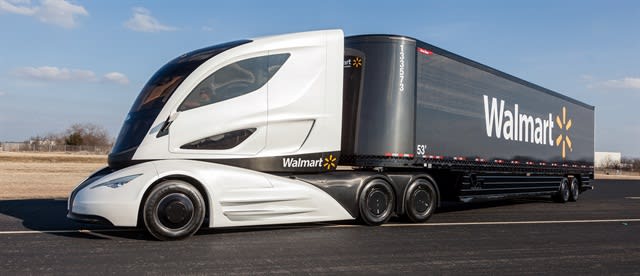
A futuristically styled tractor powered by a microturbine-electric hybrid drive system and a trailer made of lightweight carbon fiber comprise a concept rig shown off by Walmart Stores at a sustainability conference early this week.
The rig demonstrates materials and electro-mechanical systems that could help the giant retailer get further to its goal of reducing by half its energy use by 2015, executives said. They set that goal in 2005 and are now 80% there through greater efficiencies in transport procedures and energy efficiencies in its stores and other facilities, they had previously reported.
Peterbilt Motors, Capstone Turbine and Great Dane Trailer are among suppliers who assembled the vehicle, the company said. Walmart posted a 1-minute video on YouTube that explains some of the truck’s features:
The cabin tilts, cab-over-engine style, to reveal the turbine, generator, battery pack and electric motor that powers the tandem-rear axles. A sliding door allows access to the interior.
The driver sits in the center of the streamlined cabin with electronic-readout instrument panels on either side of the steering wheel, which sports a red Peterbilt oval, and sleeping accommodations are at the rear.
The trailer is a standard 53 feet long, but its walls are first-of-a-kind continuous panels of carbon fiber, the video’s narrator says. Its nose is “convex” – rounded like trailers of the 1930s – to smooth air flow and add cargo space.
Aerodynamic side skirts and wheel covers -- items readily available today -- adorn the trailer, which carries Walmart markings and "53'," along with a unit number.
The company calls the rig the Wal-Mart Advanced Vehicle Experience, or WAVE. Executives don’t say how much more aerodynamic or lightweight the vehicle is, or whether they’ll actually purchase rigs like it.
To see more visions of future trucks, see our photo gallery.
More Fuel Smarts

How Volvo Updated Its D13 for EPA 2027 [Watch]
Volvo’s updated D13 promises lower emissions without sacrificing performance or fuel economy. Take a closer look at what changed inside the engine in this HDT Spotlight video.
Read More →
Diesel Price Spike Shortens Payback for Natural Gas Trucks, Report Says
Energy Vision estimates fleets could recover the higher purchase price of an RNG-fueled Class 8 tractor in 1.3 to 2.8 years under current fuel-price scenarios.
Read More →
Calstart Becomes Catalyst Mobility, Reflecting Broader Focus
Calstart is now Catalyst Mobility, reflecting the nonprofit’s growing national role in clean transportation, including zero-emission trucks, infrastructure and incentive programs.
Read More →

Record Diesel Prices Squeeze Trucking Fleets
Average U.S. diesel prices have climbed to nearly $6 a gallon, surpassing the 2022 record as tight refinery capacity and Middle East disruptions keep fuel costs elevated.
Read More →
How Fuel Delivery Shapes Engine Performance
Fuel delivery depends on more than what happens at the injector. For fleet, maintenance and technical professionals, looking at the full path from pump to injector can provide useful context for understanding engine performance.
Read More →
East Coast Port Launches $45M Electric Truck Push
The Port Authority of New York and New Jersey announced millions in incentives for zero-emission drayage trucks, yard tractors, and new charging hubs near the port.
Read More →
California Bill Could Shed Light on Electric Truck Prices
Why do battery-electric Class 8 trucks remain so expensive? A California bill headed to Gov. Gavin Newsom would give fleets and state agencies more visibility into what manufacturers charge.
Read More →
Detroit Opens Orders for EPA 2027 Engines
Detroit isn’t starting from scratch to meet EPA 2027 diesel emissions standards. Its Gen 6 DD13 and DD15 engines keep much of today’s platform while updating the fuel and aftertreatment systems.
Read More →
Zero-Emission Truck Corridor Planned for West Coast
California, Oregon, Washington, British Columbia and Baja California are coordinating plans for truck charging and hydrogen fueling from Canada to Mexico.
Read More →
A Closer Look at Kenworth’s Electric T880E Vocational Truck [Video]
Learn more about Kenworth's T880E battery-electric vocational truck at the Paccar Technical Center, including its range, applications, upfitting considerations, and PTO options, in this HDT Spotlight video.
Read More →