





3 Electric Truck Infrastructure Issues that Must be Resolved
Volvo, University of Minnesota Test Electric Trucks in Extreme Weather
Volvo has teamed up with the University of Minnesota to conduct severe weather testing on its Class 8 VNR Electric trucks.
June 23, 2023
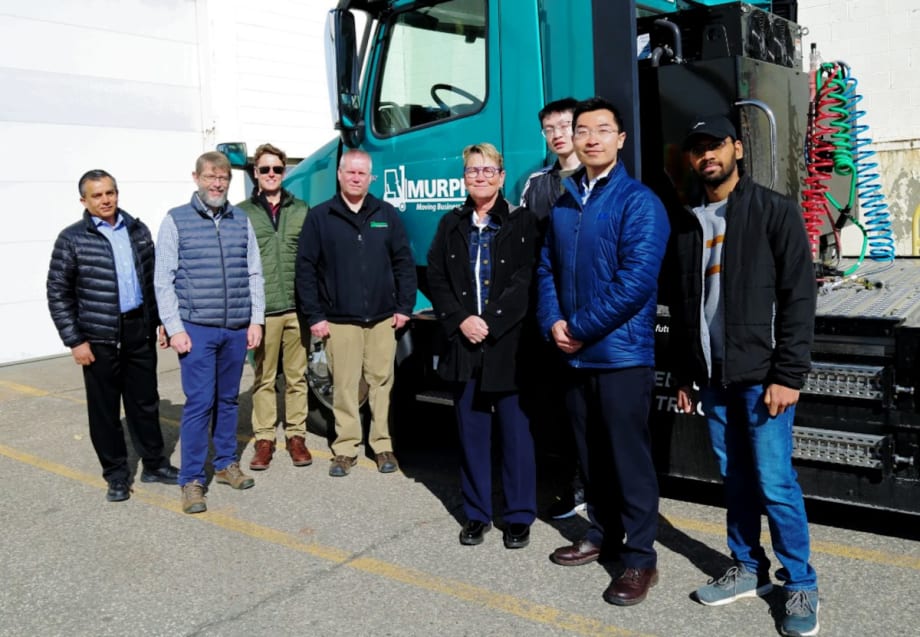
Volvo Truck engineers and project partners from the University of Minnesota, Murphy Logistics Solutions and H-E-B Grocery Company with a VNR Electric undergoing extreme weather testing trials.
Photo: Volvo Trucks North America
4 min to read
Volvo Trucks North America is working with the University of Minnesota to conduct extreme weather testing on its Class 8 VNR Electric model. The trials aim to analyze the impact of ambient temperature on a truck’s battery life.
UMN has teamed up with Murphy Logistics Solutions to test the battery-electric trucks in Minnesota with cold winter temperatures and H-E-B Grocery Company in Texas to test during periods of intense summer heat. The extreme weather testing project, which will demonstrate the capability of the Volvo VNR Electric using real-world fleet routes, is part of a Battery Efficiency for Sustainable Trucks Project sponsored by the U.S. Department of Energy’s Vehicle Technology Office.
The project will track the results of two Volvo VNR Electric engineering trucks with a six-battery configuration rated to provide up to 275 miles of range. Volvo is analyzing the battery-electric trucks’ performance on different routes in extreme temperatures with varying terrains and payload weights to better understand the challenges these factors present to help customers improve route planning and optimization.
Murphy and HEB will operate the battery-electric trucks on freight routes that exceed 250 miles in a day. The trucks will be operated by drivers in their fleets who have been trained by the Volvo Trucks electromobility team to use regenerative braking and other safe driving practices designed to maximize vehicle range.
The VNR Electric trucks will leave the warehouse at the beginning of the day with a 100% state of charge and will ideally return near empty (~10% SOC) at the end of their routes to take full advantage of useable energy in the battery.
“This research project is a critical step to ensuring the efficiency and reliability of Class 8 battery-electric trucks regardless of the environmental factors," said Keith Brandis, vice president of system solutions and partnerships for Volvo Group. "The results of this testing can be expected to bolster fleets’ confidence in the Volvo VNR Electric trucks’ reliability and performance in all weather conditions while still providing the creature comforts for drivers.”
Dedicated Environmental Control Systems
Similar to battery-electric passenger cars, heavy-duty battery-electric trucks can experience range reductions during extreme temperatures due to battery chemistry where the chemical and physical reactions in the battery can occur more slowly, reducing the BEV’s range. To combat that, a dedicated Battery Thermal Management System is included with the Volvo VNR Electric model to manage and maintain the optimum battery temperature range.
The BTMS is a dedicated heating and cooling system connected to the batteries with the purpose of avoiding chemical reaction slow down or potential cell damage in extreme conditions. This in turn provides long life and excellent performance from the batteries under a variety of weather conditions.
The other significant factor the tests will look at is the use of auxiliary power to either cool or warm the passenger cabin. If the ambient temperature is significantly above or below 70-71 degrees — the average temperature people keep their homes — the driver is more likely to turn on the heat or air conditioning, which draws energy from the battery.
Smart Energy Management
In addition to the severe weather testing, UMN has developed an Intelligent Energy Management System connected solution tool to help fleets understand how driving style can impact range, as well as how to take advantage of more energy efficient routing and decrease the cost and time required for on-route battery charging.
The tool uses a machine learning-based algorithm to dynamically inform drivers about available range and minimum charging requirements, taking load and ambient conditions into consideration. It also enables higher efficiency and longer range through advanced eco-route planning. To date, the EMS tool has helped Murphy and HEB achieve more than 20% increase in range.
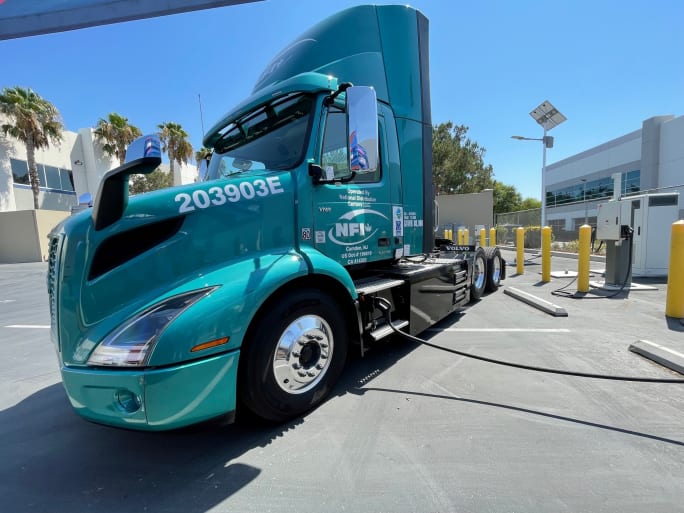
A Volvo VNL Electric recharges at NFI's Chino, California facility in 2022.
Photo: Jack Roberts
“Collaborating on research projects that will have a direct impact on the viability of battery-electric trucks in extreme weather provides a tremendous opportunity for our faculty and students to not only gain insight into the role that research and development plays in industry but make a real difference in advancing sustainable transportation,” said William Northrop, professor of mechanical engineering and director of the Thomas E. Murphy Engine Research Laboratory at the University of Minnesota – Twin Cities.
“Most testing in the past has been in a lab setting but now we are working with two fleets to improve real-world route efficiency and driver productivity to validate our data and software," Northrump said.
Once the research project in both climates is complete, UMN will publish the results in a series of conference and journal papers, in addition to sharing information with the U.S. Department of Energy and Volvo Trucks in the form of a final project report.
The two Volvo VNR Electric trucks participating in the field tests are supported by the Volvo Trucks commercial support teams and are maintained and serviced by Nuss Truck & Equipment, the local Volvo Trucks Certified Electric Vehicle Dealership in Minneapolis, Minnesota.
Volvo Trucks has a network of certified EV dealer partners across North America that have completed the required facility upgrades and rigorous training to service and maintain the Volvo VNR Electric model to ensure peak vehicle uptime, performance, and productivity.
More Equipment

How Volvo Updated Its D13 for EPA 2027 [Watch]
Volvo’s updated D13 promises lower emissions without sacrificing performance or fuel economy. Take a closer look at what changed inside the engine in this HDT Spotlight video.
Read More →
Michelin Tire Improves Efficiency and Durability for Regional Fleets
The Michelin X Multi Energy D2 is a regional haul drive tire engineered to help fleets improve fuel efficiency, durability and traction in demanding stop-and-go operations.
Read More →
ZF Expands Commercial Vehicle Push in North America
ZF is expanding its North American commercial-vehicle presence with new transmission applications, electrification, trailer technology and autonomous-driving systems.
Read More →
Tesla Wants a Self-Driving Semi. Are Cameras Enough?
Could Tesla’s camera-only autonomous driving technology work on an 80,000-pound Semi? In this commentary, HDT's Deborah Lockridge takes a look at Tesla, Cybercab, and how autonomous trucks see the road.
Read More →
Kodiak: Driverless Long-Haul Truck Launch on Track for 2026
Kodiak AI says its driverless long-haul safety case is 93% complete and it remains on track to begin commercial operations by year-end 2026.
Read More →
What DOT’s Automated Vehicle Strategy Means for Trucking
The U.S. Department of Transportation issued a new automated-vehicle strategy that outlines plans for driverless-truck regulations, cross-state freight corridors, and federal safety standards.
Read More →
East Coast Port Launches $45M Electric Truck Push
The Port Authority of New York and New Jersey announced millions in incentives for zero-emission drayage trucks, yard tractors, and new charging hubs near the port.
Read More →
PlusAI Going Public to Fund Autonomous Truck Launch
A SPAC deal could provide PlusAI with up to $300 million as it works toward a 2027 commercial launch of factory-built autonomous trucks.
Read More →
NHTSA Moves to Rewrite Truck Fuel-Economy Rules
The National Highway Traffic Safety Administration says it lacks authority to regulate medium- and heavy-duty truck engines separately from complete vehicles, but the existing standards have not yet been eliminated.
Read More →
Detroit Opens Orders for EPA 2027 Engines
Detroit isn’t starting from scratch to meet EPA 2027 diesel emissions standards. Its Gen 6 DD13 and DD15 engines keep much of today’s platform while updating the fuel and aftertreatment systems.
Read More →