




Related: Mack Anthem Makes Mexican Debut
Volvo Trucks Expands Presence in Growing Mexican Market
Volvo Trucks North America is expanding its presence in the growing Mexican truck market, debuting the new VNL long-haul truck and offering the VNR and VAH models for the first time.
by Staff
November 16, 2017
Volvo Trucks debuted the new VNL for the Mexican market. Photo: Jim Park
2 min to read
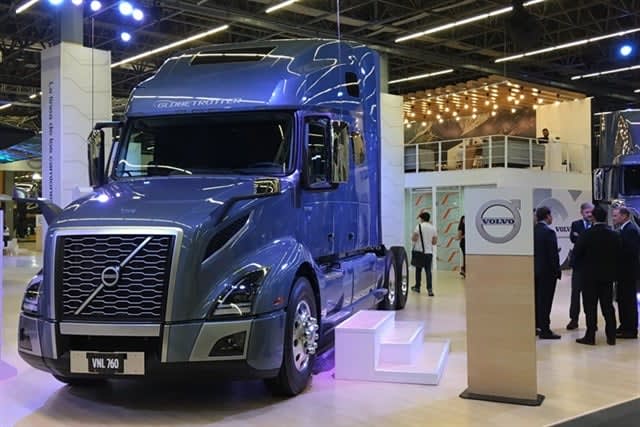
Volvo Trucks debuted the new VNL for the Mexican market.Photo: Jim Park
GUADALAJARA, MEXICO — The Mexican truck market has grown to 25,000 - 27,000 annual sales per year, according to Volvo, putting it on par with Canada and positioning it as one of the largest truck markets globally.
As a result, Volvo is expanding its presence in the country, officially launching the new VNL and for the first time, adding the VNR regional haul and VAH auto hauler truck models to the Mexican market.
“Expanding our product range makes Volvo Trucks even more competitive in the Mexican market,” said Göran Nyberg, president of Volvo Trucks North America, in making the announcement at the Expo Transporte commercial vehicle show. “We now have innovative, leading products for regional haul, long-haul and autohauler operations.”
The company has also worked to provide more access to truck buyers in and around Mexico City, investing 6 million to bring its trucks to the Group Alden dealership network and bringing the total number of Volvo dealer locations in Mexico to 43. The company has a presence in 140 countries with manufacturing operations on each continent.
Distinguishing it from U.S. versions, the VNL series trucks sold in Mexico will be offered with the Volvo D11 and D13 engines certified at EPA 04/ Euro 4, the country’s current emissions standard. Volvo GHG 17 engines will be an available option for trucks that will operate in areas where they’re permissible and ultra-low-sulfur diesel and diesel exhaust fluid are available.
For the first time, Volvo also introduced the new VNR series for regional haul operations and an expansion of the VAH auto hauler series in the country. Previously Volvo Trucks was mostly only offering the VNL in the Mexican market. The VNR and VAH will also be offered with U.S. EPA 04/ Euro 4 engines and GHG17 engines will be available as an option.
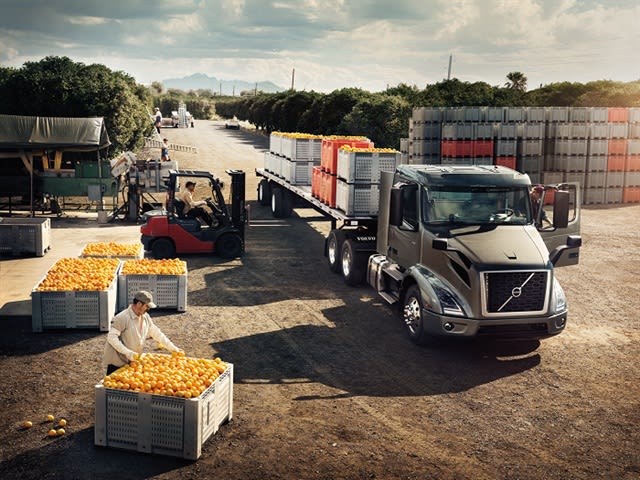
Volvo is offering the VNL for in Mexico for the first time.Photo: Volvo Trucks
All Volvo Trucks produced for the North American market are produced at the company’s Dublin, Virginia, manufacturing plant, and the number of vehicles being built is expected to increase.
Volvo now projects North America’s Class 8 market to reach 260,000 units next year, compared to 235,000 in 2017. That could even be a conservative number, according to Magnus Koeck, vice president of marketing and brand management at Volvo Trucks North America, who noted that some analysts are predicting as many as 309,000 units. “We will see if that will hold.”
John G. Smith of Today's Trucking contributed to this story.
More Equipment

How Volvo Updated Its D13 for EPA 2027 [Watch]
Volvo’s updated D13 promises lower emissions without sacrificing performance or fuel economy. Take a closer look at what changed inside the engine in this HDT Spotlight video.
Read More →
Michelin Tire Improves Efficiency and Durability for Regional Fleets
The Michelin X Multi Energy D2 is a regional haul drive tire engineered to help fleets improve fuel efficiency, durability and traction in demanding stop-and-go operations.
Read More →
ZF Expands Commercial Vehicle Push in North America
ZF is expanding its North American commercial-vehicle presence with new transmission applications, electrification, trailer technology and autonomous-driving systems.
Read More →
Tesla Wants a Self-Driving Semi. Are Cameras Enough?
Could Tesla’s camera-only autonomous driving technology work on an 80,000-pound Semi? In this commentary, HDT's Deborah Lockridge takes a look at Tesla, Cybercab, and how autonomous trucks see the road.
Read More →
Kodiak: Driverless Long-Haul Truck Launch on Track for 2026
Kodiak AI says its driverless long-haul safety case is 93% complete and it remains on track to begin commercial operations by year-end 2026.
Read More →
What DOT’s Automated Vehicle Strategy Means for Trucking
The U.S. Department of Transportation issued a new automated-vehicle strategy that outlines plans for driverless-truck regulations, cross-state freight corridors, and federal safety standards.
Read More →
East Coast Port Launches $45M Electric Truck Push
The Port Authority of New York and New Jersey announced millions in incentives for zero-emission drayage trucks, yard tractors, and new charging hubs near the port.
Read More →
PlusAI Going Public to Fund Autonomous Truck Launch
A SPAC deal could provide PlusAI with up to $300 million as it works toward a 2027 commercial launch of factory-built autonomous trucks.
Read More →
NHTSA Moves to Rewrite Truck Fuel-Economy Rules
The National Highway Traffic Safety Administration says it lacks authority to regulate medium- and heavy-duty truck engines separately from complete vehicles, but the existing standards have not yet been eliminated.
Read More →
Detroit Opens Orders for EPA 2027 Engines
Detroit isn’t starting from scratch to meet EPA 2027 diesel emissions standards. Its Gen 6 DD13 and DD15 engines keep much of today’s platform while updating the fuel and aftertreatment systems.
Read More →