




Volta Trucks to Enter U.S. Market with Electric Class 7
European electric truck manufacturer Volta Trucks plans to operate its Class 7 Volta Zero electric truck in California in 2023.

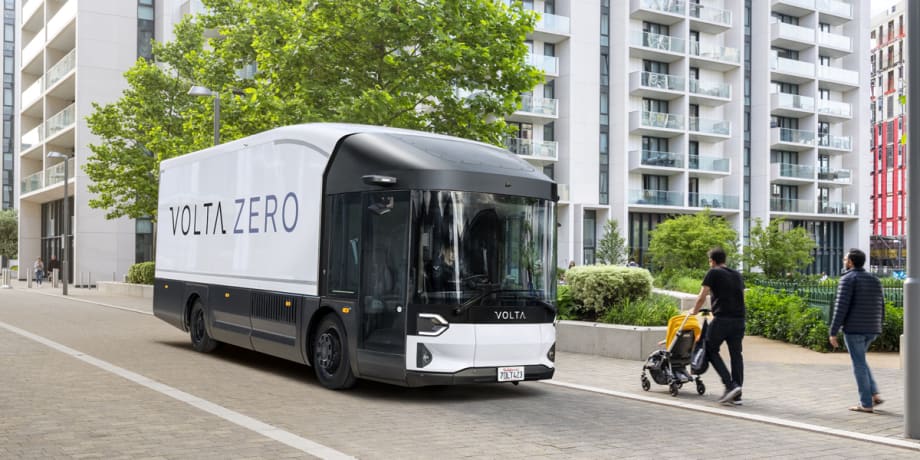
Volta Trucks will initially introduce a pilot fleet of 100 Class 7 trucks in mid-2023 that will be evaluated by U.S. customers.
Photo: Volta Trucks
European electric truck manufacturer Volta Trucks has revealed the roadmap for its entry into the North American market, and plans to operate its Class 7 Volta Zero electric truck in California in 2023.
Volta Trucks will initially introduce a pilot fleet of 100 Class 7 trucks in mid-2023 that will be evaluated by U.S. customers, starting in Los Angeles, ahead of a roll out of production vehicles in 2024.
“With more than 6,000 vehicle pre-orders in hand, from some of Europe’s largest fleet operators, it is time to expand our geographic horizons and look towards the significant market opportunity in North America,” Volta Trucks Founder Carl-Magnus Norden said. “I believe our full-electric truck will be perfectly suited to the US customer’s needs, and we look forward to engaging customers to gain feedback on our product and services, then testing and learning as we look to exceed their expectations.”
To date, Volta Trucks has built 24 prototypes which are currently undergoing a “rigorous and extensive” testing program in Europe. Ahead of the introduction in North America, the company expects to have already built more than 1,500 full-electric Class 7 trucks for European customers.
The introduction of Volta Trucks’ battery-electric commercial vehicles into North America will be led in 2023 by a Volta Zero Class 7 truck which is equivalent to the existing European 16-ton truck, with a dry or refrigerated cargo box. The Volta Zero is a medium-duty truck specifically designed for urban logistics. The truck features a compact eAxle, comprising the electric motor, transmission, and axle all in one unit, supplied by Meritor, and high-voltage batteries located within the chassis rails from Proterra.
As a vehicle specifically designed for urban logistics, the Class 7 Volta Zero will offer a modular battery configuration to deliver a range of 95 to125 miles. The vehicle is designed to accept both AC and DC 250 kW fast charging, which delivers a full charge from empty in just over an hour. Alternatively, one hour of 19 kW AC standard charging will add around 12 miles of driving range.
Volta Trucks, alongside Astheimer Design, reconfigured the entire driving experience to centrally mount the driver’s seat, and lowered it, in order to meet pedestrians and cyclists at eye level. The Volta Zero’s glasshouse-style cab offers a 220-degree view around the vehicle, for optimum visual awareness and blind-spot reduction.
Thanks to the Volta Zero’s central driving position, drivers enter and exit the vehicle on either side, always onto the sidewalk for their own safety, and through sliding rather than swinging doors, to also ensure the safety of passing cyclists, Volta officials said.
Future Vehicles
The 33,000 lbs. Class 7 Volta Zero introduction will be closely followed by a Class 5 vehicle of 19,500lbs., and a Class 6 truck of 26,000lbs., equivalent to the European 7.5- and 12-ton vehicles, in 2024/2025.
Class 5 and 6 Volta Zeros, revealed in April 2022, will bear a close visual relationship to the Class 7 vehicle.
All Volta Zeros benefit from the same safety standards of the Class 7 vehicle, as well as its zero-emission powertrain, eliminating not only carbon dioxide emissions but also harmful particulates. The Class 5 and 6 trucks will be identical to each other from the front, with the Class 6 vehicle having a longer chassis and body, and second set of rear wheels and tires, to accommodate the increased vehicle payload.
Truck-as-a-Service Model
The company will offer its Truck-as-a-Service proposition, described as a a one-stop-shop that takes all of the elements needed to electrify a truck fleet, and brings them into a single offering and monthly payment.
In Europe, Truck-as-a-Service comprises a suite of services including the initial site assessment to fully understand the infrastructure needs of a customer’s depot, through to the installation of the charging set-up. It also includes the finance and insurance of the vehicles to accelerate the adoption. It also includes all of the vehicle’s servicing and maintenance requirements over the customer’s lifetime of use.
Using the same approach as it has adopted in Europe, Volta Trucks will develop its own ‘Volta Trucks Hubs’ for vehicle service and maintenance. Hubs will be located close to its customer’s own logistics centers to maximize uptime and convenience. The company will also develop a network of third-party facilities to increase the geographic coverage of service and maintenance outlets.
U.S. Manufacturing
Work is now underway to kick-off initial U.S.-based manufacturing with an experienced partner, with agreements expected later in 2022. The first Class 7 vehicles delivered to the U.S. will be built at the company’s existing contract manufacturing facility in Steyr, Austria, to ensure the quality of the first US vehicles, officials said.
All Class 5 and 6 vehicles for North America expected to be built in the U.S., starting in 2024/2025.
More Fuel Smarts

New California Law Could Shed Light on Electric Truck Prices
Why do battery-electric Class 8 trucks remain so expensive? A California bill signed by Gov. Gavin Newsom would give fleets and state agencies more visibility into what manufacturers charge.
Read More →
How Volvo Updated Its D13 for EPA 2027 [Watch]
Volvo’s updated D13 promises lower emissions without sacrificing performance or fuel economy. Take a closer look at what changed inside the engine in this HDT Spotlight video.
Read More →
Diesel Price Spike Shortens Payback for Natural Gas Trucks, Report Says
Energy Vision estimates fleets could recover the higher purchase price of an RNG-fueled Class 8 tractor in 1.3 to 2.8 years under current fuel-price scenarios.
Read More →

Calstart Becomes Catalyst Mobility, Reflecting Broader Focus
Calstart is now Catalyst Mobility, reflecting the nonprofit’s growing national role in clean transportation, including zero-emission trucks, infrastructure and incentive programs.
Read More →
Record Diesel Prices Squeeze Trucking Fleets
Average U.S. diesel prices have climbed to nearly $6 a gallon, surpassing the 2022 record as tight refinery capacity and Middle East disruptions keep fuel costs elevated.
Read More →
How Fuel Delivery Shapes Engine Performance
Fuel delivery depends on more than what happens at the injector. For fleet, maintenance and technical professionals, looking at the full path from pump to injector can provide useful context for understanding engine performance.
Read More →
East Coast Port Launches $45M Electric Truck Push
The Port Authority of New York and New Jersey announced millions in incentives for zero-emission drayage trucks, yard tractors, and new charging hubs near the port.
Read More →
Detroit Opens Orders for EPA 2027 Engines
Detroit isn’t starting from scratch to meet EPA 2027 diesel emissions standards. Its Gen 6 DD13 and DD15 engines keep much of today’s platform while updating the fuel and aftertreatment systems.
Read More →
Zero-Emission Truck Corridor Planned for West Coast
California, Oregon, Washington, British Columbia and Baja California are coordinating plans for truck charging and hydrogen fueling from Canada to Mexico.
Read More →
A Closer Look at Kenworth’s Electric T880E Vocational Truck [Video]
Learn more about Kenworth's T880E battery-electric vocational truck at the Paccar Technical Center, including its range, applications, upfitting considerations, and PTO options, in this HDT Spotlight video.
Read More →