




Volta Trucks Begins Testing Electric Truck Prototypes
Volta Trucks has started engineering evaluation and development testing of the first prototype Volta Zero, an all-electric commercial truck designed for inner city logistics, in the United Kingdom.

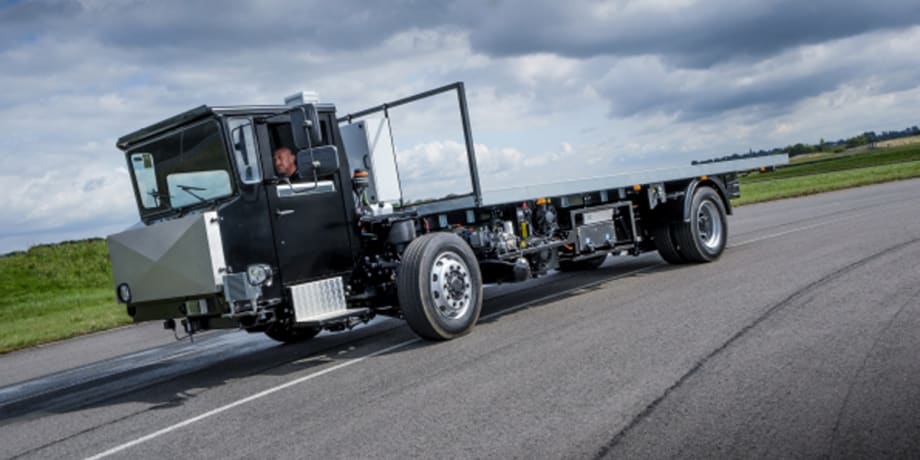
Volta Trucks will test all electro-mechanical and thermal properties of its prototype Volta Zero.
Photo: Volta
Volta Trucks has started engineering evaluation and development testing of the first prototype Volta Zero, an all-electric commercial truck designed for inner city logistics, in the United Kingdom.
The prototype vehicle uses the proposed production specification chassis frame and drivetrain of the finished vehicle and will test all the electro-mechanical and thermal properties of the truck. This includes the high-voltage battery supplied by Proterra, and the compact rear axle, electric motor and transmission eAxle unit from Meritor, Volta officials said in a press release.
The unconventional bodywork of the prototype is designed to protect the development driver from the elements when the vehicle is moving at speed. The production vehicle will feature a cargo box design, but the prototype uses a flatbed to allow engineers to add different levels and locations of loads to test its weight carrying capacity.
The prototype Volta Zero will continue testing over the coming months. The forthcoming test and development program with this and later-specification prototypes also includes periods of cold weather testing north of the Arctic Circle, and hot weather testing in southern Europe.
These learnings will be taken into the production of pilot fleet vehicles that will be tested and evaluated by key customers who have signed up for both testing and the option to purchase series production trucks. Full-scale production of customer-specification vehicles will then follow at the end of 2022.
“To have achieved this landmark moment in just eight months is a great example of the nimble and agile approach we have at Volta Trucks,” Chief Product Officer of Volta Trucks Ian Collins said. “We work at high pace to ensure that we can bring zero emission, full-electric commercial vehicles to market quickly, because our customers require vehicles as soon as possible. We need to go through a comprehensive and thorough development program, but the start of prototype testing is evidence that we are on track to deliver production vehicles, on time, by the end of next year.”
More Fuel Smarts

New California Law Could Shed Light on Electric Truck Prices
Why do battery-electric Class 8 trucks remain so expensive? A California bill signed by Gov. Gavin Newsom would give fleets and state agencies more visibility into what manufacturers charge.
Read More →
How Volvo Updated Its D13 for EPA 2027 [Watch]
Volvo’s updated D13 promises lower emissions without sacrificing performance or fuel economy. Take a closer look at what changed inside the engine in this HDT Spotlight video.
Read More →
Diesel Price Spike Shortens Payback for Natural Gas Trucks, Report Says
Energy Vision estimates fleets could recover the higher purchase price of an RNG-fueled Class 8 tractor in 1.3 to 2.8 years under current fuel-price scenarios.
Read More →

Calstart Becomes Catalyst Mobility, Reflecting Broader Focus
Calstart is now Catalyst Mobility, reflecting the nonprofit’s growing national role in clean transportation, including zero-emission trucks, infrastructure and incentive programs.
Read More →
Record Diesel Prices Squeeze Trucking Fleets
Average U.S. diesel prices have climbed to nearly $6 a gallon, surpassing the 2022 record as tight refinery capacity and Middle East disruptions keep fuel costs elevated.
Read More →
How Fuel Delivery Shapes Engine Performance
Fuel delivery depends on more than what happens at the injector. For fleet, maintenance and technical professionals, looking at the full path from pump to injector can provide useful context for understanding engine performance.
Read More →
East Coast Port Launches $45M Electric Truck Push
The Port Authority of New York and New Jersey announced millions in incentives for zero-emission drayage trucks, yard tractors, and new charging hubs near the port.
Read More →
Detroit Opens Orders for EPA 2027 Engines
Detroit isn’t starting from scratch to meet EPA 2027 diesel emissions standards. Its Gen 6 DD13 and DD15 engines keep much of today’s platform while updating the fuel and aftertreatment systems.
Read More →
Zero-Emission Truck Corridor Planned for West Coast
California, Oregon, Washington, British Columbia and Baja California are coordinating plans for truck charging and hydrogen fueling from Canada to Mexico.
Read More →
A Closer Look at Kenworth’s Electric T880E Vocational Truck [Video]
Learn more about Kenworth's T880E battery-electric vocational truck at the Paccar Technical Center, including its range, applications, upfitting considerations, and PTO options, in this HDT Spotlight video.
Read More →