




Two Ports Handle Record Volume, Cope with Freight Challenges
Two of the nation’s marine port complexes said they handled record container volume in 2014.
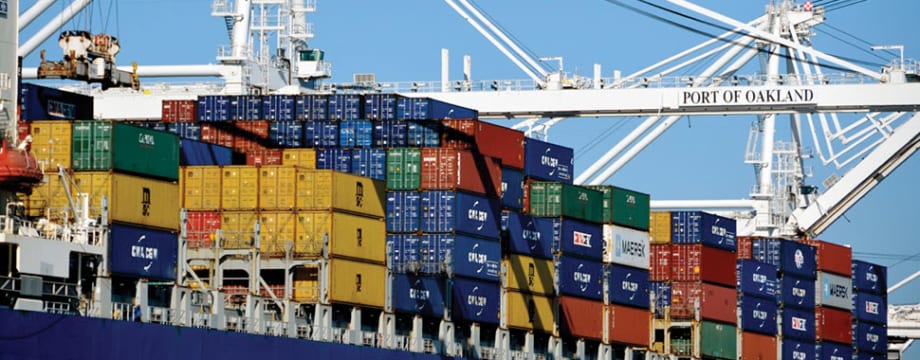
Photo: Port of Oakland
Photo: Port of Oakland
Two of the nation’s marine port complexes on the West and East Coasts said they handled record container volume in 2014.
The Port of Oakland, Calif., handled 2.394 million 20-foot-equivalent containers, breaking the record of 2.391 million boxes moved in 2006. A 20% surge in December loaded import containers contributed to the record performance, according to the port.
“An unprecedented series of events has brought us to this point,” said Port Maritime Director John Driscoll.
Overall container volume, imports and exports, increased 2% in 2014. Import volume for the year increased 5.29%.
According to port officials three factors contributed to the cargo surge: stronger U.S. demand for Asian manufactured goods, cargo diversions from congested Southern California ports and its own marketing efforts. Also a freight backlog at the ports of Los Angeles and Long Beach rerouted thousands of containers to northern California facility. Last month Oakland handled 74,356 loaded import containers, the most since May 2014.
However, the port said the big buildup has temporarily slowed cargo throughput with a labor dispute between West Coast waterfront employers and dockworkers magnifying the slowdown.
Ten-to-fifteen ships are anchored in San Francisco Bay daily awaiting berths at Oakland marine terminals, the port said, while some truckers report waits of several hours to pick up cargo. The condition is expected to persist until labor and management agree on a new contract.
The Oakland seaport is the fifth busiest container port in the U.S., according to the port.
Meantime, the Port of Virginia, which operates several facilities, also set a record for container volume in 2014, handling more than 2.3 million 20-foot equivalent units of containers, a 7.6% increase over the 2013 total.
“In 2014, we moved 169,000 more TEUs than we did in 2013, which until now was our most productive year on record,” said John F. Reinhart, CEO and executive director of the Virginia Port Authority. “The growth is significant, but it has created significant challenges as well, especially in service levels for our motor carriers.
The year included strong volume in December, when the port handled 203,276 TEUs, a jump of 12.3% when compared with the same month in 2013. December was the eighth month of 2014 when port TEU volumes exceeded 200,000 units.
In 2014, the port exceeded the 200,000-TEU mark in April, May, July, August, September, October, November and December.
Additionally, the Virginia Inland Port set a new annual throughput record having handled 36,841 containers, up 14.5% in 2014 from 2013. Total rail containers were 448,096, the highest in the port’s history, up 4% last year from 2013.
All segments of the port’s business posted increases in 2014, in terms of the number of containers, with trucks handling 868,108 containers, up 9.1%; rails handling 448,096 containers, up 4%; and barges handling 56,934 containers, up 18.4%.
The breakdown of how the cargo was moved is: 33% by rail, 63% by truck and 4% by barge.
The Virginia Port Authority operates four general cargo facilities: Norfolk International Terminals, Portsmouth Marine Terminal, Newport News Marine Terminal and the Virginia Inland Port in Warren County, while it leases the Virginia International Gateway and the Port of Richmond.
More Fleet Management

Color Match Smarter: Tools That Restore & Perform
For fleet managers and collision repair professionals keeping heavy-duty trucks on the road, getting the color right the first time isn't just about appearance — it's about efficiency, turnaround time, and bottom-line results. Discover how today's digital color tools are transforming the repair process from guesswork to precision.
Read More →
FMCSA Pauses Biennial-Update Enforcement Amid Motus Transition
Carriers whose updates were due on or after June 1 have more time, while FMCSA works to stabilize its new registration system and warns of phishing sites impersonating its new carrier registration system, Motus.
Read More →
2026 Blueprint for Countering Smarter Supply Chain Theft
Cargo theft is no longer just the cost of doing business. It's a multi-billion-dollar criminal enterprise exploiting vulnerabilities across your fleet, drivers, and supply chain.
Read More →


How Telematics Improves Visibility, Control, and Performance in Refrigerated Fleets
Explore how telematics help refrigerated fleets improve visibility, uptime, efficiency, compliance, and cargo protection across connected cold chain operations.
Read More →
What the U.S.-Canada Trade War Means for Trucking
Escalating U.S.-Canada tariffs could disrupt cross-border freight, reduce truck volumes, raise costs, and create new uncertainty for carriers on both sides of the border.
Read More →
What Are Trucking’s Top Concerns for 2026?
The American Transportation Research Institute wants to know what's worrying trucking fleet managers, drivers, and other stakeholders in its annual Industry Issues survey.
Read More →
American Trucking Associations Looks for a New Leader
ATA President and CEO Chris Spear abruptly left his job at the association on August 21, at a pivotal time for the trucking industry.
Read More →
Public Wi-Fi Cybersecurity Risks: How Truck Drivers and Fleets Can Protect Their Data
Public Wi-Fi can expose truck drivers and fleets to credential theft, malware, and other cyber threats. Here’s how to reduce the risk on the road.
Read More →
For Nicky Cupp, Fleet Innovation Starts With Frustration
HDT Truck Fleet Innovator Nicky Cupp turns everyday pain points at Fraley & Schilling into opportunities for better technology and smarter processes.
Read More →
Adam Buttgenbach’s Approach to Electric Trucks: Start With Where They Fit
HDT Truck Fleet Innovator Adam Buttgenbach helped PepsiCo build one of North America’s largest EV fleets by focusing on where electric trucks make operational sense.
Read More →