




TuSimple U.S. Exit Clouded by Autonomous Secrets Scandal
Autonomous-truck-tech company TuSimple is in the process of shutting down its U.S. business and pulling back to its China operations, but a shareholder lawsuit is seeking to block it from leaving with what it alleges are stolen corporate trade secrets, some vital to national security.

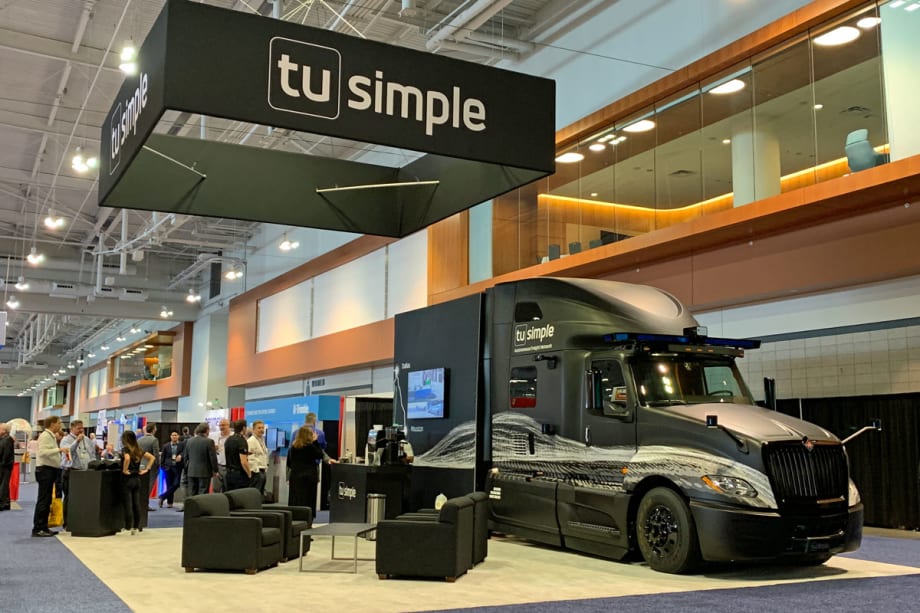
TuSImple exhibited at the American Trucking Associations' annual meeting in 2021, the same year it went public.
Photo: Deborah Lockridge
Autonomous-truck-tech company TuSimple is in the process of shutting down its U.S. business and pulling back to its China operations, but a shareholder lawsuit is seeking to block it from leaving with what it alleges are stolen corporate trade secrets, some vital to national security.
After failing to find a buyer or other alternatives for its U.S. operations, late last year, TuSimple laid off 75% of the company’s U.S. workforce, saying it would wind down its operations in this country and shift its focus to the Asia-Pacific region. TuSimple reported a loss from operations of $248.6 million for the third quarter of 2023.
On Jan. 17, TuSimple announced it would voluntarily delist the company’s common stock from The Nasdaq Stock Market and terminate the registration of its common stock with the Securities and Exchange Commission.
Since TuSimple’s initial public offering in 2021, a shift in capital markets has dampened investor enthusiasm for tech startups.
“The company's valuation and liquidity have declined, while the company's stock price volatility has increased significantly…. the benefits of remaining a publicly traded company no longer justify the costs,” the company explained in its delisting announcement. “As previously disclosed, the company is undergoing a transformation that the company believes it can better navigate as a private company than as a publicly traded one.”
In addition to the delisting, TuSimple is scheduled to auction off its autonomous trucks as well as research and development equipment, office supplies, etc., from its U.S. operations in late January/early February.
Stolen Trade Secrets?
However, TuSimple is facing allegations that it's trying to get out of the country because the company faces several pending shareholder lawsuits alleging the company misled investors and may have improperly shared information with Hydron, a Chinese hydrogen-truck startup linked to one of TuSimple’s founders. Hydron Inc. was started in 2021 by Mo Chen, TuSimple’s co-founder.
A Jan. 5 request for a temporary restraining order from two stockholders alleged that TuSimple defrauded investors by financing and giving autonomous vehicle technology to Hydron, which is believed to have ties to the Chinese Communist Party.
According to published reports, investigators from the FBI and the Securities and Exchange Commission have looked into claims that TuSimple shared with Hydron intellectual property developed in the U.S. sending valuable technology to an overseas adversary.
National Security Claims
According to the suit, the information at issue is the subject of a written National Security Agreement between the United States and TuSimple.
It charges that after TuSimple signed the NSA, Chen, who at the time held the majority of the voting power of the company, transferred at least part of the company’s trade secrets to TuSimple’s China-based business and to Hydron, a rival company Chen formed to compete in the same space as TuSimple.
As Courthouse News put it, “The plaintiffs argued in a hearing … that by trying to sell off their assets quickly, and delisting themselves from the Nasdaq stock exchange, the defendants were trying to take the company’s proceeds and more trade secrets to China so they could escape federal scrutiny and get out of reach of U.S. courts.”
Responding to the litigants’ request for an emergency action, on Jan. 23, a federal judge in San Diego granted a temporary restraining order.
“Through circumstantial evidence and reasonable inference, plaintiffs have demonstrated misappropriation of TuSimple’s trade secrets by defendant Hydron and others is likely to occur absent a [temporary restraining order], if it has not occurred already,” wrote U.S. District Judge Roger Benitez in his order. “Although the defendants argue plaintiffs lack concrete, direct proof, this is not required for a TRO.”
The plaintiffs now must file a request for a preliminary injunction by Feb. 9, and a hearing has been set for March 8.
More Equipment

How Volvo Updated Its D13 for EPA 2027 [Watch]
Volvo’s updated D13 promises lower emissions without sacrificing performance or fuel economy. Take a closer look at what changed inside the engine in this HDT Spotlight video.
Read More →
Michelin Tire Improves Efficiency and Durability for Regional Fleets
The Michelin X Multi Energy D2 is a regional haul drive tire engineered to help fleets improve fuel efficiency, durability and traction in demanding stop-and-go operations.
Read More →
ZF Expands Commercial Vehicle Push in North America
ZF is expanding its North American commercial-vehicle presence with new transmission applications, electrification, trailer technology and autonomous-driving systems.
Read More →
Tesla Wants a Self-Driving Semi. Are Cameras Enough?
Could Tesla’s camera-only autonomous driving technology work on an 80,000-pound Semi? In this commentary, HDT's Deborah Lockridge takes a look at Tesla, Cybercab, and how autonomous trucks see the road.
Read More →
Kodiak: Driverless Long-Haul Truck Launch on Track for 2026
Kodiak AI says its driverless long-haul safety case is 93% complete and it remains on track to begin commercial operations by year-end 2026.
Read More →
What DOT’s Automated Vehicle Strategy Means for Trucking
The U.S. Department of Transportation issued a new automated-vehicle strategy that outlines plans for driverless-truck regulations, cross-state freight corridors, and federal safety standards.
Read More →
East Coast Port Launches $45M Electric Truck Push
The Port Authority of New York and New Jersey announced millions in incentives for zero-emission drayage trucks, yard tractors, and new charging hubs near the port.
Read More →
PlusAI Going Public to Fund Autonomous Truck Launch
A SPAC deal could provide PlusAI with up to $300 million as it works toward a 2027 commercial launch of factory-built autonomous trucks.
Read More →
NHTSA Moves to Rewrite Truck Fuel-Economy Rules
The National Highway Traffic Safety Administration says it lacks authority to regulate medium- and heavy-duty truck engines separately from complete vehicles, but the existing standards have not yet been eliminated.
Read More →
Detroit Opens Orders for EPA 2027 Engines
Detroit isn’t starting from scratch to meet EPA 2027 diesel emissions standards. Its Gen 6 DD13 and DD15 engines keep much of today’s platform while updating the fuel and aftertreatment systems.
Read More →