




Truckload Linehaul, Intermodal Rates Continue Improvements
Truckload linehaul rates showed further stability in May, according to newly released figures, while a separate report shows intermodal rates continue to expand.

Truckload linehaul rates showed further stability in May, according to newly released figures, while a separate report shows intermodal rates continue to expand.
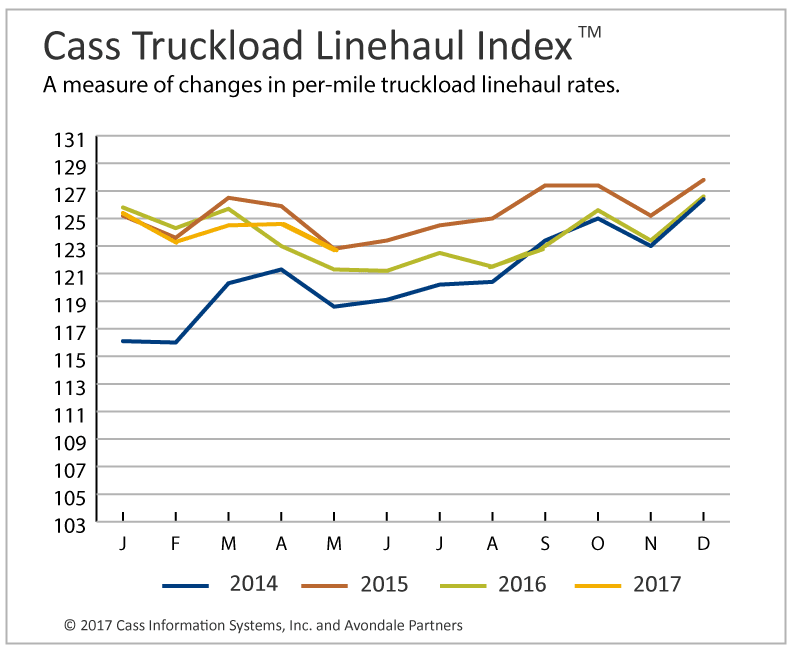
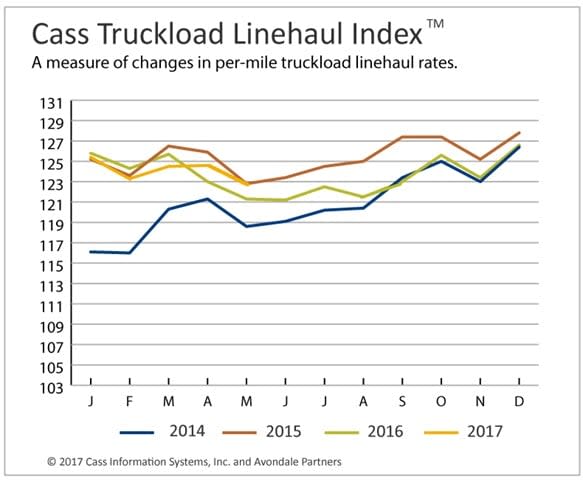
The Cass Truckload Linehaul Index increased 1.1% in May from the month before to a reading of 122.7. This follows a 1.1% rise in April from March, marking the end of 13 consecutive months of pricing contraction.
“May’s pricing, while promising, declined 1.5% sequentially versus April 2017 and is flat versus May of 2015,” said Donald Broughton with Broughton Capital.
Broughton's pricing forecast remains between a 1% decline to 2% rise for the year, as the current strength being reported in spot rates leads him to believe contract pricing rates should move back into positive territory by the end of the year.
The Cass Truckload Linehaul Index measures market fluctuations in per-mile truckload pricing that isolates the linehaul component of full truckload costs from others, such as fuel and accessorials, providing a reflection of trends in baseline truckload prices.
Meantime, the Cass Intermodal Price Index showed the pace of growth in May slowed from April. The reading of 129.3 is 2.9% lower than the previous month while it marked the eighth consecutive month of year-over-year improvements.
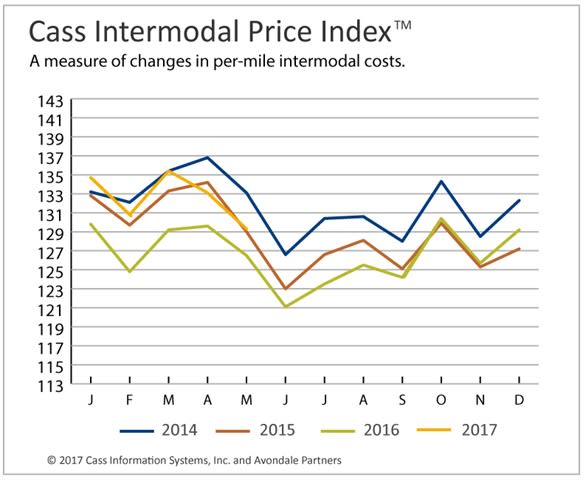
May’s data suggest that pricing momentum is slowing as growth softened compared to the 3%-near 5% monthly growth observed earlier this year, according to Broughton, who expects intermodal rates to show better strength in 2017 than during 2016.
“The price of diesel fuel has recovered from oversold lows and established a price more consistent with the marginal cost of production from domestic fracked sources,” he said. “Simply put, the current level of demand and pricing will produce a positive year-over-year comparison for the next six to nine months.”
The Cass Intermodal Price Index measures market fluctuations in per-mile U.S. domestic intermodal costs. It includes all costs associated with the move, such as linehaul, fuel and accessorials.
Data within both measures comes from actual freight invoices paid on behalf of clients of freight-payment processor Cass Information Services.
More Fleet Management

Volvo, Waabi Start Commercial Autonomous Operations in Texas
Volvo VNL Autonomous trucks, powered by the Waabi Driver, are hauling freight directly to third-party facilities for a customer in Texas.
Read More →
Samsara Launches Custom AI Agent Builder
Agent Studio lets fleets create AI tools for hours-of-service monitoring, reporting and driver support, including agents that communicate by phone.
Read More →
Geotab Links Fleet Card to Vehicle Data
The new card combines fuel discounts with telematics-based purchase controls. Geotab’s analysis also points to potential savings from choosing lower-priced fuel stops.
Read More →

How MFA Helps Protect Trucking Fleets
Multi-factor authentication adds protection when passwords are stolen. Here’s how it works and where fleets should start.
Read More →
How Better Freight Data Helps Trucking Teams Get Ahead of Disruption
Trucking and logistics teams have plenty of data. The problem is getting the right information in front of the right people soon enough to act. Better-connected data can help teams spot trouble earlier and make smarter decisions before small problems become big ones.
Read More →
Trimble: Taking Artificial Intelligence in Trucking Beyond Faster Tasks
At Insight 2026, Trimble executives argued that fleets may need to redesign workflows to get more from AI as it introduced new products and enhancements. AI’s value will depend on how fleets combine automation with their people's knowledge.
Read More →
Build a bulletproof fleet: Uniting ELDs and dash cams for total compliance
An ELD can prove compliance, but it cannot always prove what happened on the road. Discover how uniting accurate ELD data with AI-powered dash cam video can help your fleet strengthen compliance, defend against liability, protect drivers and reduce operational costs.
Read More →
Nominations Open for HDT Emerging Leaders
Heavy Duty Trucking is looking for accomplished trucking fleet professionals under 40 who are making an impact and helping lead the industry forward.
Read More →
Why Private Fleets Are Taking More Freight
Private fleets are putting their own trucks on demanding customers and high-cost lanes as companies seek greater control over service, costs, and capacity.
Read More →
Color Match Smarter: Tools That Restore & Perform
For fleet managers and collision repair professionals keeping heavy-duty trucks on the road, getting the color right the first time isn't just about appearance — it's about efficiency, turnaround time, and bottom-line results. Discover how today's digital color tools are transforming the repair process from guesswork to precision.
Read More →