




Trucking Conditions Index Drops As Capacity Utilization Softens
The FTR Trucking Conditions Index for February fell slightly in February to a reading of 7.4, reflecting a softening capacity utilization caused by fluctuating diesel prices and the suspension of controversial provisions of the 34-hour restart.
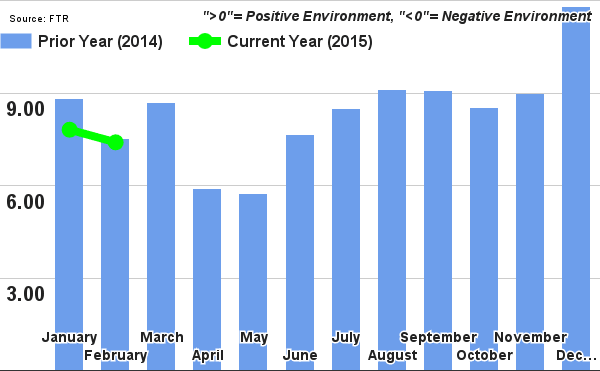
FTR's Trucking Conditions Index Graph showing this year's numbers compared with 2014. Graph via FTR
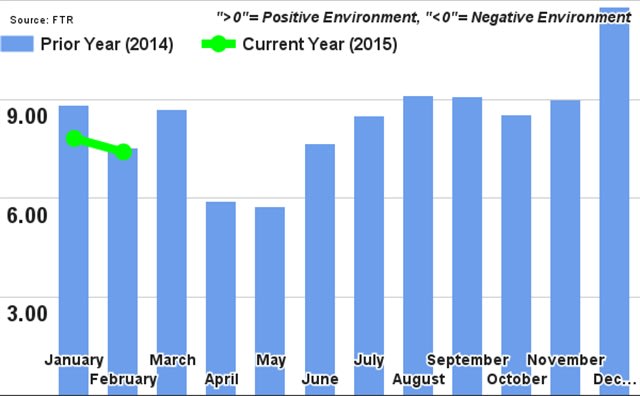
FTR's Trucking Conditions Index Graph showing this year's numbers compared with 2014.Graph via FTR
The FTR Trucking Conditions Index for February fell slightly in February to a reading of 7.4, reflecting a softening capacity utilization caused by fluctuating diesel prices and the suspension of controversial provisions of the 34-hour restart.
Despite falling from the January reading of 7.8, FTR predicts a rise into the summer months and beyond with double digit positive readings possible before 2016. The increase is expected to come as the industry faces more regulatory drag.
"We are beginning to hear of pushback from shippers about the continued rise in freight rates," said Jonathan Starks, FTR’s director of transportation analysis. “While we still expect all-in per mile rates to be fairly flat for most of 2015, base rates for trucking (and specifically contract rates) are still showing solid year-over-year gains.”
Fuel costs and spot market activity are causing shippers to question the continued increase in freight rates.
“Fuel costs are down 40% and, since fuel is about a quarter of trucking’s costs, it is a big deal,” said Starks.
Spot freight rates are also well below last year’s levels, but Starks added that harsh winter weather in 2014 was to blame for rates jumping as much as 20% during parts of the year, which has made 2015 rates seem particularly weak.
“After accounting for the drop in fuel during the year, spot rates are only down modestly during 2015, but this is opposed to the gains being seen for dedicated and contract rates,” said Starks “It takes careful explanation to educate shippers on why trucking costs are going up – but it is certainly a necessity in order to attract and retain quality drivers."
More Fleet Management

Why Private Fleets Are Taking More Freight
Private fleets are putting their own trucks on demanding customers and high-cost lanes as companies seek greater control over service, costs, and capacity.
Read More →
Color Match Smarter: Tools That Restore & Perform
For fleet managers and collision repair professionals keeping heavy-duty trucks on the road, getting the color right the first time isn't just about appearance — it's about efficiency, turnaround time, and bottom-line results. Discover how today's digital color tools are transforming the repair process from guesswork to precision.
Read More →
FMCSA Pauses Biennial-Update Enforcement Amid Motus Transition
Carriers whose updates were due on or after June 1 have more time, while FMCSA works to stabilize its new registration system and warns of phishing sites impersonating its new carrier registration system, Motus.
Read More →


2026 Blueprint for Countering Smarter Supply Chain Theft
Cargo theft is no longer just the cost of doing business. It's a multi-billion-dollar criminal enterprise exploiting vulnerabilities across your fleet, drivers, and supply chain.
Read More →
How Telematics Improves Visibility, Control, and Performance in Refrigerated Fleets
Explore how telematics help refrigerated fleets improve visibility, uptime, efficiency, compliance, and cargo protection across connected cold chain operations.
Read More →
What the U.S.-Canada Trade War Means for Trucking
Escalating U.S.-Canada tariffs could disrupt cross-border freight, reduce truck volumes, raise costs, and create new uncertainty for carriers on both sides of the border.
Read More →
What Are Trucking’s Top Concerns for 2026?
The American Transportation Research Institute wants to know what's worrying trucking fleet managers, drivers, and other stakeholders in its annual Industry Issues survey.
Read More →
American Trucking Associations Looks for a New Leader
ATA President and CEO Chris Spear abruptly left his job at the association on August 21, at a pivotal time for the trucking industry.
Read More →
Public Wi-Fi Cybersecurity Risks: How Truck Drivers and Fleets Can Protect Their Data
Public Wi-Fi can expose truck drivers and fleets to credential theft, malware, and other cyber threats. Here’s how to reduce the risk on the road.
Read More →
For Nicky Cupp, Fleet Innovation Starts With Frustration
HDT Truck Fleet Innovator Nicky Cupp turns everyday pain points at Fraley & Schilling into opportunities for better technology and smarter processes.
Read More →