




Trucking Applauds Derivatives Reforms in New Finance Law
The financial reform bill President Obama will sign today includes a provision that will lead to tougher regulation of derivatives trading, a move applauded by trucking interests that blame fuel price run-ups on excessive speculation in oil price futures
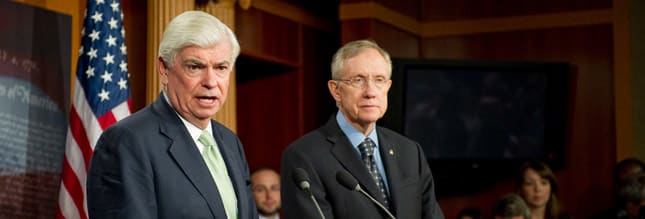
Senate Majority Leader Harry Reid (R) joined Senate Banking Committee Chairman Christopher Dodd (L) at a press conference last week, following a final passage vote on Wall Street reform legislation.
The financial reform bill President Obama will sign today includes a provision that will lead to tougher regulation of derivatives trading, a move applauded by trucking interests that blame fuel price run-ups on excessive speculation in oil price futures.
American Trucking Associations, which lobbied for this provision as the bill was being drafted, supports the measure, said Rich Moskowitz, vice president and regulatory affairs counsel.
"ATA applauds Congress's decision to curb excessive commodity speculation while protecting the ability of the trucking industry to hedge its exposure to increased fuel prices," Moskowitz said in a statement. "The legislation will help ensure that fuel prices are linked to the market forces of supply and demand."
The bill requires comprehensive reform of regulations covering the over-the-counter derivatives market, according to the Commodity Futures Trading Commission, the agency that regulates that market. The legislation, sponsored by Sen. Christopher Dodd (D-Conn.) and Rep. Barney Frank (D-Mass.), passed in the Senate last week.
Increased Oversight
"Over-the-counter derivatives dealers will - for the first time - be subject to robust oversight for their derivatives activities," said CFTC Chairman Gary Gensler in a statement. "This will greatly improve transparency and lower risk in the marketplace."
Under the bill, the commission is authorized to write rules that will set capital and margin requirements for over-the-counter derivatives dealers. The rules also will set new standards for how dealers conduct their business affairs, and will set new recordkeeping requirements.
In addition, the commission will create a regulated exchange for trading derivatives. This is a key step toward bringing the market out into the open, said Sen. Maria Cantwell, D-Wash.
"Unregulated and highly leveraged gambling in derivatives (was) a major contributing factor in a financial crisis that has now become an economic crisis," Cantwell said during the Senate debate over the bill. "Reining in the dark derivatives market is key to getting capital flowing to community banks and small businesses."
The new regime will bring most over-the-counter derivatives contracts out into the open, while continuing to protect the privacy of commercial companies like airlines and trucking companies that are hedging fuel price risk.
The speculative, non-commercial OTC derivatives contracts will now have to be cleared through central clearinghouses that act as middlemen. Participants in this market will have to post margin to back their bets.
This will give regulators information to oversee risky activities and prevent fraud, and will give participants in the market a flow of pricing information so they can shop for the best deal, said a coalition supporting the measure, Americans for Financial Reform.
Fuel Price Volatility
The trucking industry has long held that excessive speculation in the oil futures market is a significant component of fuel price spikes.
Randy Mullett, vice president of government relations and public affairs for Con-Way Carriers, put it this way in a testimony to Congress last February.
"One year ago, oil cost $42 a barrel. Today, oil has jumped to $74. Yet during this past year, global demand remained weak, crude oil inventory in storage was well above average, and the dollar declined by only 8 percent relative to the Euro. In the face of these market realities, excessive speculation is the only other variable left unaccounted for."
Mullett was representing ATA as a member of the Commodity Markets Oversight Coalition, which was lobbying for language to protect commercial hedgers and consumers from excessive speculation and systemic risk. In particular, the coalition wanted - and won - an exemption from mandatory clearing requirements for legitimate commercial end-users that use derivatives to manage risks associated with their businesses, ATA said in a statement.
The derivatives reform provision is one part of a massive bill touching all aspects of the financial services industry. Drafted in response to the near-collapse of the world financial system two years ago, it is described as the most far-reaching reform of the financial system since the legislation passed in the wake of the Great Depression. President Obama is likely to sign the measure this week.
Highlights include a new consumer protection watchdog within the Federal Reserve with authority to ensure clear, accurate information about financial products such as mortgages and credit cards, and creation of a system for liquidating financial companies that have in the past been considered too big to fail. It also creates a council charged with identifying and dealing with risks to the financial system. And it includes a version of the so-called Volcker rule, named for its chief proponent, former Federal Reserve Chairman Paul Volcker, which restricts the ability of federally insured banks to trade for their own benefit.
More Drivers

When Language Stops the Truck: The Return of ELP Out-of-Service Orders
English language proficiency rules for commercial drivers aren’t new, but renewed out-of-service enforcement has raised the stakes. Here’s what carriers need to know before a driver reaches a roadside inspection.
Read More →
Samsara Launches Custom AI Agent Builder
Agent Studio lets fleets create AI tools for hours-of-service monitoring, reporting and driver support, including agents that communicate by phone.
Read More →
Trucker Path Expands Reserved Parking Network
Trucker Path has added close to 6,000 more truck parking spaces to its Trucker Path Reserved Parking Network with the addition of Safe Truck Parking.
Read More →
EEOC Sues Texas Trucking Company Over Driver Age Limits
The agency says Trancasa USA rejected applicants over 65 and applied tougher driving-record standards to those over 60.
Read More →
Nussbaum, Roehl Announce Second Driver Pay Increase This Year
This year has seen a swath of major truck driver pay increases as freight capacity has tightened.
Read More →
From One Generation to the Next: How Mentorship Builds Safer Truck Drivers
After three decades in trucking, Harold Perry shares what he's learned about driver safety, mentorship, and helping the next generation build confidence behind the wheel.
Read More →
Truck Drivers Need More Than Another Alert
Fleets have more visibility into truck health, safety events, and driver activity than ever. The next challenge is turning all that information into useful guidance for the person who has to decide what to do next.
Read More →
FMCSA Removes 110 Truck Driver Training Schools from Certified ELDT List
Federal regulators also are targeting more than 160 additional training providers and launching a nationwide audit of third-party CDL skills testers as part of a broader crackdown on trucking fraud.
Read More →
Hours of Service Pilot Programs: FMCSA Readies for 2027 Rollout
Two pilot programs could eventually reshape hours-of-service rules, giving truck drivers options to pause their 14-hour clock or use longer split sleeper rest periods.
Read More →
Medical Cards, English Proficiency Reshape Roadcheck Violations
Medical-card violations jumped to the top of the driver out-of-service list during CVSA’s 2026 International Roadcheck, while English-language proficiency violations appeared among the leading violations for the first time.
Read More →