





Hair Testing Could Take Nearly 300,000 Truck Drivers Off the Road
Trucking Alliance Pushes for Hair-Testing Exemption
Why should motor carriers be allowed to report drivers to the Drug and Alcohol Clearinghouse for overhearing a conversation about drug-use under "actual knowledge," but not be able to report hair-testing? The Trucking Alliance wants to know.
September 21, 2022
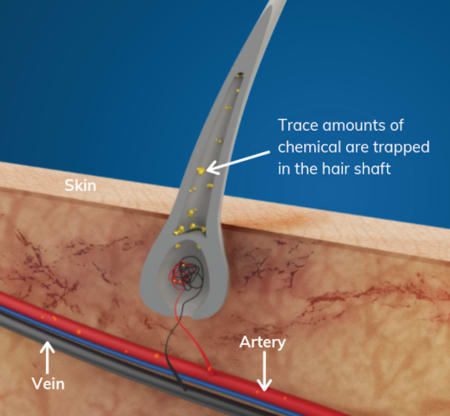
Proponents of hair-testing say it can detect drug-users who may cheat on urine tests or simply abstain long enough to pass.
Photo: Psychemedics
3 min to read
The Trucking Alliance says the Federal Motor Carrier Safety Administration has miscontrued its petition for an exemption from the Federal Motor Carrier Safety Regulations that would allow employers to include positive hair tests under the definition of “actual knowledge," which would require such results be reported to the FMCSA Drug and Alcohol Clearinghouse and to inquiring carriers.
The Trucking Alliance is a safety-oriented group of motor carriers, including Cargo Transporters; Dupré Logistics; Frozen Food Express; J.B. Hunt Transport; KLLM Transport Services; Knight Transportation; Maverick Transportation; Schneider; Swift Transportation; U.S. Xpress; and May Trucking Company.
In its notice for comments, the agency said that it lacks the statutory authority to grant the Trucking Alliance's request for exemption until the Department of Health and Human Services has taken certain action. However, it still requested public comment on the exemption application, as required by statute.
FMCSA drug and alcohol use and testing regulations were authorized by the Omnibus Transportation Employee Testing Act of 1991, which requires that DOT follow the Department of Health and Human Services' (HHS) Mandatory Guidelines for technical and scientific testing issues.
“Thus, while DOT has discretion concerning many aspects of the regulations governing testing in the transportation industries' regulated programs, DOT and FMCSA must follow the HHS Mandatory Guidelines for the laboratory standards and procedures used for regulated testing,” FMCSA said in its request for comments. “Therefore, allowing the use of a non-DOT drug test to serve as the basis for an actual knowledge report under 49 CFR part 382 is contrary to OTETA.”
HHS action on this issue is long overdue. In the 2015 Fixing America's Surface Transportation Act (FAST Act) Congress required that HHS, not later than one year after the act, issue those hair-testing guidelines. The FAST Act also amended OTETA by adding a requirement that FMCSA’s drug and alcohol testing regulations permit the use of hair testing as an acceptable alternative to urine testing for pre-employment drug testing, and for random drug testing when the driver was subject to pre-employment hair testing.
HHS finally issued proposed Mandatory Guidelines for Federal Workplace Drug Testing Using Hair (HMG) in September 2020 (85 FR 56108) which were roundly denounced by proponents. HHS has still not issued a final version of the HMG.
On Sept. 21, as the comment period was drawing to a close on the petition, the Trucking Alliance wrote to FMCSA Deputy Administrator Robin Hutcheson (who is also currently acting administrator).
The Alliance argued that FMCSA has established precedent for granting this petition, referring to FMCSA’s published guidance earlier this year regarding an employer’s “actual knowledge” of a truck driver’s illegal drug use. FMCSA explained that if a truck driver receives a citation to appear in court for driving under the influence, the driver’s employer must immediately report the DUI citation to the Clearinghouse, “regardless of conviction.”
“This DUI reporting requirement is correctly intended to prevent drivers from operating a commercial vehicle for another company while the DUI charges are pending,” the letter noted. “This is precisely what members of The Trucking Alliance aim to achieve with this Petition – to prevent drivers who fail a hair drug test from operating a commercial vehicle for another company until he/she completes rehabilitation.”
It also pointed out that FMCSA accepts non-regulated, subjective information as “actual knowledge,” such as if someone at the company overhears the driver talking about his/her drug use.
In addition, the Trucking Alliance said FMCSA misconstrued the petition. “The petition does not seek to circumvent forthcoming HHS drug testing guidelines. If the petition is granted, Trucking Alliance carriers will continue to utilize both hair testing and a urinalysis until HHS issues a final rule. The petition simply seeks to give equal standing to an accredited hair drug test as FMCSA does to a DUI citation and other non-DOT examples of drug use.”
Comments must be received on or before Sept. 23, 2022, and may be submitted through the Federal eRulemaking Portal at www.regulations.gov.
More Safety & Compliance

FMCSA Pauses Biennial-Update Enforcement Amid Motus Transition
Carriers whose updates were due on or after June 1 have more time, while FMCSA works to stabilize its new registration system and warns of phishing sites impersonating its new carrier registration system, Motus.
Read More →
ZF Expands Commercial Vehicle Push in North America
ZF is expanding its North American commercial-vehicle presence with new transmission applications, electrification, trailer technology and autonomous-driving systems.
Read More →
Truck Drivers Need More Than Another Alert
Fleets have more visibility into truck health, safety events, and driver activity than ever. The next challenge is turning all that information into useful guidance for the person who has to decide what to do next.
Read More →
Tesla Wants a Self-Driving Semi. Are Cameras Enough?
Could Tesla’s camera-only autonomous driving technology work on an 80,000-pound Semi? In this commentary, HDT's Deborah Lockridge takes a look at Tesla, Cybercab, and how autonomous trucks see the road.
Read More →
What DOT’s Automated Vehicle Strategy Means for Trucking
The U.S. Department of Transportation issued a new automated-vehicle strategy that outlines plans for driverless-truck regulations, cross-state freight corridors, and federal safety standards.
Read More →
NYC Expands Speed, Pedestrian Safety Tech Across Fleet
New York City is expanding intelligent speed assistance and pedestrian-alert systems across its municipal fleet, moving the technologies from pilot programs into vehicle procurement and retrofit requirements.
Read More →
FMCSA Removes 110 Truck Driver Training Schools from Certified ELDT List
Federal regulators also are targeting more than 160 additional training providers and launching a nationwide audit of third-party CDL skills testers as part of a broader crackdown on trucking fraud.
Read More →
Beyond DOT Compliance: What Makes a Trucking Fleet Truly Safe?
A trucking fleet can follow every rule and still make unsafe decisions. The real test comes when safety conflicts with freight, productivity, or cost.
Read More →
Hours of Service Pilot Programs: FMCSA Readies for 2027 Rollout
Two pilot programs could eventually reshape hours-of-service rules, giving truck drivers options to pause their 14-hour clock or use longer split sleeper rest periods.
Read More →
New Guide Offers Pet Safety Tips for Truck Drivers
Hundreds of thousands of pets travel in truck cabs. A new safety guide from Volvo Trucks and the Center for Pet Safety offers practical advice for truck drivers who bring dogs and cats along for the ride.
Read More →