





Dig Deeper: How to Get Control of Driver Log Falsification
Truckers Should Stop Using These ELDs
What are the latest electronic logging devices to be removed from the FMCSA's list of registered ELDs?
December 9, 2025
FMCSA is cracking down on electronic logging devices that allow truck drivers and motor carriers to cheat on their hours of service.
HDT Graphic
3 min to read
The Federal Motor Carrier Safety Administration removed three more devices from the agency’s list of electronic logging devices. These devices were placed on the Revoked Devices list due to the companies’ failure to meet the minimum requirements in the mandatory ELD regulation for truckers.
The latest revocation news comes a week after FMCSA announced it is changing the way ELD providers get added to the list.
ELDs, mandatory for most interstate truck drivers, electronically record driver hours-of-service to help prevent fatigue-related crashes and ensure compliance with federal safety regulations.
Under the self-certification system originally set up by the ELD regulations, it has been relatively easy to register non-compliant devices or re-register devices that had been revoked by the agency. FMCSA said its updated process closes this loophole. New ELD listings will no longer flow straight from self-certification to public listing.
“If an ELD isn’t meeting federal requirements, it’s taken out of service, plain and simple,” said FMCSA Administrator Derek Barrs in a news release.
Which ELDs Were Removed From the FMCSA List?
The FMCSA revocation notice from December 8 said motor carriers or drivers using the following revoked ELDs have up to 60 days to replace the revoked ELDs with compliant ELDs.
ELD Provider: Pioneer Safety Solutions LLC
Device Name: PSS ELD
Model Number: PRS
ELD Identifier: PRS271
ELD Provider: Black Bear ELD
Device Name: Black Bear ELD
Model Number: BRS
ELD Identifier: BRS254
ELD Provider: Rollingtrans
Device Name: RT ELD Plus - ACCURATE ELITE
Model Number: RT-ELITE-BLE3647
ELD Identifier: RTEL47
What Should You Do If You're Using One of these ELDs?
FMCSA will send an industry-wide email to inform motor carriers that anyone using the revoked ELDs must take the following steps:
Discontinue using the revoked ELDs and revert to paper logs or logging software to record required hours of service data.
Replace the revoked ELDs with compliant ELDs from the Registered Devices list before February 7, 2026.
Prior to February 7, 2026, safety officials are encouraged not to cite drivers using revoked ELDs for 395.8(a)(1) – “No record of duty status” or 395.22(a) – “Failing to use a registered ELD.”
Instead, safety officials should request the driver’s paper logs, logging software, or use the ELD display as a back-up method to review the hours-of-service data, according to FMCSA.
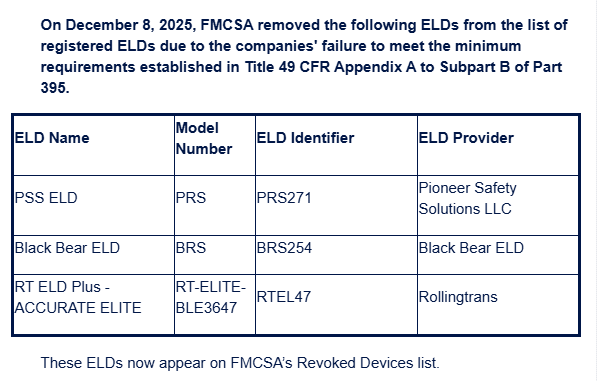
These electronic logging devices should no longer be used.
Source: FMCSA
Beginning February 7, 2026, motor carriers who continue to use the revoked devices listed above will be considered as operating without an ELD. Safety officials who encounter a driver using a revoked device on or after February 7, 2026, should cite 395.8(a)(1) and place the driver out-of-service (OOS) in accordance with the Commercial Vehicle Safety Alliance OOS Criteria.
If the ELD provider corrects all identified deficiencies for its device, FMCSA will place the ELD back on the list of registered devices and inform the industry of the update. However, that is a rare occurrence.
FMCSA strongly encourages motor carriers to take the actions listed above now and not wait to see if the ELD is returned to the list.
More Safety & Compliance
PrePass, Kodiak Connect Driverless Trucks to Roadside Enforcement
The system will allow enforcement agencies to verify Enhanced Inspection information and decide whether Kodiak’s autonomous trucks can bypass roadside screening sites.
Read More →
From One Generation to the Next: How Mentorship Builds Safer Truck Drivers
After three decades in trucking, Harold Perry shares what he's learned about driver safety, mentorship, and helping the next generation build confidence behind the wheel.
Read More →
FMCSA Pauses Biennial-Update Enforcement Amid Motus Transition
Carriers whose updates were due on or after June 1 have more time, while FMCSA works to stabilize its new registration system and warns of phishing sites impersonating its new carrier registration system, Motus.
Read More →
ZF Expands Commercial Vehicle Push in North America
ZF is expanding its North American commercial-vehicle presence with new transmission applications, electrification, trailer technology and autonomous-driving systems.
Read More →
Truck Drivers Need More Than Another Alert
Fleets have more visibility into truck health, safety events, and driver activity than ever. The next challenge is turning all that information into useful guidance for the person who has to decide what to do next.
Read More →
Tesla Wants a Self-Driving Semi. Are Cameras Enough?
Could Tesla’s camera-only autonomous driving technology work on an 80,000-pound Semi? In this commentary, HDT's Deborah Lockridge takes a look at Tesla, Cybercab, and how autonomous trucks see the road.
Read More →
What DOT’s Automated Vehicle Strategy Means for Trucking
The U.S. Department of Transportation issued a new automated-vehicle strategy that outlines plans for driverless-truck regulations, cross-state freight corridors, and federal safety standards.
Read More →
NYC Expands Speed, Pedestrian Safety Tech Across Fleet
New York City is expanding intelligent speed assistance and pedestrian-alert systems across its municipal fleet, moving the technologies from pilot programs into vehicle procurement and retrofit requirements.
Read More →
FMCSA Removes 110 Truck Driver Training Schools from Certified ELDT List
Federal regulators also are targeting more than 160 additional training providers and launching a nationwide audit of third-party CDL skills testers as part of a broader crackdown on trucking fraud.
Read More →
Beyond DOT Compliance: What Makes a Trucking Fleet Truly Safe?
A trucking fleet can follow every rule and still make unsafe decisions. The real test comes when safety conflicts with freight, productivity, or cost.
Read More →