




Truck Makers Hit With Record EU Fines for Price-Fixing in Europe
The European Union is fining five truck makers nearly 3 billion euros for acting as a cartel to fix prices of medium and heavy-duty trucks and time the introduction of technologies to comply with emissions rules.

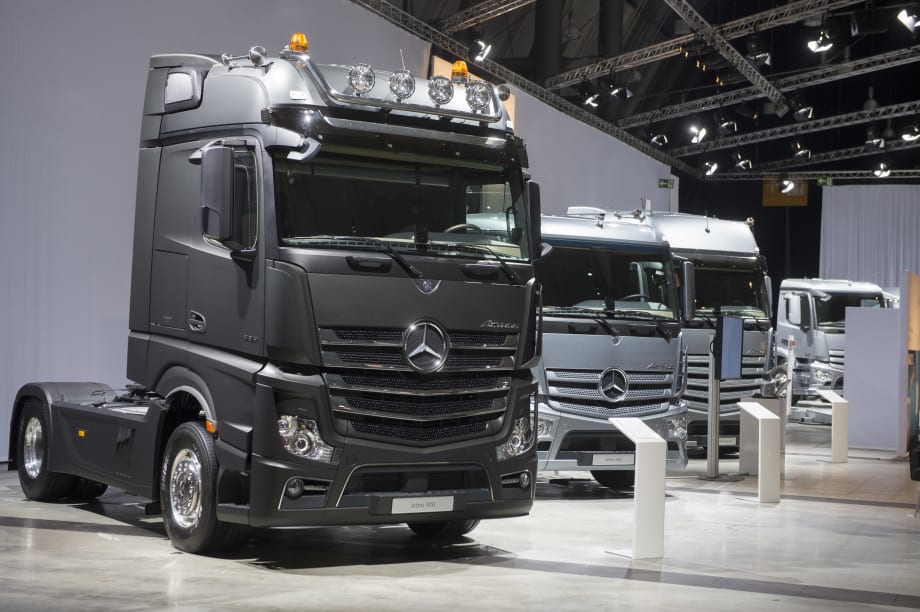
Mercedes-Benz trucks on display in 2012 at a pre-IAA Commercial Vehicle Show event. Daimler, as the largest of the truck makers involved in the EU investigation, also faces the largest fine. Photo by Sven-Erik Lindstrand.
Mercedes-Benz trucks on display in 2012 at a pre-IAA Commercial Vehicle Show event. Daimler, as the largest of the truck makers involved in the EU investigation, also faces the largest fine.Photo by Sven-Erik Lindstrand.
UPDATED -- The European Union is fining five truck makers nearly 3 billion euros for acting as a cartel to fix prices of medium and heavy-duty trucks and time the introduction of technologies to comply with emissions rules.
It’s the highest fines ever imposed by the EU for a single cartel — twice the previous highest amount, imposed in 2012, according to Margrethe Vestager, the European Union’s competition commissioner, in a statement.
MAN (now owned by Volkswagen), Daimler, DAF (owned by Paccar), Iveco and Volvo/Renault, which together account for around nine out of every 10 medium and heavy trucks sold in Europe, had been working together for 14 years, from 1997 until the European Commission’s investigation in 2011 put a stop to it.
MAN alerted the EU to the cartel’s activities and got full immunity from fines. Volvo/Renault, Daimler and Iveco also cooperated with the EU and had their fines reduced.
Paying the fines
Daimler faces the largest single fine, slightly more than 1 billion euros, also a record.
The five truck producers now have three months to pay the fine. However, the case has been under way for some time and most if not all of the truck makers, including Daimler, Volvo, Paccar, and CNH (parent company of Iveco) had already been setting aside funds to cover the anticipated fines.
Daimler had set aside 600 million euros back in 2014, and last week announced it had set aside 400 million for unspecified legal costs, so it already has accounted for the 1 billion.
In response to a query from HDT, Daimler officials confirmed that a settlement has been reached with the EU Commission in the antitrust investigation and noted that the company had cooperated in full with commission. The approximately 1 billion euro fine is partially based on the company’s related revenue during the period of the violation.
"Daimler regrets these occurrences and took appropriate action some time ago," according to a statement obtained by HDT. "Daimler takes its responsibility with regard to competition law very seriously and has taken all appropriate measures to ensure that all employees act in compliance with applicable law. The company has strengthened its internal controls and has intensified its regular and comprehensive employee training with regard to antitrust law and competition law."
In a press release announcing its settlement with the EU, Volvo noted that its 670 million euro fine is mainly covered by provisions made in 2014 and 2016. However, another provision will have a negative impact of 20 million euros on its third-quarter 2016 operating income.
“The commission case was already more than five years under way,” said Martin Lundstedt, Volvo President and CEO, of the settlement. “Without the settlement we would have been facing many more years of proceedings, with an uncertain outcome. We are now able to look forward and focus on our business.”
“While we regret what has happened, we are convinced that these events have not impacted our customers,” Lundstedt said.
However, now the truck makers may face litigation. Following the announcement by the European Commission, the litigation funding company Claims Funding Europe and the Netherlands law firm BarentsKrans announced that that they are preparing and will file
proceedings on behalf of businesses from all over Europe who bought trucks in the cartel
period from 1997 to 2011.
What happened
Senior managers from the truck makers first met in Brussels in January 1997, and for seven years met frequently, sometimes at trade shows or other events, according to Vestager. Starting in 2004, the cartel was organized at a lower level by the truck producers' subsidiaries in Germany.
According to EU officials, the companies were coordinating with each other on increasing the gross list price of trucks, as well as how to respond to the increasingly strict European emissions standards, when to introduce the new emissions technologies required, as well as the pricing for them.
“Delaying the introduction of environmentally friendly technology in agreement with competitors is not my idea of competition,” Vestager said.
Update 4 p.m. EDT adds comments from Daimler
More Equipment

How Volvo Updated Its D13 for EPA 2027 [Watch]
Volvo’s updated D13 promises lower emissions without sacrificing performance or fuel economy. Take a closer look at what changed inside the engine in this HDT Spotlight video.
Read More →
Michelin Tire Improves Efficiency and Durability for Regional Fleets
The Michelin X Multi Energy D2 is a regional haul drive tire engineered to help fleets improve fuel efficiency, durability and traction in demanding stop-and-go operations.
Read More →
ZF Expands Commercial Vehicle Push in North America
ZF is expanding its North American commercial-vehicle presence with new transmission applications, electrification, trailer technology and autonomous-driving systems.
Read More →
Tesla Wants a Self-Driving Semi. Are Cameras Enough?
Could Tesla’s camera-only autonomous driving technology work on an 80,000-pound Semi? In this commentary, HDT's Deborah Lockridge takes a look at Tesla, Cybercab, and how autonomous trucks see the road.
Read More →
Kodiak: Driverless Long-Haul Truck Launch on Track for 2026
Kodiak AI says its driverless long-haul safety case is 93% complete and it remains on track to begin commercial operations by year-end 2026.
Read More →
What DOT’s Automated Vehicle Strategy Means for Trucking
The U.S. Department of Transportation issued a new automated-vehicle strategy that outlines plans for driverless-truck regulations, cross-state freight corridors, and federal safety standards.
Read More →
East Coast Port Launches $45M Electric Truck Push
The Port Authority of New York and New Jersey announced millions in incentives for zero-emission drayage trucks, yard tractors, and new charging hubs near the port.
Read More →
PlusAI Going Public to Fund Autonomous Truck Launch
A SPAC deal could provide PlusAI with up to $300 million as it works toward a 2027 commercial launch of factory-built autonomous trucks.
Read More →
NHTSA Moves to Rewrite Truck Fuel-Economy Rules
The National Highway Traffic Safety Administration says it lacks authority to regulate medium- and heavy-duty truck engines separately from complete vehicles, but the existing standards have not yet been eliminated.
Read More →
Detroit Opens Orders for EPA 2027 Engines
Detroit isn’t starting from scratch to meet EPA 2027 diesel emissions standards. Its Gen 6 DD13 and DD15 engines keep much of today’s platform while updating the fuel and aftertreatment systems.
Read More →