




Torc Looks to Logistics to Further Develop Autonomous Trucks
Torc is cooperating with leading U.S. logistics companies to further develop the real-world applications for autonomous trucking.

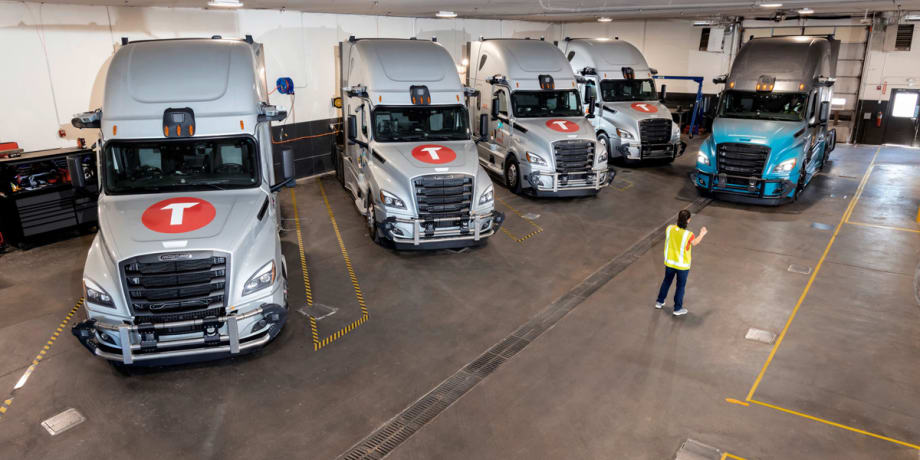
Torc has established the Torc Autonomous Advisory Council with key freight industry players to incorporate deep industry insights into its development process.
Photo: Torc
With its independent subsidiary Torc Robotics, Daimler Truck is pushing ahead with the development of autonomous trucking in the United States.
The companies have one of the longest autonomous driver technology and truck OEM partnership in the industry and have been testing a fleet of autonomous trucks on public roads in the U.S. on a daily basis. As a next step, Torc is now cooperating with leading U.S. logistics companies to further develop the real-world applications for autonomous trucking.
To that end, Torc has established the Torc Autonomous Advisory Council with key freight industry players to incorporate deep industry insights into its development process. Council members such as Schneider, Covenant Logistics, Penske Truck Leasing, Ryder System, C.H. Robinson and Baton as well as Daimler Truck North America as OEM, will provide strategic guidance to Torc as they integrate with the freight network and tackle challenges beyond highway driving.
With customer co-creation, Torc enters into the next stage of development, focusing even more sharply on specific customer requirements and concrete business models.
Progress on the Way to Hub-to-Hub Deployment
Since acquiring a majority stake in Torc three years ago, Daimler Truck has made significant progress in turning autonomous trucks from an idea into reality, Daimler officials said in a press release.
Typical driving scenarios such as lane changes and complex merges have been tested intensively and have proven that Torc’s autonomous driving software can safely navigate on highways, company officials said.
Recently, Torc has expanded its testing and is demonstrating L4 autonomous trucks with enhanced capabilities in more complex scenarios. Equipped with state-of-the-art lidar, radar and camera technology, the trucks are capable of advanced driving behaviors on surface streets, ramps and turns at controlled intersections.
These capabilities are essential for the planned deployment in the hub-to-hub use case. In this application, drivers deliver goods in conventional trucks over the first mile to transfer hubs along highways in key U.S. freight corridors. From there, the trailer is coupled with a purpose built L4 autonomous truck that safely navigates long stretches of highways by driving autonomously from hub-to-hub. Once the L4 truck reaches the destination hub, the last-mile distribution will continue via manually driven trucks. Factors such as long, open stretches of highway, increasing demand for freight movement, large fleets and forward-looking regulators make the U.S. the ideal proving ground to deploy this new technology first, company officials said.
“With Torc’s experience in commercializing autonomous vehicle solutions and Daimler Truck’s strong customer relationships in the freight industry, we’ve formed a powerhouse team to develop Level 4 technology for long-haul applications,” said Michael Fleming, founder and CEO of Torc. “The cooperation with our partners from the logistics industry creates numerous opportunities to co-develop concepts and facilities, and conduct research and development for Class 8 autonomous trucks, hub-to-hub operations, fleet operations, and fleet maintenance services.”
Autonomous-Ready Freightliner Cascadia
In the past few years, engineers at Daimler Truck North America have developed a scalable autonomous truck platform with critical safety systems.
Based on Freightliner’s flagship truck, the Class 8 autonomous-ready Cascadia with redundant functions enables the deployment of autonomous trucking. This truck has been designed and developed with a second set of critical systems, such as steering and braking to meet safety standards.
The vehicle continuously monitors and assesses the health of these systems. In case of interruption or errors, the redundant systems will be able to control the truck.
More Equipment

How Volvo Updated Its D13 for EPA 2027 [Watch]
Volvo’s updated D13 promises lower emissions without sacrificing performance or fuel economy. Take a closer look at what changed inside the engine in this HDT Spotlight video.
Read More →
Michelin Tire Improves Efficiency and Durability for Regional Fleets
The Michelin X Multi Energy D2 is a regional haul drive tire engineered to help fleets improve fuel efficiency, durability and traction in demanding stop-and-go operations.
Read More →
ZF Expands Commercial Vehicle Push in North America
ZF is expanding its North American commercial-vehicle presence with new transmission applications, electrification, trailer technology and autonomous-driving systems.
Read More →
Tesla Wants a Self-Driving Semi. Are Cameras Enough?
Could Tesla’s camera-only autonomous driving technology work on an 80,000-pound Semi? In this commentary, HDT's Deborah Lockridge takes a look at Tesla, Cybercab, and how autonomous trucks see the road.
Read More →
Kodiak: Driverless Long-Haul Truck Launch on Track for 2026
Kodiak AI says its driverless long-haul safety case is 93% complete and it remains on track to begin commercial operations by year-end 2026.
Read More →
What DOT’s Automated Vehicle Strategy Means for Trucking
The U.S. Department of Transportation issued a new automated-vehicle strategy that outlines plans for driverless-truck regulations, cross-state freight corridors, and federal safety standards.
Read More →
East Coast Port Launches $45M Electric Truck Push
The Port Authority of New York and New Jersey announced millions in incentives for zero-emission drayage trucks, yard tractors, and new charging hubs near the port.
Read More →
PlusAI Going Public to Fund Autonomous Truck Launch
A SPAC deal could provide PlusAI with up to $300 million as it works toward a 2027 commercial launch of factory-built autonomous trucks.
Read More →
NHTSA Moves to Rewrite Truck Fuel-Economy Rules
The National Highway Traffic Safety Administration says it lacks authority to regulate medium- and heavy-duty truck engines separately from complete vehicles, but the existing standards have not yet been eliminated.
Read More →
Detroit Opens Orders for EPA 2027 Engines
Detroit isn’t starting from scratch to meet EPA 2027 diesel emissions standards. Its Gen 6 DD13 and DD15 engines keep much of today’s platform while updating the fuel and aftertreatment systems.
Read More →