





You Also Might Like: CFI Expands Portfolio of Services Under its Brand
The Growth of Dedicated Truckload Capacity
Dedicated truckload capacity has been growing more than five times the rate of traditional dedicated contract carriage, according to Armstrong & Associates.
November 29, 2021
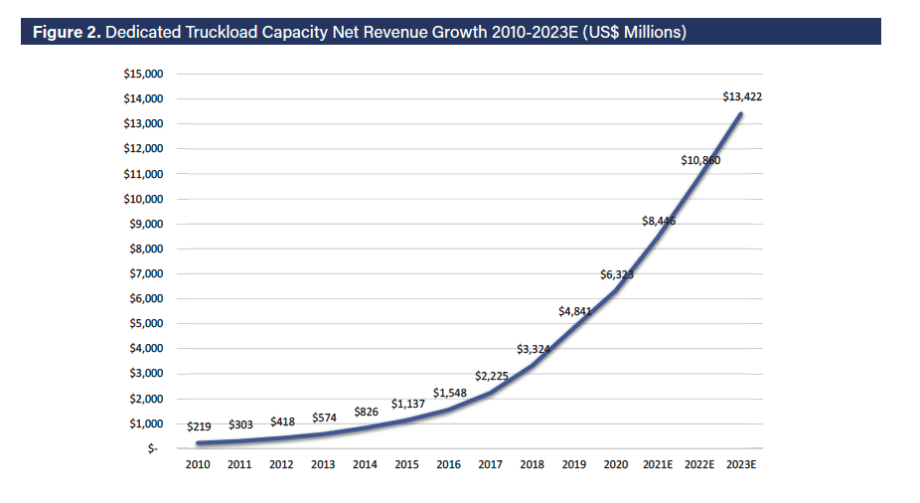
Shippers' need for flexibility has been driving dedicated truckload capacity growth.
Graph: Armstrong & Associates
2 min to read
Dedicated truckload capacity has been growing more than five times the rate of traditional dedicated contract carriage, according to Armstrong & Associates.
Image: Armstrong & Associates
In its report, “Dedicated Contract Carriage vs. Dedicated Truckload Capacity – The Search for Untapped Capacity,” Armstrong explains that dedicated truckload capacity, or DTC, is where a provider agrees to providing ongoing trucking capacity to a customer account in specific lanes or routes and equipment can be shared between customers. This kind of dedicated business has seen tremendous growth over the past 10 years. In 2020 alone, DTC net revenues jumped 30.6% to $6.3 billion among dedicated transportation providers.
This differs from the traditional, asset-heavy dedicated contract carriage third-party logistics segment, where specific trucking assets are dedicated to a customer account for a given contract length. This segment provides core trucking capacity to buyers in a market subject to cyclical driver/tractor shortages. In 2020, Armstrong reports, the DCC segment had the second highest net revenue growth of the four 3PL market segments, but it was just 0.3% to $20 billion. The negative effect of COVID-10 made 2020 a volatile and lower-volume year versus 2019 when DCC net revenues grew 12.1%.
DCC is an outgrowth of the way contract carriage used to be regulated. Up until deregulation in 1980, contract carriers were limited to a maximum of eight customers. Today, nearly all of truck transportation in the U.S. is done on some type of contract carriage, Armstrong explains. Over time, exclusive DCC has been supplemented by dedicated truckload capacity. DTC agreements tend to be shorter than those for DCC, as dedicated contract carriage relationships tend to be more long-term and “stickier,” to use Armstrong’s term. Food and groceries are the top industry served and also the top industry for revenue growth, according to the report.
Some of the largest DCC carriers are J.B. Hunt Dedicated, Penske Logistics, and Werner Dedicated, according to Armstrong.
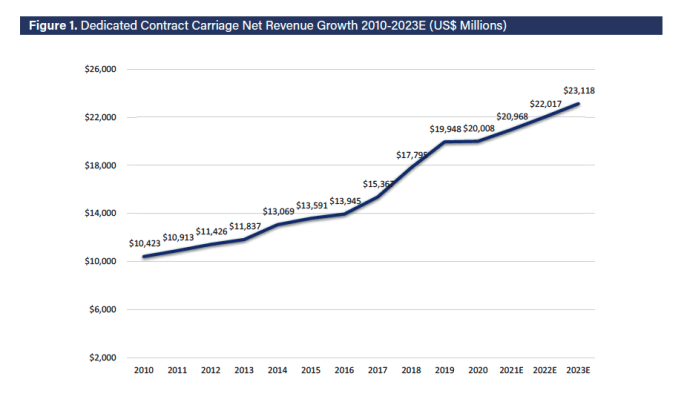
Dedicated contract carriage relationships tend to be more long-term and “stickier,” to use Armstrong’s term.
Graph: Armstrong & Associates
Armstrong survey respondents noted that when capacity tightens, the demand for dedicated seems to increase. The COVID-19 pandemic and its effects have tightened capacity and made it very difficult for companies who usually rely on the spot market. Customers want more committed capacity to combat rising spot market rates. In addition, the driver shortage is resulting in traditional truckload customers exploring a change to the dedicated model.
More Fleet Management

Sponsored•September 16, 2026
Color Match Smarter: Tools That Restore & Perform
For fleet managers and collision repair professionals keeping heavy-duty trucks on the road, getting the color right the first time isn't just about appearance — it's about efficiency, turnaround time, and bottom-line results. Discover how today's digital color tools are transforming the repair process from guesswork to precision.
Read More →
FMCSA Pauses Biennial-Update Enforcement Amid Motus Transition
Carriers whose updates were due on or after June 1 have more time, while FMCSA works to stabilize its new registration system and warns of phishing sites impersonating its new carrier registration system, Motus.
Read More →
Sponsored•September 14, 2026
2026 Blueprint for Countering Smarter Supply Chain Theft
Cargo theft is no longer just the cost of doing business. It's a multi-billion-dollar criminal enterprise exploiting vulnerabilities across your fleet, drivers, and supply chain.
Read More →


Sponsored•September 1, 2026
How Telematics Improves Visibility, Control, and Performance in Refrigerated Fleets
Explore how telematics help refrigerated fleets improve visibility, uptime, efficiency, compliance, and cargo protection across connected cold chain operations.
Read More →
What the U.S.-Canada Trade War Means for Trucking
Escalating U.S.-Canada tariffs could disrupt cross-border freight, reduce truck volumes, raise costs, and create new uncertainty for carriers on both sides of the border.
Read More →
What Are Trucking’s Top Concerns for 2026?
The American Transportation Research Institute wants to know what's worrying trucking fleet managers, drivers, and other stakeholders in its annual Industry Issues survey.
Read More →
American Trucking Associations Looks for a New Leader
ATA President and CEO Chris Spear abruptly left his job at the association on August 21, at a pivotal time for the trucking industry.
Read More →
Public Wi-Fi Cybersecurity Risks: How Truck Drivers and Fleets Can Protect Their Data
Public Wi-Fi can expose truck drivers and fleets to credential theft, malware, and other cyber threats. Here’s how to reduce the risk on the road.
Read More →
For Nicky Cupp, Fleet Innovation Starts With Frustration
HDT Truck Fleet Innovator Nicky Cupp turns everyday pain points at Fraley & Schilling into opportunities for better technology and smarter processes.
Read More →
Adam Buttgenbach’s Approach to Electric Trucks: Start With Where They Fit
HDT Truck Fleet Innovator Adam Buttgenbach helped PepsiCo build one of North America’s largest EV fleets by focusing on where electric trucks make operational sense.
Read More →