




Texting Ban Is Hard to Enforce But Still Has Teeth
It is not a simple thing for police to enforce the new federal ban on texting. The fact is, a patrolman at automobile level cannot see for sure what a driver is doing in a truck cab above him. That's only one of several concerns the enforcement community has about the guidance issued last month by the Federal Motor Carrier Safety Administration. But drivers and carriers should be aware that the policy does have teeth
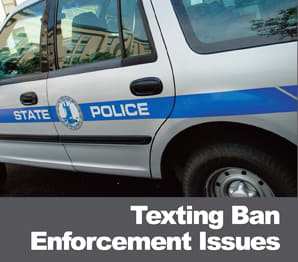
(Photo courtesy of CVSA)
It is not a simple thing for police to enforce the new federal ban on texting. The fact is, a patrolman at automobile level cannot see for sure what a driver is doing in a truck cab above him. That's only one of several concerns the enforcement community has about the guidance issued last month by the Federal Motor Carrier Safety Administration.
But drivers and carriers should be aware that the policy does have teeth.
"I feel confident that should a driver have a collision involving texting, that they can expect the maximum fine the first time from FMCSA," said Capt. Dan Meyer of the Kansas Highway Patrol. "I feel 100 percent confident in that statement."
The fine can go up to $2,750, and criminal penalties can apply as well. "Texting can be a criminal violation if it precipitates a fatal or injury crash," FMCSA Administrator Anne Ferro said when the ban was announced.
Carriers can expect police to subpoena a driver's cell phone to see if he was texting at the time of the crash, said Steve Keppler, interim executive director of the Commercial Vehicle Safety Alliance, which represents the enforcement community.
Buzzy France, administrative officer with the Maryland State Police and president of CVSA, put it this way: "If there's an accident (police) can apply for a search warrant and check that cell phone and determine if you were texting. If you were in violation, you know what's going to happen."
Non-Accident Enforcement
While the post-accident aspect of enforcement is straightforward, everyone from Transportation Secretary Ray LaHood down to the patrolman on the highway understands that it will be difficult to catch a driver in the act of texting.
"Enforcement of cell phone misuse while driving is difficult and we need to figure it out," LaHood said when he announced the FMCSA ban. He acknowledged that to a certain extent the ban is a symbolic act, intended to send a message.
France said that if a patrolman sees a truck driver texting, he'll definitely enforce the ban. "But how does a patrolman see it? I don't see a lot of enforcement going on with that violation at the moment. Everyone understands that it is a tough violation to enforce."
In Maryland, the situation is complicated by a state law that bans texting but does not ban receiving texts. "You can get a text and look at it, but you can't text back while you're driving," France said.
Police in Kansas will have no hesitation at all in using the FMCSA guidance as a tool in enforcement, Meyer said. "We fully support the ban and we will do whatever we have to, to ensure the safety of the public."
"(But) from the roadside perspective it is going to be somewhat difficult to distinguish between somebody looking down and dialing a phone, versus texting," he said.
Administrative Issues
Apart from this physical limitation, there are administrative complexities that are causing the enforcement community to approach the issue cautiously, according to Keppler of CVSA.
FMCSA posted its ban on texting as a "guidance" - essentially, an interpretation of a more generic safety rule - while it works on a proposed rule targeting not just texting but overall cell phone use by truck drivers. This approach gave the agency a quick way of getting a simple texting ban in place while it figures out the much more complicated question of cell phone usage. That proposal was supposed to be opened for public comment in February, but it is not on schedule.
Keppler said that states will do their best to enforce the ban but many will wait to see what's in the rule before they make major changes in their systems.
One issue is that the states must adopt FMCSA regulations before they can start enforcing them. About half of the states do that automatically, but the other half must go through a legislative process that can take months, Keppler said.
Another issue is that by putting the texting ban on a fast track, the agency left unanswered some questions that the enforcement community must still address.
One issue, for example, is how enforcement officials should handle compliance with the texting ban when they do on-site Compliance Reviews at carrier facilities. Inspectors can compare driver logs with cell phone records to see if the driver was texting illegally, but the procedures for doing such sampling are not clear, Keppler said.
"There are a lot of things that go into enforceability of rules, and the clarity of the rule can be changed by the notice and comment process (that will accompany the proposed rule,)" he said. "I think many of the states will wait and see what (the rule) looks like before going gangbusters."
Keppler also said there are many competing enforcement issues at the state level, including, notably, resources. "(The texting ban) is Mom and Apple Pie but there are lots of other competing interests. This is an unfunded mandate," he said.
CVSA is working on policy principles that should be available soon, he said.
Looking Ahead
In the longer term, LaHood and the enforcement community want to see action by the wireless industry to figure out how to prevent use of cell phones while driving. Meyer of the Kansas State Patrol suggested that one alternative might be to make texting inoperable while a vehicle is in motion. "That would be the simplest thing, to be proactive in that manner than reactive and punitive."
Meanwhile, though, as LaHood said, a large part of reducing the peril of driving while distracted comes down to individuals taking responsibility for their own actions.
France put it this way: "The fact of the matter is, in most instances the police will not be able to enforce the rule. So it is up to each of us as individuals to do the safe thing."
More Drivers

Platform Science Adds Dispatch and Safety Tools
Four additions to PS Fleet help fleets monitor loads, manage driver coaching, share truck locations and adjust video system settings.
Read More →
When Language Stops the Truck: The Return of ELP Out-of-Service Orders
English language proficiency rules for commercial drivers aren’t new, but renewed out-of-service enforcement has raised the stakes. Here’s what carriers need to know before a driver reaches a roadside inspection.
Read More →
Samsara Launches Custom AI Agent Builder
Agent Studio lets fleets create AI tools for hours-of-service monitoring, reporting and driver support, including agents that communicate by phone.
Read More →
Trucker Path Expands Reserved Parking Network
Trucker Path has added close to 6,000 more truck parking spaces to its Trucker Path Reserved Parking Network with the addition of Safe Truck Parking.
Read More →
EEOC Sues Texas Trucking Company Over Driver Age Limits
The agency says Trancasa USA rejected applicants over 65 and applied tougher driving-record standards to those over 60.
Read More →
Nussbaum, Roehl Announce Second Driver Pay Increase This Year
This year has seen a swath of major truck driver pay increases as freight capacity has tightened.
Read More →
From One Generation to the Next: How Mentorship Builds Safer Truck Drivers
After three decades in trucking, Harold Perry shares what he's learned about driver safety, mentorship, and helping the next generation build confidence behind the wheel.
Read More →
Truck Drivers Need More Than Another Alert
Fleets have more visibility into truck health, safety events, and driver activity than ever. The next challenge is turning all that information into useful guidance for the person who has to decide what to do next.
Read More →
FMCSA Removes 110 Truck Driver Training Schools from Certified ELDT List
Federal regulators also are targeting more than 160 additional training providers and launching a nationwide audit of third-party CDL skills testers as part of a broader crackdown on trucking fraud.
Read More →
Hours of Service Pilot Programs: FMCSA Readies for 2027 Rollout
Two pilot programs could eventually reshape hours-of-service rules, giving truck drivers options to pause their 14-hour clock or use longer split sleeper rest periods.
Read More →