





All About Truck Tires: Load Ratings, Sizes & More
Tesla Electric Semi Truck Debuts for Real
We know a little more now about the Tesla battery-electric Semi truck, as the first one is delivered to a customer — five years after its initial debut.
December 2, 2022
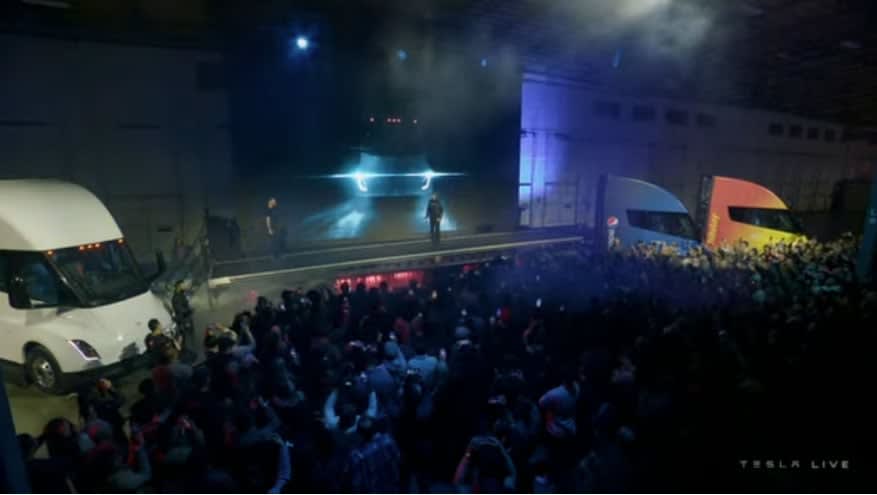
Tesla handed over a battery-electric Semi truck to PepsiCo.
Screen capture from Tesla livestream of event
4 min to read
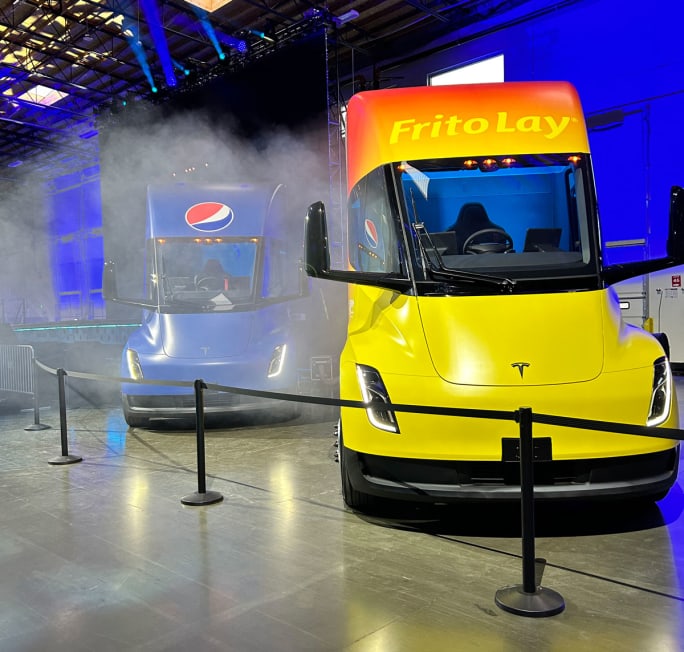
The Dec. 1 Tesla Semi event included two trucks with the colors and logos of Pepsi and its subsidiary Frito-Lay.
Photo: Mike Roeth/NACFE
After five years of controversy and skepticism, electric-car maker Tesla finally rolled out production-ready models of its Class 8 battery-electric Semi tractor. Yet many questions still remain about the new electric 18-wheeler as trucking prepares to move a away from diesel engines in the coming years.
Tesla first announced its plans to enter the Class 8 truck market with electric commercial vehicles in the fall of 2017, with a splashy debut for early validation Semi models at Tesla CEO’s SpaceX facility in Hawthorne, California. At the time, CEO Elon Musk and Tesla engineers raised eyebrows by promising an all-electric Class 8 tractor that would be capable to run loaded up to 80,000 pounds for 500 miles on a single battery charge.
At the Semi’s 2017 unveiling, Musk indicated it would go into production sometime in 2019. Various delays and extensions on that production date led to speculation in the trucking industry that Tesla had over-promised on the Semi’s capabilities, eventually leading to skepticism that the truck would ever see the light of day, much less enter into private fleet operations.
“I can’t believe it’s been five years since we unveiled the Semi,” Musk said the evening of Dec. 1, taking the stage at Tesla’s Semi production facility outside of Sparks, Nevada. “A lot has happened in that time, to say the least,” he added. “But we’re incredibly excited tonight to actually deliver our first production Tesla Semi trucks.”
Pepsico and the 500-Mile Tesla Semi Run
Tesla used the event to formally hand over the first production Semi trucks to PepsiCo and shared some details about the new vehicle.
Chief among these was the report of a 500-mile, single-charge run made by a fully loaded Semi tractor-trailer from Northern California to San Diego. The run, which was made on Nov. 26, featured a Semi loaded to “just under 82,000 pounds,” and included driving over Grapevine Pass, a particularly steep grade on Interstate 5 running through California.
Tesla officials talked about "hardcore testing" and said the company would be using the trucks in its own supply chain.
However, industry analysts noted that there were many important details about the Semi that Tesla still has yet to reveal. Musk did not discuss GVWR for the Semi, details on a production schedule for the truck, or any information on pricing.
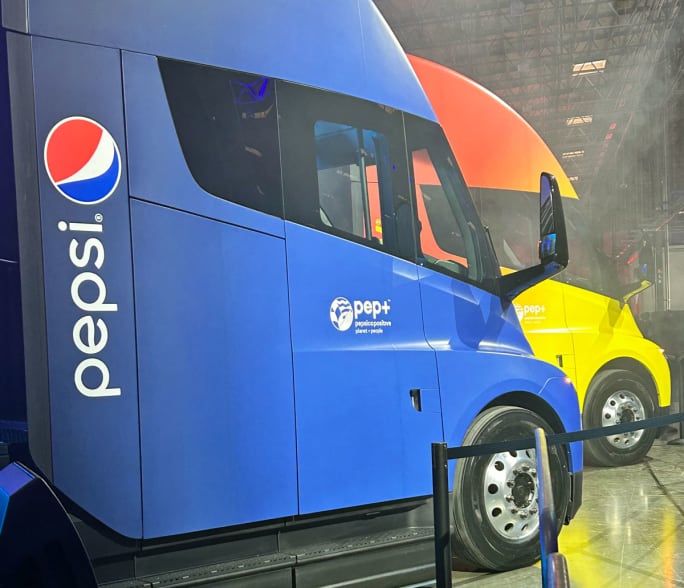
Tesla's Elon Musk said the Semi pulled a huge load of Frito-Lay products, including delivering some for the event attendees to enjoy.
Photo: Mike Roeth/NACFE
Tesla Semi Features Simple Design
Overall, the event was a mixed bag of promising information and a frustrating lack of details, said Mike Roeth, executive director of the North American Council for Freight Efficiency, who was on hand for the launch and spoke with HDT the next morning.
“We were able to tour the Semi production plant, and that verified for me just how simple the truck’s design is,” Roeth said. “There are only nine stations needed to build a truck. And the entire factory is smaller than most engine plants I’ve toured.”
Roeth noted that simplicity seems to be Tesla’s defining design concept for this first-generation production Semi. “There’s only one spec available right now, a daycab model with room enough for what will ultimately be a small sleeper berth behind the center-position driver’s seat,” he said. “And, as far as I can tell, there’s really only one option available — and that’s one or two jump seats that can be spec’d behind the driver.”
Roeth said the smaller size of almost all the Semi’s components also struck him as a new concept for the North American Class 8 truck market.
“All of the components on this truck appear to be smaller and simpler in design that what I’ve seen on other electric trucks,” he said. “The motors are smaller. So, too, are the battery packs. And it’s amazing that they’re able to get 500 miles of usable range out of those batteries and components.”
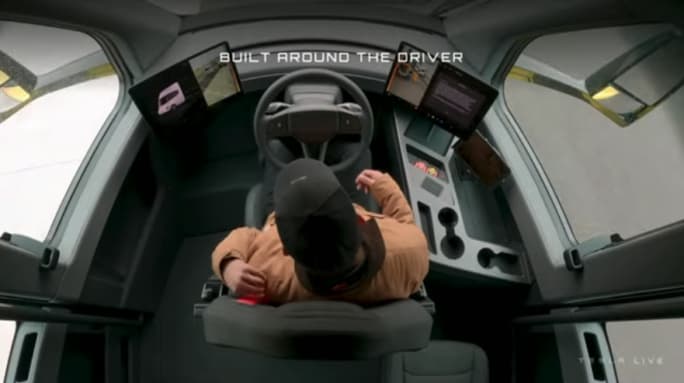
The center-driver position allows for more bullet-like aerodynamics.
Screen capture from Tesla livestream of event
Is Tesla Semi a Game-Changer in Electric Trucks?
Roeth said the reaction from various fleet customers in attendance was one of vindication after the long, five-year wait for trucks.
“I think the 500-mile run from North California to San Diego impressed a lot of people and has the potential to be a game-changer for the trucking industry and battery-electric trucks,” Roeth said. “They only made that run a few days ago, so I don’t think they have a whole lot of data to share yet. But we do know that the truck started the run with a 97% battery charge and ended with 4% of charge remaining. And that was a hell of a run for a fully loaded truck — including pulling Grapevine Pass, which is no easy thing to do. So I feel like they really delivered what they promised five years ago in terms of range and performance.”
For the moment, Tesla is mum on future production plans for the Semi, although Musk has said in the past that the company plans to build 50,000 Tesla 18-wheelers in 2024.
More Equipment

How Volvo Updated Its D13 for EPA 2027 [Watch]
Volvo’s updated D13 promises lower emissions without sacrificing performance or fuel economy. Take a closer look at what changed inside the engine in this HDT Spotlight video.
Read More →
Michelin Tire Improves Efficiency and Durability for Regional Fleets
The Michelin X Multi Energy D2 is a regional haul drive tire engineered to help fleets improve fuel efficiency, durability and traction in demanding stop-and-go operations.
Read More →
ZF Expands Commercial Vehicle Push in North America
ZF is expanding its North American commercial-vehicle presence with new transmission applications, electrification, trailer technology and autonomous-driving systems.
Read More →
Tesla Wants a Self-Driving Semi. Are Cameras Enough?
Could Tesla’s camera-only autonomous driving technology work on an 80,000-pound Semi? In this commentary, HDT's Deborah Lockridge takes a look at Tesla, Cybercab, and how autonomous trucks see the road.
Read More →
Kodiak: Driverless Long-Haul Truck Launch on Track for 2026
Kodiak AI says its driverless long-haul safety case is 93% complete and it remains on track to begin commercial operations by year-end 2026.
Read More →
What DOT’s Automated Vehicle Strategy Means for Trucking
The U.S. Department of Transportation issued a new automated-vehicle strategy that outlines plans for driverless-truck regulations, cross-state freight corridors, and federal safety standards.
Read More →
East Coast Port Launches $45M Electric Truck Push
The Port Authority of New York and New Jersey announced millions in incentives for zero-emission drayage trucks, yard tractors, and new charging hubs near the port.
Read More →
PlusAI Going Public to Fund Autonomous Truck Launch
A SPAC deal could provide PlusAI with up to $300 million as it works toward a 2027 commercial launch of factory-built autonomous trucks.
Read More →
NHTSA Moves to Rewrite Truck Fuel-Economy Rules
The National Highway Traffic Safety Administration says it lacks authority to regulate medium- and heavy-duty truck engines separately from complete vehicles, but the existing standards have not yet been eliminated.
Read More →
Detroit Opens Orders for EPA 2027 Engines
Detroit isn’t starting from scratch to meet EPA 2027 diesel emissions standards. Its Gen 6 DD13 and DD15 engines keep much of today’s platform while updating the fuel and aftertreatment systems.
Read More →