




Tank Carriers Seek Relief from Pending Rules
Tank carriers are asking the Department of Transportation to drop a pair of rules-in-progress on grounds that they are unnecessary and ineffective. John Conley, president of the National Tank Truck Carriers, the industry's national association, asked Transportation Secretary Ray LaHood to consider withdrawing two proposals that fit President Obama's description as putting "an unnecessary burden on businesses."
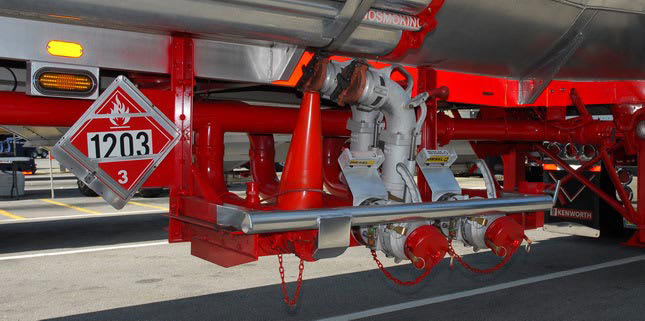
Proposed wetlines rules have twice been rejected by regulators on grounds that costs exceeded benefits. Photo by Jim Park.
Tank carriers are asking the Department of Transportation to drop a pair of rules-in-progress on grounds that they are unnecessary and ineffective.
John Conley, president of the National Tank Truck Carriers, the industry's national association, asked Transportation Secretary Ray LaHood to consider withdrawing two proposals that fit President Obama's description as putting "an unnecessary burden on businesses."
Obama last January issued an Executive Order for government agencies to cull unnecessary rules from their books. Conley said there are two proposals at the Pipelines and Hazardous Materials Safety Administration that fall into this category.
One would require carriers to make sure there is no gasoline in the loading lines of their tanks, the so-called "wetlines" rule. The other would outsource regulations covering standards for construction, testing and repair of tanks to private entities, Conley said.
The wetlines rule would prohibit transport of flammable liquids in the pipes beneath new and existing cargo tanks. Under the proposal, any trailer built two years after the rule goes into effect could carry no more than 0.26 gallons in its wetlines, or have structural protection. Existing tanks would have to be equipped with purging systems. Carriers would have 12 years to complete that work.
Conley told LaHood that the proposal has twice been rejected by regulators on grounds that its costs exceeded its benefits and is being considered now only for political reasons.
"As you know, the Chairman of the House Transportation & Infrastructure Committee in the last Congress (Rep. James Oberstar, D-Minn.) took a hatchet to PHMSA and inflicted harm that continues to this day," Conley said.
Oberstar's Argument
Oberstar, who was defeated in last year's elections, had proposed legislation to require the rule, citing crashes in which the wetlines rupture and the fuel ignites. That happened in 2008 in New Jersey, when a car struck a gasoline tanker, wedged beneath the tank and burned in the spill of 13 gallons of gas from the wetlines, killing the driver.
Oberstar said there have been 184 incidents over the past decade in which wetlines were damaged or ruptured. PHMSA has identified 13 fatalities and seven injuries from crashes involving wetlines. Six of the fatalities and all of the injuries were attributable to spills from the wetlines, as opposed to the impact of the collision.
Tank carriers replied with this statistic: There have been more than 180 million shipments of flammable liquids in the past decade, making the risk of a fatal wetlines incident about one in 30 million.
"The odds of being struck by lightning during your lifetime are 6,000 times greater than the odds of being killed in a wetlines incident," said Barbara Windsor, president of Hahn Transportation, in 2009 testimony on the issue.
Tank carriers also point out that the process of welding purging equipment onto tanks can be hazardous, considering the risk of igniting fumes inside the tank.
Congressional Debate
Congressional debate over the issue continued at a hearing earlier this year. Asked by Rep. Bill Shuster, R-Pa., why PHMSA was continuing with the rulemaking, agency administrator Cynthia Quarterman replied, "If a school bus full of children were to hit a wetline and burn, the analysis would be compelling, I think. We don't want that to happen if we can avoid it at the beginning."
Shuster replied, "It certainly would be a terrible, terrible tragedy if that were to happen to a school bus. But ... my understanding of what happens with a wetline accident is that a school bus couldn't get underneath a truck, and that would be highly unlikely to happen."
The rule was proposed last January. Comments still are being reviewed at the agency. When the agency is done, the rule must be vetted by LaHood's office and by the White House Office of Management and Budget. Publication is scheduled for next May.
Privatizing Regulations?
The other rule concerns PHMSA's plan to in effect privatize a public regulatory process, Conley said.
The proposal would remove key safety regulations that govern the construction, operation, test and inspection, and repair of cargo tanks from the federal code, and turn them over to private enterprise (the American Society of Mechanical Engineers and the National Board of Boiler and Pressure Vessel Inspectors), Conley said.
"The current open process would be replaced by one where a private entity ordained by PHMSA in a no-bid process would develop and copyright regulations which your department would adopt by reference," he said.
It takes the public out of the system in terms of developing the regulations and having access to them, he said.
"The (Engineers and Boiler Inspectors) look to make millions of dollars if they are successful in getting this through," Conley said in an interview. "There are regulations in place now that are working. Why are we going to change that system and fix something that isn't broken?"
More Drivers

From One Generation to the Next: How Mentorship Builds Safer Truck Drivers
After three decades in trucking, Harold Perry shares what he's learned about driver safety, mentorship, and helping the next generation build confidence behind the wheel.
Read More →
Truck Drivers Need More Than Another Alert
Fleets have more visibility into truck health, safety events, and driver activity than ever. The next challenge is turning all that information into useful guidance for the person who has to decide what to do next.
Read More →
FMCSA Removes 110 Truck Driver Training Schools from Certified ELDT List
Federal regulators also are targeting more than 160 additional training providers and launching a nationwide audit of third-party CDL skills testers as part of a broader crackdown on trucking fraud.
Read More →
Hours of Service Pilot Programs: FMCSA Readies for 2027 Rollout
Two pilot programs could eventually reshape hours-of-service rules, giving truck drivers options to pause their 14-hour clock or use longer split sleeper rest periods.
Read More →
Medical Cards, English Proficiency Reshape Roadcheck Violations
Medical-card violations jumped to the top of the driver out-of-service list during CVSA’s 2026 International Roadcheck, while English-language proficiency violations appeared among the leading violations for the first time.
Read More →
Driver Trust Can Make or Break the Success of Fleet Safety Technology
New Teletrac Navman research suggests that onboarding, transparency about driver data, and positive feedback can play a significant role in how commercial drivers respond to safety and coaching technology.
Read More →
EEOC Sues KLLM Over Alleged Sex Discrimination in Driver Training
KLLM is facing a federal sex-discrimination lawsuit over policies the EEOC alleges put female truck driver trainees at a disadvantage.
Read More →
FMCSA Moves to Codify English Language Requirements for Commercial Drivers
By changing regulations on English-language proficiency requirements for commercial drivers, rather than relying on a guidance memo, the FMCSA said future administrations won't be able to walk back the Trump administration's stricter enforcement with just a memo.
Read More →
Drivers Put Western Star Trucks to the Test at Star Nation Experience
Watch to get an inside look at the Western Star trucks, technology, and community behind the Star Nation Experience 2026!
Read More →
Trump Administration Looks to Put More Veterans Behind the Wheel
The Freedom Haulers program pulls together existing and expanded programs at several federal agencies to recruit veterans to drive commercial heavy-duty trucks and cut the red tape for them to get a CDL, training, and employment.
Read More →