




Swift Improvements Help Drive Knight-Swift Earnings
Knight-Swift Transportation Holdings is growing its profits through more efficient operations, rather than by adding trucks to increase capacity, as it reported fourth-quarter 2018 results that were better than analysts expected, especially in Swift Truckload.

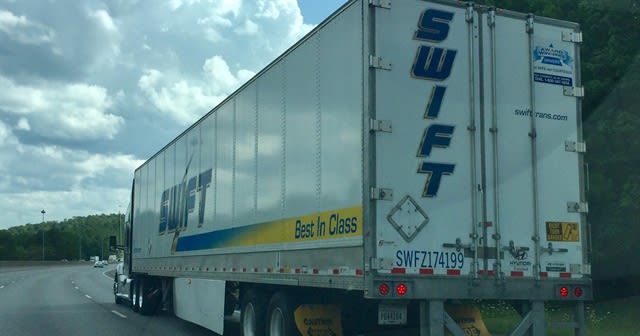
Swift trucking operations have become much more efficient since the merger with Knight.
Photo by Deborah Lockridge

Knight-Swift Transportation Holdings is growing its profits through more efficient operations, rather than by adding trucks to increase capacity, as it reported fourth-quarter 2018 results that were better than analysts expected, especially in Swift Truckload.
Total company revenue for the quarter was $1.39 billion, up 2.6% from the same time last year, which missed Wall Street forecasts. The increase was largely driven by improvements in average revenue per tractor and growth in the asset-light business.
Fourth-quarter net income of $151.7 million translated to 86 cents per share. Earnings, adjusted for one-time gains and costs, were 93 cents per share, which exceeded Wall Street expectations.
Swift Drives Trucking Improvement
Knight-Swift’s trucking business made up about 80% of revenue. The trucking segments operated on a combined basis at an 80.9% adjusted operating ratio, while its average operational tractor count remained stable at 14,737.
Swift Truckload profitability significantly improved, as the segment achieved a 75.9% adjusted operating ratio, despite a drop in revenue. According to analysts at Stifel, Swift Truckload was for the first time ever the margin leader in the truckload industry.
“The significant year-over-year improvement was driven by a 5.9% increase in average revenue per tractor, improved safety results and cost control,” the company said in its earnings statement. “We have emphasized improving revenue per tractor over the last year, which has led to a change in our freight mix and 9.3% fewer miles per tractor.”
Knight’s adjusted operating ratio was 78.1, Knight enjoyed significant increases in revenue per tractor; its fleet growth was due to the acquisition of Abilene Motor Express last year.
“The beauty of not integrating the Swift and Knight networks is that Knight was not unnecessarily messed up,” said Stifel analysts in a note to investors. “Only Swift is getting cleaned up.”
Knight-Swift has been growing its asset-light business in logistics and intermodal, with year-over-year fourth-quarter revenue growth in logistics of 40%, and 22% growth in intermodal, operating some 700 tractors and 9,700 containers. The asset-light businesses operated at an 89.3% adjusted operating ratio.
Looking Ahead
For 2019, company officials said they expect to see more normal seasonal trends and for contract rate increases to be in the mid single digits, with opportunities to grow its brokerage and intermodal business while the driver market remains challenging. The company also said it will actively pursue acquisition opportunities.
“After experiencing a strong freight market in the fourth quarter of 2018, which supported increases in both contract and non-contract rates, we are experiencing typical seasonality thus far in the first quarter of 2019,” the company said in its earnings release. “We expect contract rate improvements to continue in 2019, but at a slower pace.”
The company continues to see opportunities in its trucking operations to improve yields, increase revenue per tractor, and improve its ability to recruit and retain drivers “without compromising our commitment to improve safety.”
This will be the last time the company reports Knight and Swift separately, since Knight bought Swift in 2017. Going forward, the company will create a trucking segment that will include Knight Trucking, Swift Truckload, Swift Dedicated and Swift Refrigerated. The Logistics segment will include Knight brokerage and Swift logistics. The Intermodal segment will include Swift Intermodal and Knight Intermodal.
Complete earnings release:
More Fleet Management

Why Private Fleets Are Taking More Freight
Private fleets are putting their own trucks on demanding customers and high-cost lanes as companies seek greater control over service, costs, and capacity.
Read More →
Color Match Smarter: Tools That Restore & Perform
For fleet managers and collision repair professionals keeping heavy-duty trucks on the road, getting the color right the first time isn't just about appearance — it's about efficiency, turnaround time, and bottom-line results. Discover how today's digital color tools are transforming the repair process from guesswork to precision.
Read More →
FMCSA Pauses Biennial-Update Enforcement Amid Motus Transition
Carriers whose updates were due on or after June 1 have more time, while FMCSA works to stabilize its new registration system and warns of phishing sites impersonating its new carrier registration system, Motus.
Read More →


2026 Blueprint for Countering Smarter Supply Chain Theft
Cargo theft is no longer just the cost of doing business. It's a multi-billion-dollar criminal enterprise exploiting vulnerabilities across your fleet, drivers, and supply chain.
Read More →
How Telematics Improves Visibility, Control, and Performance in Refrigerated Fleets
Explore how telematics help refrigerated fleets improve visibility, uptime, efficiency, compliance, and cargo protection across connected cold chain operations.
Read More →
What the U.S.-Canada Trade War Means for Trucking
Escalating U.S.-Canada tariffs could disrupt cross-border freight, reduce truck volumes, raise costs, and create new uncertainty for carriers on both sides of the border.
Read More →
What Are Trucking’s Top Concerns for 2026?
The American Transportation Research Institute wants to know what's worrying trucking fleet managers, drivers, and other stakeholders in its annual Industry Issues survey.
Read More →
American Trucking Associations Looks for a New Leader
ATA President and CEO Chris Spear abruptly left his job at the association on August 21, at a pivotal time for the trucking industry.
Read More →
Public Wi-Fi Cybersecurity Risks: How Truck Drivers and Fleets Can Protect Their Data
Public Wi-Fi can expose truck drivers and fleets to credential theft, malware, and other cyber threats. Here’s how to reduce the risk on the road.
Read More →
For Nicky Cupp, Fleet Innovation Starts With Frustration
HDT Truck Fleet Innovator Nicky Cupp turns everyday pain points at Fraley & Schilling into opportunities for better technology and smarter processes.
Read More →