




Stoneridge Continues to Improve MirrorEye Rear-View Camera System
Stoneridge CEO Jim Zizelman detailed new MirrorEye safety enhancements and the regulatory outlook for additional rear-view camera testing and validation work at CES 2024 in Las Vegas.

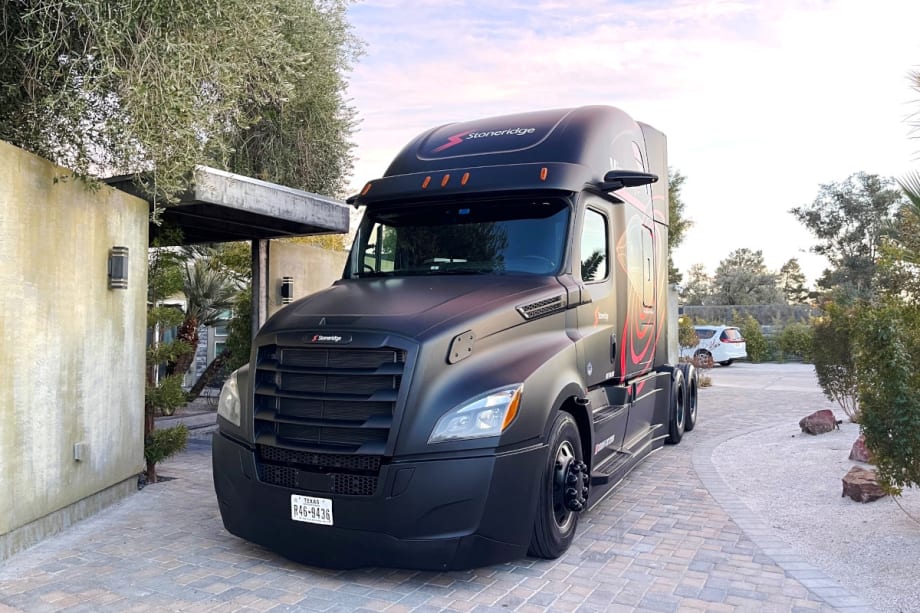
A MirrorEye-equipped Freightliner Cascadia showcases rear-view camera technology at the House of Journalists at CES 2024 in Las Vegas.
Photo: Jack Roberts
As the quest to lower truck emissions continues, Stoneridge continues to enhance and test its MirrorEye rear-view camera system for commercial vehicles, which can replace traditional mirrors for improved aerodynamics and visibiilty.
During a press briefing at the House of Journalists at CES 2024 tech trade show in Las Vegas, Jim Zizelman, Stoneridge president and CEO, highlighted the latest additions to the camera system. He also discussed the status of Federal Motor Carrier Safety Administration regulations on rear-view cameras.
MirrorEye replaces a truck's mirrors with external digital cameras encased in roof-mounted folding wings and high-resolution displays mounted on the A-pillars inside the cab. The system includes heated lenses, active color night-vision, automated "panning" to keep the trailer wheels in view, enlarged "zoom" views, and infrared "spotlight" for improved docking visibility, plus optional video recording.
SuperTruck Exclusive
All four truck OEMs that have produced advanced SuperTruck II fuel and freight efficiency test vehicles (Daimler Truck North America, Navistar, Peterbilt, and Volvo) chose to use MirrorEye rear-view camera systems on the vehicles.
In fact, Stoneridge worked closely with the truck makers to design and build camera systems for each company to meet its specific needs and efficiency goals.
Zizelman explained that each MirrorEye camera module on a truck is shaped like an airplane wing to be as aerodynamically efficient as possible. And the results are impressive, he said. A truck equipped with MirrorEye rear-view cameras obtains a 3% boost in fuel economy right off the bat, compared to trucks with conventional rear-view mirrors.
“That’s really good,” Zizelman added. “And in terms of emissions, that works out to 5,000 pounds of CO2 per vehicle per year eliminated just with the addition of MirrorEye.”
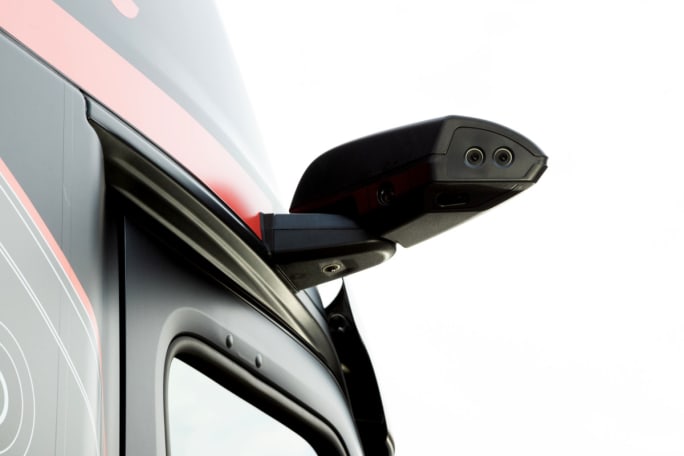
Stoneridge says the aerodynamic shape of its MirrorEye camera sensors gives trucks a three percent fuel economy boost.
Photo: Stoneridge
Truck Driver Feedback on Using Cameras Instead of Mirrors
Feedback from drivers has been positive, according to Zezelman. He said they particularly like the comprehensive views and the elimination of blind spots MirrorEye gives them. They also give high marks to the system’s nighttime views, which give drivers much better visibility of the traffic around them.
But some drivers noted that unlike conventional mirrors, camera systems don’t give them a good depth-of-field view. This can be a problem when working a trailer through tight areas or when turning.
To help drivers with this depth of field issue, MirrorEye engineers have added dynamic digital marker lines to the rear-view displays when the truck is maneuvering a trailer. These digital lines, which become smaller the farther back they appear in the rear-view screen, give drivers a sense of depth that helps them better understand the trailer’s relation to curbs, road signs, and other hazards.
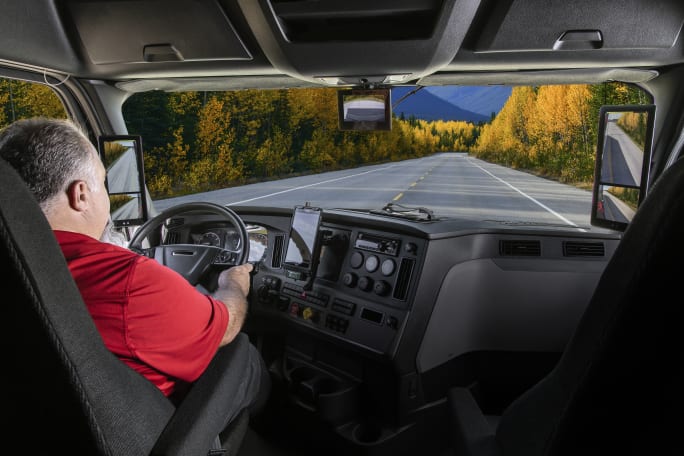
The company reports positive feedback from drivers who have tired MirrorEye.
Photo: Stoneridge
No Regulatory Roadblocks for Camera Mirrors
Zizelman also explained that MirrorEye research is continuing and accelerating, even though a five-year FMCSA exemption from regulations requiring conventional rear-view mirrors is set to expire this year.
“The regulations are a little odd,” Zizelman said. “In the U.S. today, it is not legal to produce a truck without rear-view mirrors. But it is legal to remove the mirror and replace it with a MirrorEye camera" as an aftermarket addition.
The FMCSA exemption was issued five years ago, and Zezelman believes it will be extended without any problems later this year.
“As rear-view camera technology has matured, we’re not starting to see more pull-through from the regulatory side to allow us additional time to validate this technology,” he said. “We have confidence that the National Transportation Safety Administration and FMCSA are actually quite happy with our technology. They like what we’re doing and like what we’re discovering. So we don’t see any roadblocks at this point from the legislative perspective to continue our testing and validation work.”
More Equipment

How Volvo Updated Its D13 for EPA 2027 [Watch]
Volvo’s updated D13 promises lower emissions without sacrificing performance or fuel economy. Take a closer look at what changed inside the engine in this HDT Spotlight video.
Read More →
Michelin Tire Improves Efficiency and Durability for Regional Fleets
The Michelin X Multi Energy D2 is a regional haul drive tire engineered to help fleets improve fuel efficiency, durability and traction in demanding stop-and-go operations.
Read More →
ZF Expands Commercial Vehicle Push in North America
ZF is expanding its North American commercial-vehicle presence with new transmission applications, electrification, trailer technology and autonomous-driving systems.
Read More →
Tesla Wants a Self-Driving Semi. Are Cameras Enough?
Could Tesla’s camera-only autonomous driving technology work on an 80,000-pound Semi? In this commentary, HDT's Deborah Lockridge takes a look at Tesla, Cybercab, and how autonomous trucks see the road.
Read More →
Kodiak: Driverless Long-Haul Truck Launch on Track for 2026
Kodiak AI says its driverless long-haul safety case is 93% complete and it remains on track to begin commercial operations by year-end 2026.
Read More →
What DOT’s Automated Vehicle Strategy Means for Trucking
The U.S. Department of Transportation issued a new automated-vehicle strategy that outlines plans for driverless-truck regulations, cross-state freight corridors, and federal safety standards.
Read More →
East Coast Port Launches $45M Electric Truck Push
The Port Authority of New York and New Jersey announced millions in incentives for zero-emission drayage trucks, yard tractors, and new charging hubs near the port.
Read More →
PlusAI Going Public to Fund Autonomous Truck Launch
A SPAC deal could provide PlusAI with up to $300 million as it works toward a 2027 commercial launch of factory-built autonomous trucks.
Read More →
NHTSA Moves to Rewrite Truck Fuel-Economy Rules
The National Highway Traffic Safety Administration says it lacks authority to regulate medium- and heavy-duty truck engines separately from complete vehicles, but the existing standards have not yet been eliminated.
Read More →
Detroit Opens Orders for EPA 2027 Engines
Detroit isn’t starting from scratch to meet EPA 2027 diesel emissions standards. Its Gen 6 DD13 and DD15 engines keep much of today’s platform while updating the fuel and aftertreatment systems.
Read More →