




Related: Trucks Cited for Size/Weight During 2015 Safe Driver Week
State, Local Violations Top List of Citations in Safe Driver Week
State and local moving violations were the most common citations given to commercial vehicle drivers during the Commercial Vehicle Safety Alliance’s Operation Safe Driver Week.
by Staff
December 16, 2016
3 min to read
Source: CVSA
State and local moving violations were the most common citations given to commercial vehicle drivers during the Commercial Vehicle Safety Alliance’s Operation Safe Driver Week.
The recently released results from the week-long enforcement event, which took place from Oct. 16 to 22, show that more than half of all the citations and warnings given were moving violations. Speeding was the top violation handed out to passenger vehicle drivers.
Safety enforcement officials issued warnings and citations to 20,648 commercial vehicle and passenger vehicle drivers during Operation Safe Driver Week. Unsafe driving behaviors including speeding, failure to use a seatbelt, and distracted driving instances were also among the top results collected by more than 3,000 law enforcement officials.
“This year, the Operation Safe Driver Week campaign specifically targeted the unsafe driving behaviors that are more often the cause of crashes,” said Julius Debuschewitz of Yukon Highways and Public Works and CVSA President.
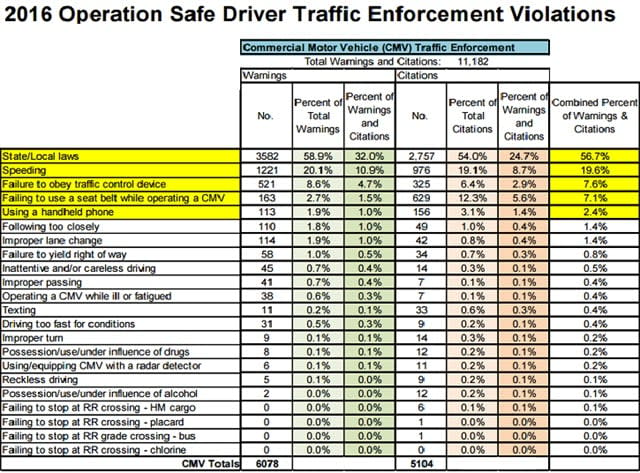
Of the total number of violations, 11,182 were issued to commercial vehicle drivers, who often differed in the types of violations cited compared to those driving passenger vehicles.
When broken down as a percentage of the total number of violations, the top-five warnings and citations issued to commercial drivers were:
State and Local Moving Violations – 56.7%
Speeding – 19.6%
Failure to Obey Traffic Control Device – 7.6%
Failing to Use Seatbelt While Operating CMV – 7.1%
Using a Handheld Phone – 2.4%
CVSA holds this annual week-long campaign because unsafe driving behavior is at the root of most roadway crashes. Driver behavior was found to be the leading cause of large truck crashes, according to the Federal Motor Carrier Safety Administration’s Large Truck Crash Causation Study.
In more specific instances, commercial drivers tended to be cited less often for speeding and inattentive driving. Eight citations were related to a commercial vehicle driver’s failure to stop at a railroad crossing and 7 drivers received a citation for operating a vehicle while ill or fatigued, though 38 were given warnings.
Though not a major issue, 1.4% of commercial drivers were cited for following too closely while passenger vehicle drivers were cited less than 1% of the time. Passenger vehicle drivers were also more likely to not wear a seatbelt at 11.7%, compared to 7.1% for commercial drivers.
“Through a variety of high-visibility and covert driver traffic enforcement initiatives, in addition to driver education and outreach activities, law enforcement agencies capitalized on the opportunity the weeklong campaign provided to continue their work toward making sure the drivers on our nations’ roadways are sharing and navigating those roadways safely,” said Debuschewitz.
Operation Safe Driver was launched in 2007 by CVSA to combat the number of deaths resulting from crashes involving large trucks, buses, and cars by improving the behavior of all drivers operating in an unsafe manner.
More Fleet Management

Sponsored•September 16, 2026
Color Match Smarter: Tools That Restore & Perform
For fleet managers and collision repair professionals keeping heavy-duty trucks on the road, getting the color right the first time isn't just about appearance — it's about efficiency, turnaround time, and bottom-line results. Discover how today's digital color tools are transforming the repair process from guesswork to precision.
Read More →
FMCSA Pauses Biennial-Update Enforcement Amid Motus Transition
Carriers whose updates were due on or after June 1 have more time, while FMCSA works to stabilize its new registration system and warns of phishing sites impersonating its new carrier registration system, Motus.
Read More →
Sponsored•September 14, 2026
2026 Blueprint for Countering Smarter Supply Chain Theft
Cargo theft is no longer just the cost of doing business. It's a multi-billion-dollar criminal enterprise exploiting vulnerabilities across your fleet, drivers, and supply chain.
Read More →


Sponsored•September 1, 2026
How Telematics Improves Visibility, Control, and Performance in Refrigerated Fleets
Explore how telematics help refrigerated fleets improve visibility, uptime, efficiency, compliance, and cargo protection across connected cold chain operations.
Read More →
What the U.S.-Canada Trade War Means for Trucking
Escalating U.S.-Canada tariffs could disrupt cross-border freight, reduce truck volumes, raise costs, and create new uncertainty for carriers on both sides of the border.
Read More →
What Are Trucking’s Top Concerns for 2026?
The American Transportation Research Institute wants to know what's worrying trucking fleet managers, drivers, and other stakeholders in its annual Industry Issues survey.
Read More →
American Trucking Associations Looks for a New Leader
ATA President and CEO Chris Spear abruptly left his job at the association on August 21, at a pivotal time for the trucking industry.
Read More →
Public Wi-Fi Cybersecurity Risks: How Truck Drivers and Fleets Can Protect Their Data
Public Wi-Fi can expose truck drivers and fleets to credential theft, malware, and other cyber threats. Here’s how to reduce the risk on the road.
Read More →
For Nicky Cupp, Fleet Innovation Starts With Frustration
HDT Truck Fleet Innovator Nicky Cupp turns everyday pain points at Fraley & Schilling into opportunities for better technology and smarter processes.
Read More →
Adam Buttgenbach’s Approach to Electric Trucks: Start With Where They Fit
HDT Truck Fleet Innovator Adam Buttgenbach helped PepsiCo build one of North America’s largest EV fleets by focusing on where electric trucks make operational sense.
Read More →