




Stability Control Proposal Nearing Publication
A proposal to require stability control systems on heavy-duty tractors is nearing publication. The National Highway Traffic Safety Administration proposal has been cleared by the White House Office of Management and Budget, the last step in the review process
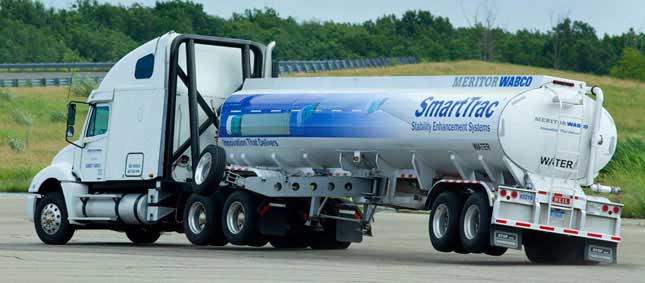
Major suppliers of stability control systems, Bendix Commercial Vehicle Systems and Meritor WABCO Vehicle Control Systems (seen above), estimate that perhaps as many as 25% of new trucks have stability controls.
A proposal to require stability control systems on heavy-duty tractors is nearing publication. The National Highway Traffic Safety Administration proposal has been cleared by the White House Office of Management and Budget, the last step in the review process.
It make take a year or more, but the proposal could lead to a mandate for technology that many carriers already have adopted because they see a safety benefit.
Major suppliers of stability control systems, Bendix Commercial Vehicle Systems and Meritor WABCO Vehicle Control Systems, estimate that perhaps as many as 25% of new trucks have these controls.
Among tank truck carriers, in particular, stability control is practically standard, according to John Conley, president of National Tank Truck Carriers.
Ted Scott, engineering director at American Trucking Associations, said the association is likely to support the proposal.
"I don't see any reason not to support it at this point, given the language I've seen," he said.
Owner operators likely will oppose a mandate. It's a cost issue, said a spokesman for the Owner-Operator Independent Drivers Association. A stability control system on top of other federal requirements could be more than small businesses can afford, he said.
Details of the proposal are not yet available but it is likely to cover only tractors, rather than tractors and trailers, and is not likely to include a retrofit requirement.
NHTSA says its research shows the technology can provide a significant safety benefit.
Rollover and loss-of-control crashes are responsible for 304 deaths and 2,738 injuries a year, and the agency estimates that the systems will save as many as 66 lives and prevent almost 1,000 injuries a year.
The out-of-pocket cost to carriers would be up to $107 million a year, but the savings from preventing property damage and travel delays alone would amount to $372 million, the agency said.
The big question is how the agency will handle the distinction between the two types of stability systems on the market, Roll Stability Control and Electronic Stability Control.
Both systems perform a similar function: if sensors detect the risk of rollover or instability, the control module slows the vehicle by cutting back the throttle and applying the brakes automatically.
The difference is that RSC is triggered only when the system detects roll instability, which might occur when a truck is going too fast into a turn or maneuvers too quickly. ESC reacts to both roll instability and yaw instability, such as a skid that could lead to a jackknife. In addition to slowing the vehicle to prevent a rollover, it applies the brakes on the wheel that needs to be slowed to counteract the skid.
Studies have demonstrated that both systems are effective, but not equally so. In 2009 the University of Michigan Transportation Institute concluded that if all 5-axle tractor-trailers had RSC, there would be 3,489 fewer crashes and 106 fewer deaths each year. If all of these trucks had ESC, there would be 4,659 fewer crashes and 126 fewer deaths.
The other difference is cost. ESC is more expensive. Costs range from $800 to $1,600 for RSC, while ESC might go for $1,800 to $2,300. But discounts are common and prices should go down due to economies of scale after the mandate takes effect.
This cost differential is important to the industry. Dan Murray, vice president of research for the American Transportation Research Institute, said the Institute will soon begin looking into the cost-benefit breakdown between RSC and ESC.
"A number of carriers have internal data showing that while ESC has a few extra crash scenarios thrown in because of the lateral sensors, RSC may have a better cost-benefit outcome because it does most of what ESC does at a lower cost," he said.
More Drivers

When Language Stops the Truck: The Return of ELP Out-of-Service Orders
English language proficiency rules for commercial drivers aren’t new, but renewed out-of-service enforcement has raised the stakes. Here’s what carriers need to know before a driver reaches a roadside inspection.
Read More →
Samsara Launches Custom AI Agent Builder
Agent Studio lets fleets create AI tools for hours-of-service monitoring, reporting and driver support, including agents that communicate by phone.
Read More →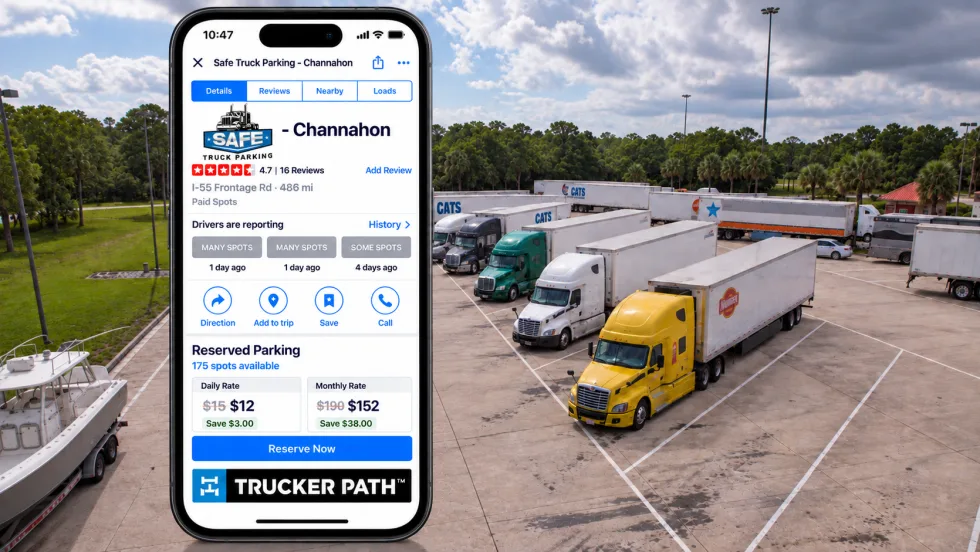
Trucker Path Expands Reserved Parking Network
Trucker Path has added close to 6,000 more truck parking spaces to its Trucker Path Reserved Parking Network with the addition of Safe Truck Parking.
Read More →
EEOC Sues Texas Trucking Company Over Driver Age Limits
The agency says Trancasa USA rejected applicants over 65 and applied tougher driving-record standards to those over 60.
Read More →
Nussbaum, Roehl Announce Second Driver Pay Increase This Year
This year has seen a swath of major truck driver pay increases as freight capacity has tightened.
Read More →
From One Generation to the Next: How Mentorship Builds Safer Truck Drivers
After three decades in trucking, Harold Perry shares what he's learned about driver safety, mentorship, and helping the next generation build confidence behind the wheel.
Read More →
Truck Drivers Need More Than Another Alert
Fleets have more visibility into truck health, safety events, and driver activity than ever. The next challenge is turning all that information into useful guidance for the person who has to decide what to do next.
Read More →
FMCSA Removes 110 Truck Driver Training Schools from Certified ELDT List
Federal regulators also are targeting more than 160 additional training providers and launching a nationwide audit of third-party CDL skills testers as part of a broader crackdown on trucking fraud.
Read More →
Hours of Service Pilot Programs: FMCSA Readies for 2027 Rollout
Two pilot programs could eventually reshape hours-of-service rules, giving truck drivers options to pause their 14-hour clock or use longer split sleeper rest periods.
Read More →
Medical Cards, English Proficiency Reshape Roadcheck Violations
Medical-card violations jumped to the top of the driver out-of-service list during CVSA’s 2026 International Roadcheck, while English-language proficiency violations appeared among the leading violations for the first time.
Read More →