




Spot Market Freight Levels Continue Improving, Rates Up in Majority of Segments
Spot market freight activity continued picking up steam the second week of December, following some improvements the week before as well as in November.

Spot market freight activity continued picking up steam the second week of December, following some improvements the week before as well as in November.
The freight matching service provider DAT reports total spot market loads available Dec. 8 through Dec. 14 increased 20% from the week before.
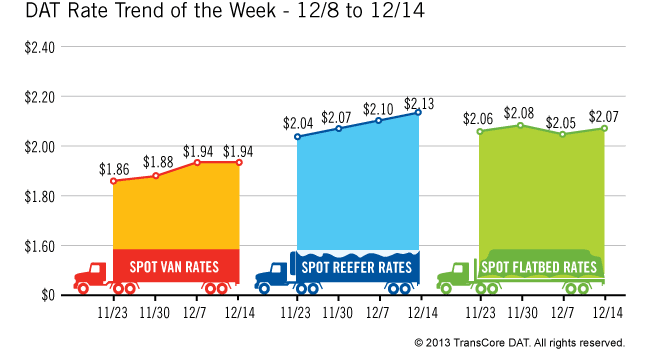
Rates during the period for vans were unchanged at $1.94 per mile, while flatbeds increased 1% to $2.07 per mile. Reefer rates posted the biggest gain, 1.4%, to $2.13 per mile.

“Winter weather is here, but the typical slowdown isn't,” says DAT, with van loads increasing another 18.7% last week. Rates (including fuel) stayed elevated at $1.94 per mile, which DAT says is 6 cents higher than the national average in November. “Most holiday retail goods are already through the supply chain, so this surge may be attributed, in part, to businesses trying to take advantage of favorable pricing on commodities prior to 2014.”
Ddemand for flatbeds increased last week from the week before, while reefer demand hit its highest level in the past month.
November numbers
Looking back at November's monthly numbers, spot market freight availability remained strong, according to the DAT North American Freight Index.

For the fifth consecutive month, freight availability continued to outpace levels seen in recent years, during a time when volume typically declines. Month over month, freight availability declined 9.5%, the result of four fewer business days in November versus October, but average daily freight volume during the month actually exceeded October volume by 10%. On a year-over-year basis, freight volume increased 8%.
Load availability increased 0.9% for vans, but fell 5% for refrigerated trailers and 21% for flatbeds compared to October. Year over year, van freight volume declined 11%, while reefer loads added 6.2% and flatbed freight increased 4.3%.
The relative strength of November's overall freight volume was validated by an increase in spot market rates. Rates rose 5% for vans and 1.9% for reefers compared to October, while flatbed rates declined seasonally by 2.5% Compared to November 2012, rates rose 6% for vans and 1.9% for reefers, but declined 5.4% for flatbeds compared to last year's record high rates in that segment.
Rates are cited for line haul only, excluding fuel surcharges, which declined on both a month-over-month and year-over-year basis. The monthly DAT North American Freight Index reflects spot market freight availability on the TransCore DAT network of load boards in the United States and Canada.
More Drivers

EEOC Sues KLLM Over Alleged Sex Discrimination in Driver Training
KLLM is facing a federal sex-discrimination lawsuit over policies the EEOC alleges put female truck driver trainees at a disadvantage.
Read More →
FMCSA Moves to Codify English Language Requirements for Commercial Drivers
By changing regulations on English-language proficiency requirements for commercial drivers, rather than relying on a guidance memo, the FMCSA said future administrations won't be able to walk back the Trump administration's stricter enforcement with just a memo.
Read More →
Drivers Put Western Star Trucks to the Test at Star Nation Experience
Watch to get an inside look at the Western Star trucks, technology, and community behind the Star Nation Experience 2026!
Read More →
Trump Administration Looks to Put More Veterans Behind the Wheel
The Freedom Haulers program pulls together existing and expanded programs at several federal agencies to recruit veterans to drive commercial heavy-duty trucks and cut the red tape for them to get a CDL, training, and employment.
Read More →
Putting Mack’s Command Steer to the Test
A test drive of Mack’s Command Steer active steering system evaluates how it can make truck driving easier and less tiring.
Read More →
Competition Heating Up for Truck Drivers
New report reveals rising driver hiring costs, the return of sign-on bonuses, growing AI advantages, and the operational factors shaping driver retention.
Read More →
How Fraley & Schilling Improved Logbook Compliance by Over 50%
Fraley & Schilling needed a way to close a compliance workflow gap in its ELD system without adding more work from driver training, reminders, and back-office follow-ups. It found the answer in a custom driver app.
Read More →
Volvo Goes Gaming
Volvo has roared into American Truck Simulator with two new flagship trucks.
Read More →
What the Best Fleets to Drive For Teach About Driver Retention
Survey fatigue, AI-powered routing, owner-operator expectations, and the decline of social media all emerged as themes from this year's Best Fleets to Drive For program.
Read More →
Driver Retention Lessons From the Best Fleets to Drive For
What separates trucking's best workplaces from the rest? Jane Jazrawy shares the biggest lessons from this year's Best Fleets to Drive For program on driver retention, communication, AI, and workforce trends on the HDT Talks Trucking podcast.
Read More →